Solar Contractors Get Jobs Done Faster With Private Providers

Key Takeaways
- Private providers can review solar permits in under 5 days vs. 18+ at building departments
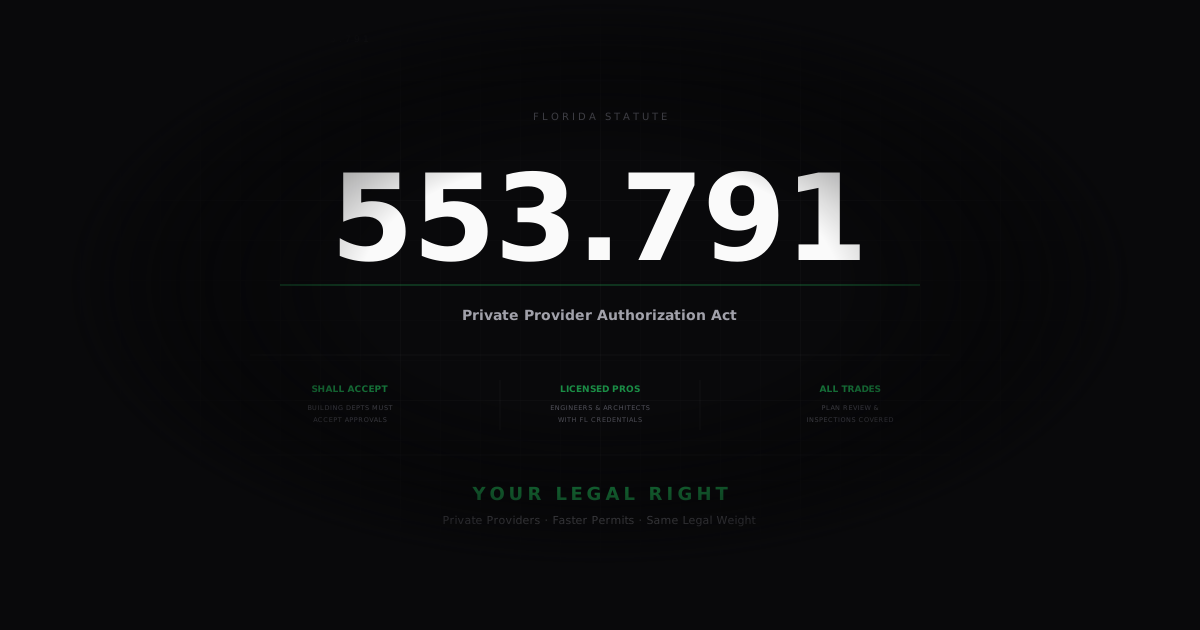
- FL Statute 553.791 gives private provider approvals the same legal standing as building department approvals
- Faster permits improve crew utilization, cash flow, and competitive positioning
- Solar permits are well-suited for private provider review due to standardized plan packages
- Volume contractors see the biggest benefit—scalable permitting without growing pains
How can Florida solar contractors get permits approved faster?
Florida solar contractors can dramatically speed up permit approvals by using licensed private providers under FL Statute 553.791. While building departments often take 3-6 weeks for solar plan reviews due to volume backlogs, private providers can typically complete the same reviews in under a week with full legal authority.
Solar contractors in Florida are living in an interesting paradox. On one hand, demand for residential solar has never been higher. Homeowners want to lock in energy savings, take advantage of federal tax credits, and get some independence from the grid. On the other hand, the permitting process can feel like it was designed for a different era entirely.
If you've been in the solar business in Florida for any length of time, you know exactly what I'm talking about. The permits themselves aren't particularly complicated—it's the waiting that kills you.
The Hidden Cost of Slow Permits
I was talking to a solar contractor from Tampa a few months back. He runs a mid-sized operation—maybe 15-20 installs per month during peak season. His crews are efficient, his equipment is dialed in, and his sales team keeps the pipeline full.
"My bottleneck isn't installation," he told me. "It's permits. I've got customers who signed contracts six weeks ago and they're still waiting for plan review approval."
Six weeks. For a project that might only take two or three days to actually install.
The math doesn't work. Every day a permit sits in a queue, that's a customer getting antsy. It's a crew that could be working but isn't. It's capital tied up in equipment that hasn't been deployed. For his operation, he estimated that permit delays were costing him somewhere between $50,000 and $75,000 per month in lost productivity and delayed revenue.
Why Solar Permits Get Stuck
Here's the thing about building departments: they're not trying to slow you down. Most plan reviewers are professionals who want to get projects approved. The problem is structural.
Florida's solar boom has been incredible for the industry, but building departments weren't staffed for this volume. When a county that used to see 50 solar permit applications per month suddenly gets 500, something has to give. Usually, it's turnaround time.
Add to that the complexity factor. Solar permits touch multiple disciplines—electrical, structural, sometimes even fire safety depending on the system size and location. Each of those reviews might be handled by different people, and the permit can't move forward until everyone signs off.
The result? What should be a straightforward process becomes a multi-week waiting game.
The Private Provider Alternative
This is where Florida Statute 553.791 changes everything for solar contractors.
Under this law, you don't have to wait in the building department's queue. You can work with a licensed private provider who has the same legal authority to review and approve plans—but with the capacity to actually handle your volume.
That Tampa contractor I mentioned? He started working with us about four months ago. His average plan review time went from 18 business days to under 5. Not because we cut corners—our plan review process is just as thorough as anything the building department does. We just have the bandwidth to do it faster.
How It Works for Solar Projects
The process is simpler than most contractors expect. You submit your plans to us instead of (or sometimes alongside) the building department. Our licensed engineers review everything—structural calculations, electrical diagrams, equipment specs, the works.
When we approve, the building department is required by law to accept our approval. They issue the permit based on our sign-off. Same legal standing, fraction of the time.
For solar contractors specifically, this approach works well because:
- Solar permit packages are fairly standardized once you know a contractor's typical system configurations
- We can establish review relationships that speed up repeat submissions
- Our team understands solar-specific code requirements inside and out
- We communicate directly with you if questions come up—no black box waiting period
The Compound Effect of Faster Permits
What most contractors don't realize until they experience it: faster permits don't just mean faster individual projects. They change how you can run your entire business.
Think about it. If you can reliably promise customers a 2-week timeline from signed contract to powered-on system instead of 8-10 weeks, that's a competitive advantage worth marketing. Your sales team can close deals with confidence. Your installation crews stay busy with predictable schedules instead of feast-or-famine cycles.
One solar contractor told us that switching to private provider reviews actually let him reduce his crew size by two people—not because he was doing less work, but because his remaining crews were utilized more efficiently. Less standing around waiting for permits meant more time on roofs installing panels.
The Inspection Side
Plan review is usually the bigger bottleneck for solar, but inspections matter too. Nothing kills project momentum like waiting three days for an inspector to show up for a 20-minute sign-off.
Private providers can handle inspections as well. Same concept—licensed inspectors with full legal authority, but better availability and scheduling. For solar installs, where the inspection itself is usually straightforward, this can mean same-day or next-day turnaround instead of waiting in a scheduling queue.
Is It Right for Your Operation?
Private provider services work best for contractors who:
- Are doing enough volume that permit delays materially impact their business
- Have organized, code-compliant plan packages ready to submit
- Value predictable timelines over lowest-possible-cost permitting
- Operate across multiple jurisdictions (we handle the relationships so you don't have to)
If you're doing two or three installs a month and the local building department knows you by name, you might not need this. But if you're scaling, if you're expanding into new counties, or if permit delays are genuinely hurting your business—this is worth a serious look.
The Bottom Line
Solar in Florida isn't going anywhere but up. Homeowner demand is strong, the economics work, and the technology keeps getting better and cheaper. The question for contractors isn't whether there's opportunity—it's whether you can capture it efficiently.
Permitting shouldn't be what holds you back. It's solvable.
Ready to Speed Up Your Solar Permits?
See how private provider plan reviews can transform your project timelines.
Learn More About Solar Services →Frequently Asked Questions
Are private provider solar permit approvals accepted by building departments?
Yes. Under Florida Statute 553.791, building departments are legally required to accept plans approved by licensed private providers. The permit is issued based on the private provider's approval with the same legal standing.
How much faster is private provider review for solar permits?
Most solar contractors see plan review times drop from 2-4 weeks at building departments to under 5 business days with private providers. The actual timeline depends on plan complexity and completeness.
Is private provider permitting cost-effective for solar contractors?
For contractors doing consistent volume, the productivity gains typically far outweigh the service costs. Faster permits mean better crew utilization, shorter customer wait times, and improved cash flow from completed projects.