How to Get Building Permits Faster in Florida (7 Ways That Actually Work)
Key Takeaways
- The single biggest time-saver is using a private provider under Florida Statute 553.791 — plan reviews in 24 hours vs. weeks through the building department
- Incomplete submissions are the #1 cause of preventable permit delays — a single correction cycle adds 2+ weeks to your timeline
- Pre-application consultations with building departments catch requirement mismatches before you submit, not after
- Florida's e-permitting systems (most major counties now offer them) eliminate intake processing delays that can add 3-5 business days
- Private providers handle both plan reviews and inspections — virtual inspections return results in minutes to 2 hours with no scheduling windows
- Starting July 1, 2026, HB 405 requires building departments to reduce permit fees 50-75% when private providers are used on commercial projects
How do you get building permits faster in Florida?
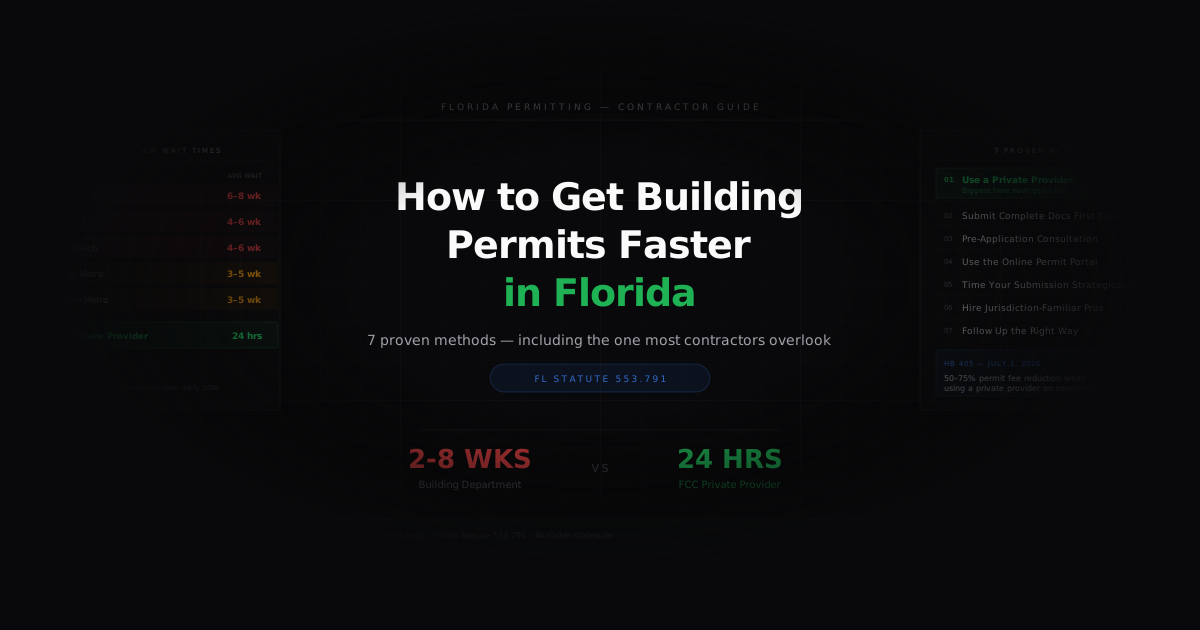
The fastest way to get building permits in Florida is to use a private provider under Florida Statute 553.791 — a licensed engineer or architect who performs plan reviews and inspections instead of the local building department. Private providers deliver plan reviews in 24 hours (residential) and 2 days (commercial), compared to 2-8 weeks through building departments. Beyond that, complete documentation, pre-application consultations, and online submission systems all reduce friction — but none come close to the time savings of bypassing the building department queue entirely.
You submitted your plans two weeks ago. The building department portal still says “Under Review.” Your crew starts next Monday. The clock is ticking.
Florida building permit delays in 2026 are running 2-8 weeks across the state's major counties. Miami-Dade averages 6-8 weeks. Broward and Palm Beach run 4-6 weeks. Even smaller counties that used to turn reviews around in days are now taking 2-3 weeks.
The fastest way to get building permits faster in Florida is to stop waiting in the building department queue entirely — but there are several tactics that help whether or not you make that switch. Here are seven that actually work, ranked from most to least impact.
1. Use a Private Provider (The One Most Contractors Overlook)
This is the single highest-leverage move available to Florida contractors, and most have never used it.
Florida Statute 553.791 gives every property owner the right to hire a private provider — a licensed Florida engineer or architect — to perform plan reviews and inspections instead of the local building department. The building department is required by law to accept the private provider’s work.
The comparison is not close:
| Service | Building Department | Private Provider (FCC) |
|---|---|---|
| Residential plan review | 2–6 weeks | 24-hour average |
| Commercial plan review | 3–8 weeks | 2-day average |
| Inspection scheduling | Days to weeks + vague windows | Instant (live) or 1-2 hours (offline) |
Here is how the process works: You submit your plans to FCC instead of (or alongside) the building department. We return a stamped review and Notice to Building Official (NTBO) within 24 hours on residential, 2 days on commercial. You take that package to the building department and file your permit application. They are required to accept it.
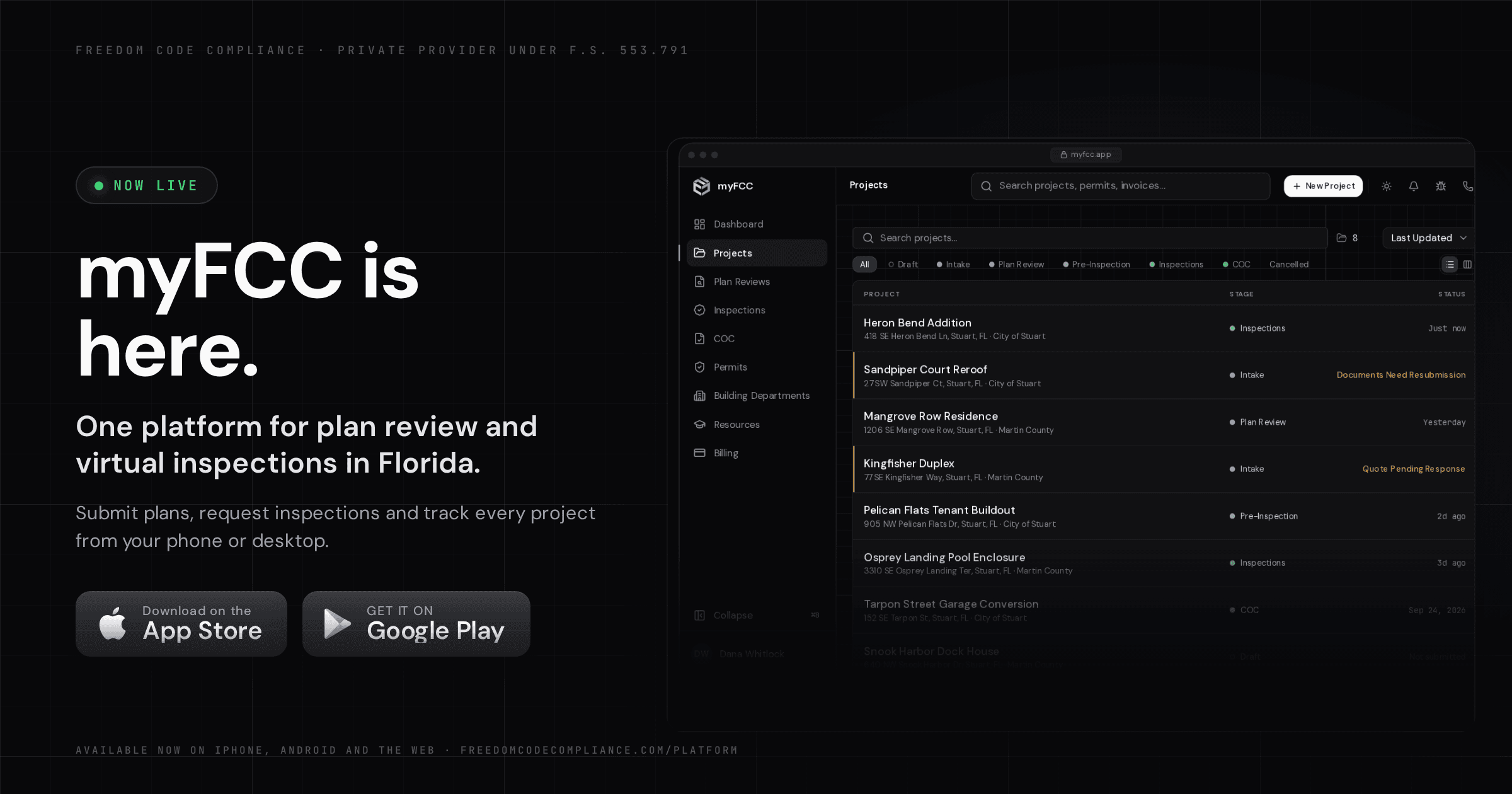
On the inspection side, FCC offers virtual inspections via the myFCC Mobile app — live video inspections where you get your result before the call ends, or offline photo submissions reviewed within 1-2 hours. No scheduling windows. No waiting on-site for an inspector who may or may not show up.
FCC is registered in 47 Florida counties with 150+ building department registrations. Set up your account and have your next plan review back before the building department would even assign a reviewer.
2. Submit Complete Documentation the First Time
Incomplete submissions are the #1 cause of preventable permit delays. Every correction request resets the review clock — you go back to the bottom of the queue. In a department running 4-week average reviews, a single correction cycle can add another 4 weeks on top.
Before you submit, confirm you have:
- Signed and sealed construction drawings with all required plan views and details
- A current site plan showing setbacks, lot coverage, and utility locations
- Florida Energy Code compliance (EnergyGauge or equivalent calculations for new construction)
- Product approval documentation for windows, doors, roofing materials, and impact-resistant products (required statewide)
- Structural calculations for commercial projects, additions, and anything requiring engineering review
- Fire protection plans if applicable (commercial new construction and certain renovations)
Every jurisdiction has its own submittal checklist. Download it from your building department’s website and check off every item before you click submit. This one step alone can cut weeks off your timeline by avoiding the correction cycle entirely.
3. Do a Pre-Application Consultation
Most building departments offer pre-application meetings — a chance to sit down (or get on a call) with a plan reviewer before you submit. These are underused and highly valuable.
A pre-application consultation lets you:
- Confirm the exact submittal requirements for your specific project type
- Ask about any local amendments to the Florida Building Code that apply
- Identify potential issues in your design before they become correction requests
- Understand the current review backlog and what to expect on timing
An hour with a plan reviewer before you submit is worth days (or weeks) on the back end. Call the building department and ask if they offer pre-application reviews. Most do.
4. Use the Online Permit Portal
Most Florida counties now have online permitting systems — CSS, Accela, EnerGov, CityView, and others depending on the jurisdiction. If you are still submitting paper plans or driving to the permit counter, you are adding days to your timeline for no reason.
Online submission benefits:
- Instant intake — no waiting for staff to process a paper application
- Status visibility — you can see where your application is in the queue without calling
- Digital correction requests — reviewers mark up your plans digitally and return them faster
- Resubmittal without a trip — upload corrected documents from your office
Check your county’s building department website for the specific portal. Some municipalities within a county use a different system than the county itself, so confirm which jurisdiction your project address falls under.
5. Time Your Submission Strategically
Florida’s peak construction season runs March through October. Building departments that average 3-5 week reviews in December and January can push to 5-8 weeks or more by April. If you have flexibility on when you submit, use it.
Practical timing considerations:
- Submit before peak season starts if the project can wait until you have permits in hand
- Avoid Monday morning intake rushes — submitting Tuesday or Wednesday means your application is not competing with the weekend backlog
- Watch for post-storm spikes — after a major hurricane or tropical storm, rebuilding permits flood the system and backlogs can double almost overnight
This tactic has a ceiling — you can’t always choose when to build. But combined with the other methods here, it reduces exposure to the worst backlogs.
6. Work with Professionals Who Know the Jurisdiction
A licensed contractor or design professional who has worked extensively in your specific jurisdiction knows what the local reviewers look for, what the common rejection triggers are, and how to format submittals to match that office’s preferences.
This matters more than it should. Two identical projects can have very different review timelines based purely on how they are submitted. An experienced local professional reduces correction cycles because they know the local quirks before you pay for them.
If you are working in a county for the first time, ask your contractor or design team how many projects they have permitted in that specific jurisdiction. Familiarity with the process is a real accelerator.
7. Follow Up — But Do It the Right Way
Staying visible in the queue can matter when review timelines are backlogged. But there’s a right way and a wrong way to follow up.
Do:
- Check your online portal status before calling — many departments post review status in real time
- Call once per week if your application has been pending longer than the posted average review time
- Be specific: give your permit number, project address, and the date of submittal
- Respond to correction requests within 24 hours — delays on your end restart your position in the queue
Don’t:
- Call daily — it does not speed up the review and can irritate the staff who are processing your application
- Show up in person to pressure a resolution — this rarely works and occasionally backfires
- Ignore correction notices — some departments archive applications with unanswered corrections after 90-180 days
Proactive follow-up is a backstop, not a strategy. It catches applications that have fallen through the cracks — it does not move you ahead of the applicants who submitted before you.
Bonus: HB 405 Makes the Private Provider Case Even Stronger Starting July 2026
Starting July 1, 2026, HB 405 requires Florida building departments to reduce permit fees by at least 50% when a private provider handles part of the plan review or inspection services on a commercial project, and by at least 75% when a private provider handles all of it.
That means private providers now save you on two fronts: weeks of review time and thousands in permit fees. For commercial contractors especially, this changes the math significantly. Read our full HB 405 breakdown for county-by-county savings estimates.
The Bottom Line
Six of these seven methods reduce friction inside the existing building department process. They help — complete documentation and pre-application consultations in particular can cut weeks off your timeline by eliminating correction cycles.
But only one method removes the building department queue from your critical path entirely.
If you are a Florida contractor who has never used a private provider, you are leaving weeks of project start time on the table every time you submit to the building department. Florida Statute 553.791 gives you the right to use one. FCC is registered and ready in 47 counties.
Submit your plans or call us. We answer the phone.
Frequently Asked Questions
How long does it take to get a building permit in Florida?
Florida building permit processing times vary widely by county. In 2026, Miami-Dade averages 6-8 weeks, Broward and Palm Beach average 4-6 weeks, and Tampa and Orlando metro areas average 3-5 weeks. Smaller counties typically run 2-3 weeks. These timelines reflect plan review processing only — inspection scheduling adds additional time. Using a private provider under Florida Statute 553.791 reduces plan review turnaround to 24 hours for residential and 2 days for commercial projects.
What causes building permit delays in Florida?
The main causes of Florida building permit delays are: (1) high permit volume that building departments cannot process fast enough due to understaffing, (2) incomplete or non-compliant submissions that trigger correction cycles adding weeks per round, (3) seasonal backlogs during peak construction season (March-October), and (4) post-hurricane rebuilding demand concentrated in coastal counties. The structural cause is that most building departments have not increased staffing to match Florida's construction growth.
What is a private provider and how does it speed up permitting in Florida?
A private provider is a licensed Florida engineer or architect authorized under Florida Statute 553.791 to perform plan reviews and building inspections as an alternative to local building departments. Property owners have the legal right to use a private provider in any Florida county, and building departments are required to accept their work. Private providers like Freedom Code Compliance deliver plan reviews in 24 hours (residential) to 2 days (commercial), compared to 2-8 weeks through building departments.
Does using a private provider cost more than a building department?
The plan review fee for a private provider is separate from and in addition to the building department permit fee. However, starting July 1, 2026, HB 405 requires Florida building departments to reduce permit fees by 50-75% on commercial projects when a private provider is used. On commercial projects, the fee savings alone often offset or exceed the private provider's review cost — plus you recover weeks of carrying costs. For residential projects, the time savings alone typically justify the private provider fee many times over.
Can I use a private provider in any Florida county?
Florida Statute 553.791 authorizes private providers statewide. However, private providers must be registered with each building department where they operate. Freedom Code Compliance is registered in 47 Florida counties with 150+ building department registrations statewide. Confirm with your private provider that they are registered in your specific jurisdiction before submitting.
What documents do I need to submit for a building permit in Florida?
Required documents vary by project type and jurisdiction, but most Florida building permit applications require: signed and sealed construction drawings, a site plan, energy calculations (Florida Energy Code), product approval documentation for windows, doors, and roofing materials, and the permit application form. Commercial projects typically also require civil drawings, structural calculations, and fire protection plans. Confirm the exact checklist with your building department or private provider before submitting — missing a single item often resets the review clock.