Florida's New Coastal Fastener Rule: Section 1711 and the 3,000-Foot Line
Key Takeaways
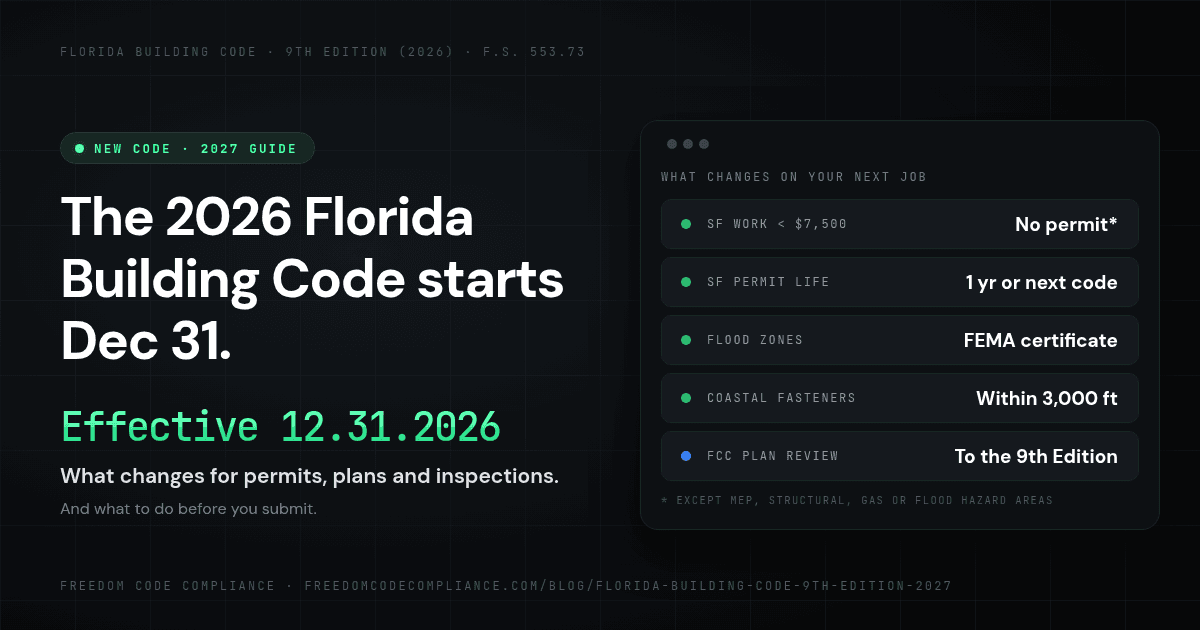
- New Section 1711 (Building) and Section R332 (Residential) apply to permits applied for on or after December 31, 2026.
- The rule covers fasteners and metal connectors and plates located within 3,000 feet of a saltwater coastline.
- A table sets the required level, stainless steel, enhanced galvanizing or standard galvanizing, by distance from the coastline and exposure to salt-laden air.
- The rule is referenced from roofing nails, screws and clips, exterior walls, cold-formed steel, wood framing and truss connector plates, and residential floors, walls, wall coverings and roof framing.
- The High-Velocity Hurricane Zone has the same requirement at Section 1517.5.1.1.
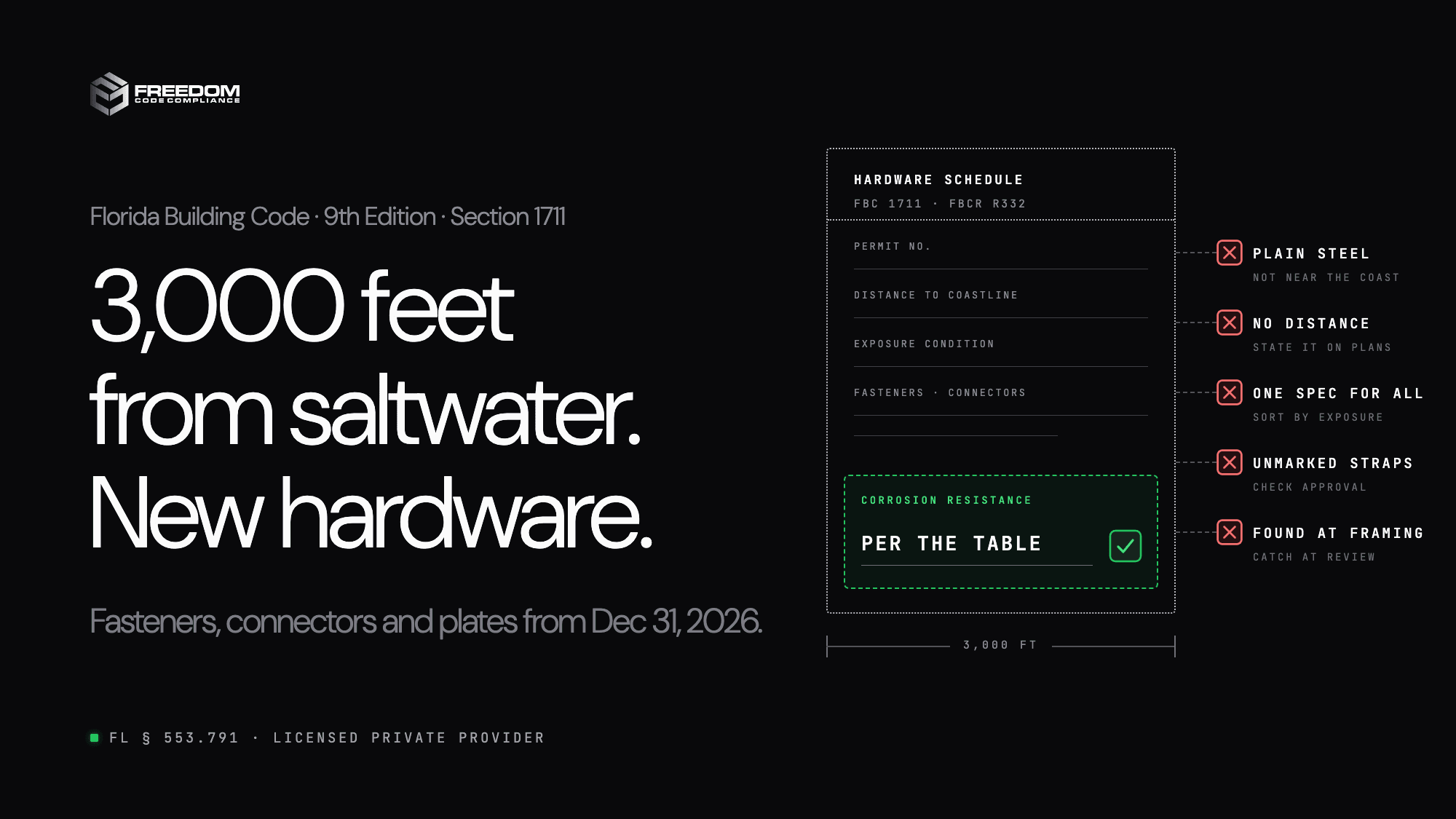
- Put the distance to the coastline and the hardware specification on the plans so the reviewer and the supplier are working from the same line.
What does Section 1711 of the 2026 Florida Building Code require for fasteners near the coast?
Section 1711 of the 9th Edition (2026) Florida Building Code, and Section R332 of the Residential code, set corrosion resistance requirements for fasteners, metal connectors and plates within 3,000 feet of a saltwater coastline. A table assigns stainless steel, enhanced galvanizing or standard galvanizing based on the distance from the coastline and how exposed the hardware is to salt-laden air. The rule applies to permits applied for on or after December 31, 2026 and is referenced from the roofing, exterior wall, steel, wood, floor and wall framing sections.
Starting with permits applied for on December 31, 2026, the Florida Building Code has a section just for metal hardware near saltwater. Section 1711 in the Building code and Section R332 in the Residential code set corrosion resistance requirements for fasteners, metal connectors and plates located within 3,000 feet of a saltwater coastline. In a state with this much coast, that is a large share of the work, and it changes what you order as well as what you draw.
The rule for which edition you are under is simple. Under Florida Statute 553.73(7)(d), the code in effect on the date the building department receives your permit application governs the work for the life of the permit. Applications received on or after December 31, 2026 fall under the 9th Edition. Our guide to the December 31 cutoff covers what counts as filed.
What the Section Requires
The Florida Building Commission's Analysis of Changes describes the new section this way:
- It applies to fasteners and metal connectors and plates located within 3,000 feet of a saltwater coastline.
- It gives criteria for three levels of protection: stainless steel, enhanced galvanizing and standard galvanizing.
- A new table sets the required level based on the distance from the coastline and the exposure condition. The exposure conditions describe how exposed the hardware is to salt-laden air.
Engineering Express, an engineering firm that published a summary of the table in August 2026, reads it as two distance bands, up to 300 feet and from 300 to 3,000 feet, and three exposure conditions: exterior, unconditioned interior that is vented, and unconditioned interior that is unvented. In that reading, exposed exterior fasteners and connectors within 300 feet call for stainless steel, and hardware farther out or in enclosed spaces calls for a level of galvanizing. That is one firm's summary. Use Table 1711.1 or Table R332.1 in the adopted code for the level on your job.
Where the Rule Reaches
The section is not limited to one trade. The 9th Edition adds a reference to it in each of these places.
- Roofing: nails, screws and clips (Building 1506.5 through 1506.7, Residential R904.5.1 through R904.5.3).
- Exterior walls: fasteners and connectors (Building 1403.12, Residential R701.3 for wall coverings).
- Cold-formed steel: structural and light-frame construction (Building 2204.3 and 2206.4).
- Wood: fasteners and connectors (Building 2304.10.8), and truss connector plates and plywood panel nails in the High-Velocity Hurricane Zone wood sections.
- Residential framing: floors (R501.3), walls (R601.3) and roof-ceiling construction (R801.4).
- High-Velocity Hurricane Zone roofing: Section 1517.5.1.1.
On a house near the beach that covers hurricane straps, joist hangers, truss plates, siding fasteners and roofing nails.
What to Do Before You File
- Measure the distance. Find out whether the site is within 3,000 feet of a saltwater coastline, and whether any of it is within 300 feet. State the distance on the plans.
- Sort the hardware by exposure. Exposed exterior connectors and hardware inside an enclosed attic are not treated the same.
- Write a hardware schedule. Name the material or coating for fasteners and for connectors and plates, by location.
- Check the product approvals. Manufacturers are adding notes to their 2026 Florida product approvals that hardware used within 3,000 feet of saltwater must comply with Section 1711 or R332. Ask your truss and connector suppliers which of their products meet each level.
- Price it. Stainless and heavier galvanized hardware cost more and can take longer to get. Put it in the bid.
Catch It at Plan Review, Not at the Truss Delivery
The expensive version of this rule is finding out at framing inspection that the connectors on site do not meet the table. A plan review to the 9th Edition checks the hardware specification against Section 1711 or R332 before anything is ordered.
Under Florida Statute 553.791, a private provider reviews your plans to the applicable code and signs an affidavit that they comply. Freedom Code Compliance reviews to the edition your permit falls under and inspects by video through myFCC, where the inspector can read a connector stamp or a fastener box on camera. Single-trade plan reviews come back in minutes, single-family in hours, and commercial and multifamily in one to two days. A licensed inspector joins a live video inspection in minutes. This week's measured figures are on our home page. Start with a plan review.
FCC does not pull permits, file permit applications, or file the Notice to Building Official. You or the owner files with the building department, and the department issues the permit. Check the coverage map to confirm FCC is registered with your department.
Sources
- Florida Building Commission, Analysis of Changes for the 9th Edition (2026), Building
- Florida Building Commission, Analysis of Changes for the 9th Edition (2026), Residential
- Engineering Express, Coastal Requirements for Fasteners, Connectors and Metal Plates: Section 1711 (August 2026)
- Florida Roofing and Sheet Metal Contractors Association, Tile Changes in the 2026 Ninth Edition Florida Building Code
- Greenberg Traurig, New Florida Building Code Edition Takes Effect Dec. 31, 2026 (November 10, 2026)
- Florida Statute 553.73, Florida Building Code (subsection 7(d), which edition governs a permit)
- Florida Statute 553.791, Alternative plans review and inspection
Frequently Asked Questions
What is the 3,000-foot rule in the 2026 Florida Building Code?
It is the trigger for the new corrosion section. Fasteners and metal connectors and plates located within 3,000 feet of a saltwater coastline must meet the corrosion resistance requirements of Section 1711 in the Building code or Section R332 in the Residential code.
Do I need stainless steel fasteners on every coastal job?
No. The section provides criteria for stainless steel, enhanced galvanizing and standard galvanizing, and a table picks the level from the distance to the coastline and the exposure condition. Engineering Express, an engineering firm that has published a summary of the table, reads it as calling for stainless steel on exposed exterior hardware within 300 feet of the coastline and levels of galvanizing farther out and in enclosed locations. Confirm the level for your job against Table 1711.1 or Table R332.1.
Does the coastal fastener rule apply to houses?
Yes. Section R332 is the Residential code version. It is referenced from the floor, wall construction, wall covering, roof-ceiling construction and roof assembly chapters, so it reaches framing connectors, hurricane straps, siding fasteners and roofing nails on a single-family home near the coast.
Does the rule apply to a project already permitted?
No. Under Florida Statute 553.73(7)(d), the code edition in effect on the date of the permit application governs for the life of the permit. Permits applied for on or before December 30, 2026 stay under the 8th Edition (2023).
How is the distance to the coastline measured?
The Commission's analysis describes the trigger as within 3,000 feet of a saltwater coastline and does not explain the measurement. Read the adopted text of Section 1711 or R332 for the definition, and state the distance you used on the plans.
Will a plan reviewer check fastener corrosion resistance?
A plan review under the 9th Edition checks the plans against the sections that apply, and near the coast that includes Section 1711 or R332. Freedom Code Compliance reviews plans to the edition your permit falls under, so a hardware schedule that does not match the table gets a comment before the material is ordered.