2026 Florida Building Code (9th Edition): What Contractors Need to Know in 2027
Key Takeaways
- The 9th Edition (2026) Florida Building Code takes effect December 31, 2026.
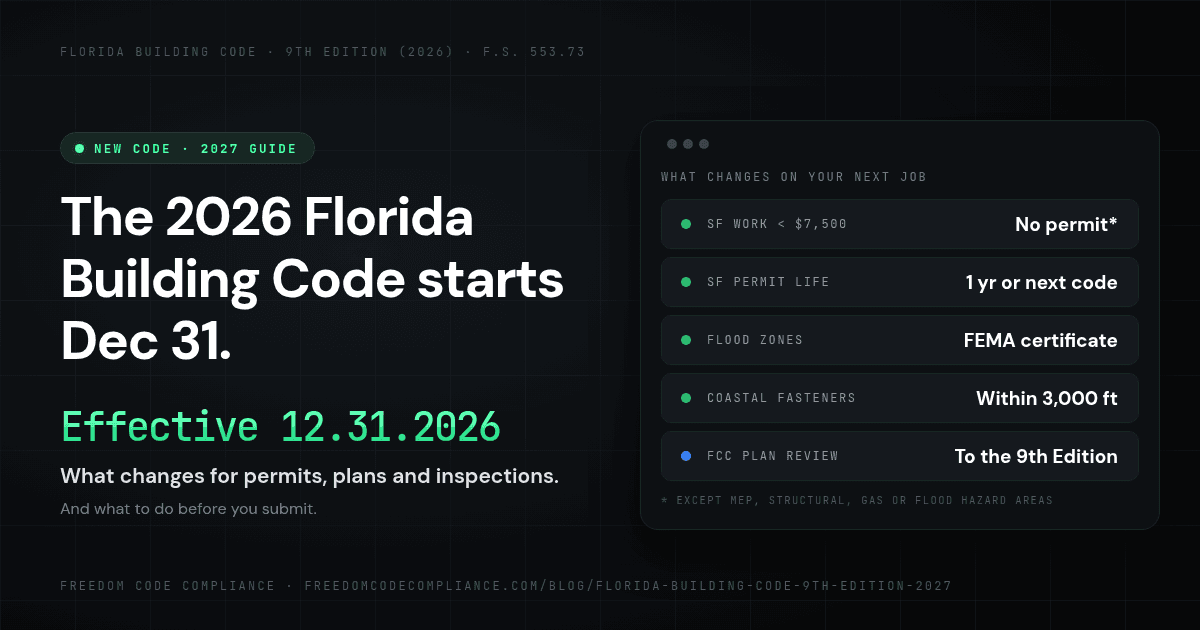
- Single-family work under $7,500 needs no permit, except electrical, plumbing, structural, mechanical or gas work, or work in a flood hazard area. You still file a written request.
- A single-family permit lasts 1 year or until the next code edition takes effect, whichever is later.
- Flood-zone jobs now call for a FEMA Elevation Certificate or equivalent, plus base flood and proposed lowest floor elevations on the plans.
- With a private provider, the building department checks your forms for completeness only. It has 10 business days to flag missing forms in writing, or the permit is deemed approved (F.S. 553.791).
What changes with the 2026 Florida Building Code (9th Edition), and when does it take effect?
The 9th Edition (2026) Florida Building Code takes effect December 31, 2026. It updates the 8th Edition (2023) using the 2024 International Codes. A supplement the Florida Building Commission approved on October 13, 2026 adds the 2026 law changes: no permit for most single-family work under $7,500, single-family permits that last 1 year or until the next code edition, and new permit exemptions for temporary flood barriers and multi-lot retaining walls.
The 9th Edition (2026) Florida Building Code takes effect December 31, 2026. It updates the 8th Edition (2023) using the 2024 International Codes. A supplement the Florida Building Commission approved on October 13, 2026 adds the 2026 law changes: no permit for most single-family work under $7,500, single-family permits that last 1 year or until the next code edition, and new permit exemptions for temporary flood barriers and multi-lot retaining walls.
When does the 2026 Florida Building Code take effect?
On December 31, 2026. By law (F.S. 553.73), a code update can't take effect sooner than six months after it's published. Each department sets its own cutoff. Miami-Dade says applications submitted on or after December 31 must meet the 9th Edition, and anything submitted through its portal after 4 PM on December 30 counts as on or after. Check your department's notice before you submit.
What changed for permits?
- Single-family work under $7,500: no permit. The exemption doesn't cover electrical, plumbing, structural, mechanical or gas work, or any property in a flood hazard area. Send the department a written request with the contract. You can't split a job to get under the limit.
- Single-family permits last longer: 1 year after issuance or until the next code edition takes effect, whichever is later.
- Temporary hurricane and flood barriers: no permit on one- and two-family homes and townhouses, when the barrier meets the code's conditions (including install by a licensed contractor).
- Retaining walls across several lots get one permit for the whole project, not one per lot.
- Accessibility renovations on one- and two-family homes are exempt: ramps that rise 48 inches or less, wider interior doors and grab bars.
What changed on plans and in the field?
- Flood zones: Plans must show the base flood elevation and the proposed lowest floor elevation. Inspections call for a FEMA Elevation Certificate or equivalent. Commercial dry floodproofing needs a FEMA Dry Floodproofing Certificate or equivalent.
- Coastal fasteners: On homes within 3,000 feet of a saltwater coastline, fasteners and connectors must meet the new Section R332.
- Roofing: Underlayment must lap over hips and ridges by at least 6 inches, except where vents are provided.
- Smoke alarms: They must be listed to UL 217 and installed per the manufacturer's instructions. Combination smoke and CO alarms must be listed to UL 217 and UL 2034.
- Digital plans: The building official may require construction documents in digital form.
What should contractors do before December 31?
- Update master plans and model homes to the 9th Edition.
- Confirm which edition your next application falls under.
- Start FEMA elevation paperwork early on flood-zone jobs.
- Check coastal fastener and roofing specs with your suppliers.
How does a private provider help with the code change?
A code change tends to slow department review queues. Under F.S. 553.791, a private provider reviews your plans to the code that applies and signs an affidavit that they comply. The building department checks your forms for completeness, plus local items like floodplain rules, but it may not re-review the plans for building code compliance. It has 10 business days (5 for a single-trade job on a one- or two-family home) to flag missing forms in writing. If it doesn't, the permit is deemed approved.
FCC reviews plans to the edition that applies to your permit and does inspections virtually through myFCC. See our live turnaround times or start a project.
FAQ
When does the 2026 Florida Building Code take effect?
December 31, 2026. The 9th Edition (2026) Florida Building Code replaces the 8th Edition (2023). Check your building department's cutoff. Miami-Dade, for example, says applications submitted on or after December 31, 2026 must meet the new edition.
Do I need a permit for work under $7,500 in Florida?
Not for most work on a single-family home. Under F.S. 553.79, the exemption doesn't cover electrical, plumbing, structural, mechanical or gas work, or any property partly or fully in a flood hazard area. The owner or contractor must send the building department a written request with the contract or other proof of the work and its value.
How long does a Florida single-family building permit last?
One year after it's issued, or until the next edition of the Florida Building Code takes effect, whichever is later. A local government can still extend a permit.
Is the 9th Edition based on the 2024 International Building Code?
Yes. The Florida Building Commission's Analysis of Changes says the 8th Edition (2023) is the base code and the 2024 International Building Code is the model code for the update. Not every 2024 IBC change was adopted.
Can a private provider review my plans to the 2026 Florida Building Code?
Yes. Under F.S. 553.791, a private provider reviews plans to the applicable codes: the Florida Building Code in effect, plus local technical amendments. FCC reviews plans to the edition that applies to your permit and does inspections in person or virtually, as the statute allows.
Sources
- Florida Building Commission, 9th Edition work plan (October 2026)
- Supplement 1 to the 9th Edition, approved October 13, 2026
- Analysis of Changes: Building and Residential
- F.S. 553.79 and F.S. 553.791 (2026 Florida Statutes)
Frequently Asked Questions
When does the 2026 Florida Building Code take effect?
December 31, 2026. The 9th Edition (2026) Florida Building Code replaces the 8th Edition (2023). Check your building department's cutoff. Miami-Dade, for example, says applications submitted on or after December 31, 2026 must meet the new edition.
Do I need a permit for work under $7,500 in Florida?
Not for most work on a single-family home. Under F.S. 553.79, the exemption doesn't cover electrical, plumbing, structural, mechanical or gas work, or any property partly or fully in a flood hazard area. The owner or contractor must send the building department a written request with the contract or other proof of the work and its value.
How long does a Florida single-family building permit last?
One year after it's issued, or until the next edition of the Florida Building Code takes effect, whichever is later. A local government can still extend a permit.
Is the 9th Edition based on the 2024 International Building Code?
Yes. The Florida Building Commission's Analysis of Changes says the 8th Edition (2023) is the base code and the 2024 International Building Code is the model code for the update. Not every 2024 IBC change was adopted.
Can a private provider review my plans to the 2026 Florida Building Code?
Yes. Under F.S. 553.791, a private provider reviews plans to the applicable codes: the Florida Building Code in effect, plus local technical amendments. FCC reviews plans to the edition that applies to your permit and does inspections in person or virtually, as the statute allows.