Florida Building Code Deadline: How to Lock In the 2023 Code Before December 31, 2026
Key Takeaways
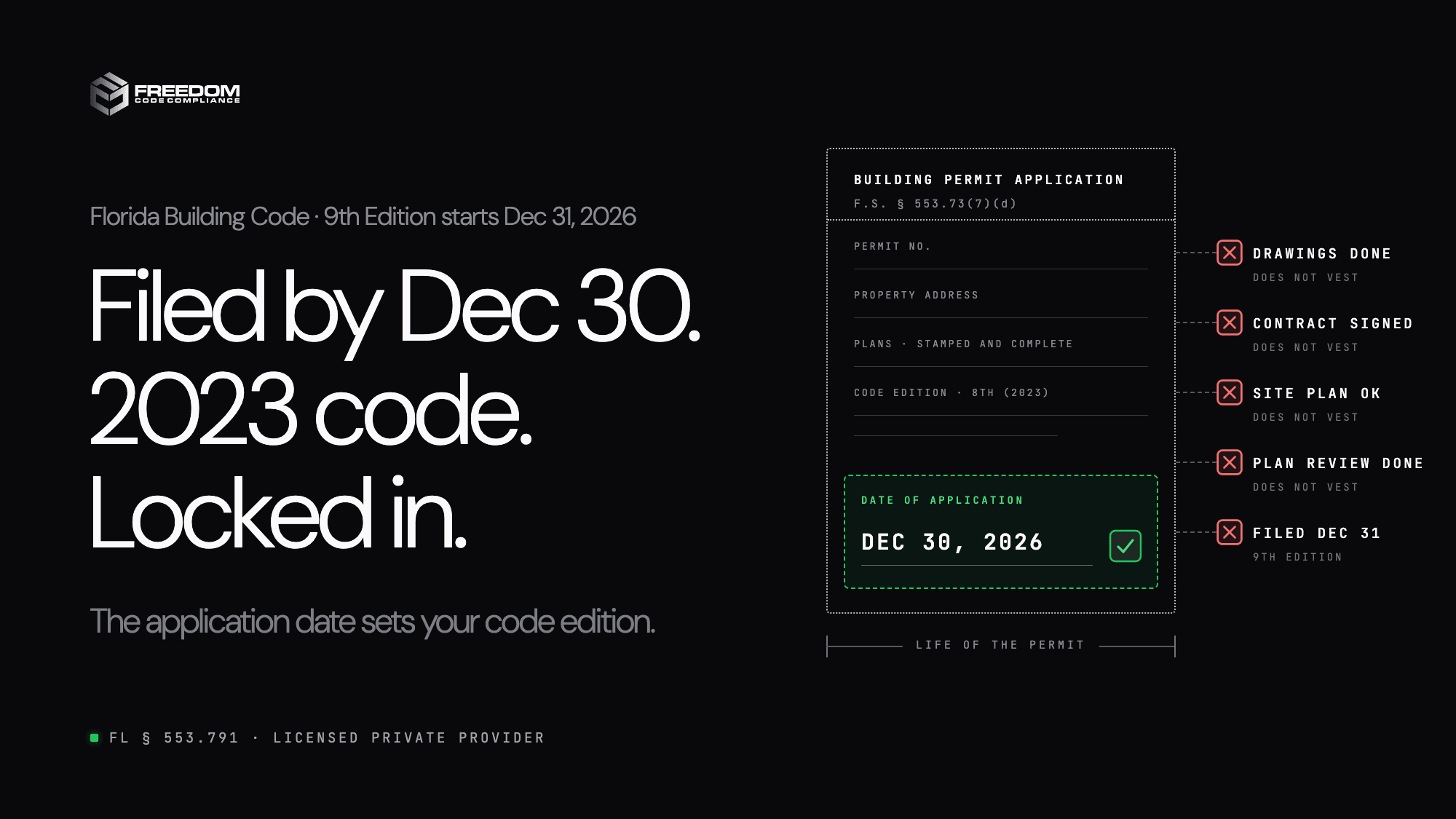
- Under F.S. 553.73(7)(d), the Florida Building Code edition in effect on the date of your permit application governs the work for the life of the permit and any extension.
- A set of plans at 90 percent, a signed contract, or an approved private provider plan review does not vest the 2023 code. Only the building department's receipt of a complete application does.
- Several departments treat portal submissions after their business cutoff on December 30 as filed on December 31. Check your department's notice and file a day early.
- Under FBC Section 105.3.2, an application not pursued in good faith is deemed abandoned 180 days after filing, which can cost you the vested edition.
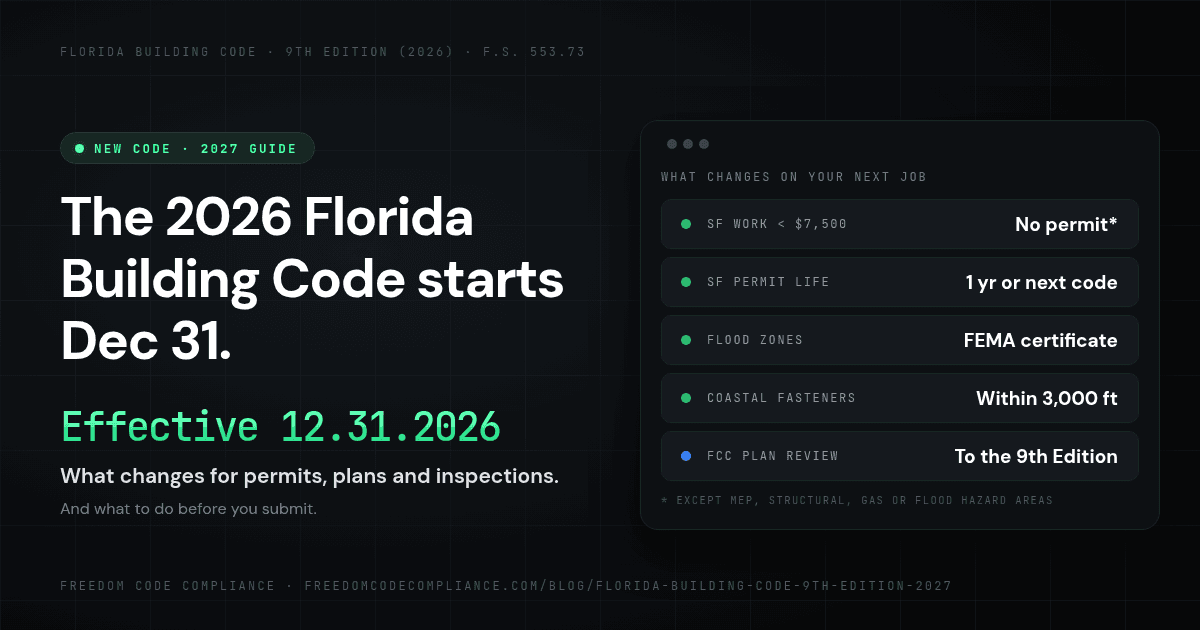
- The 9th Edition adds ASCE 7-22 wind loads, coastal corrosion rules within 3,000 feet of saltwater, new flood documentation, and construction site safety requirements. Product approvals may need revalidation.
- A private provider plan review under F.S. 553.791 returns a stamped, submittal-ready set in about 24 hours for single-family work, and the department then has 10 business days to flag anything missing or the permit is deemed approved.
How do I keep my Florida project under the 2023 Florida Building Code after the 9th Edition takes effect on December 31, 2026?
File a complete building permit application with the building department before December 31, 2026. Under Florida Statute 553.73(7)(d), the edition of the Florida Building Code in effect on the date of application governs the permitted work for the life of the permit and any extension. Design dates, contracts, and private provider plan approvals do not vest the code. Only the department's receipt of your application does, and some departments cut off portal submissions on the afternoon of December 30.
The 2026 Florida Building Code (9th Edition) takes effect December 31, 2026. If you want a project built to the 8th Edition (2023), the building department has to receive a complete permit application before that date. Nothing else locks it in: not the design date, not the contract, not an approved plan review. This post covers the rule, the traps, and how to get a submittal-ready set filed in the next few weeks.
For the full list of what changes in the new edition, see our earlier guide, 2026 Florida Building Code (9th Edition): What Contractors Need to Know. This one is about the deadline.
The One Rule That Decides Your Code Edition
Florida Statute 553.73(7)(d) states it plainly: the edition of the Florida Building Code in effect on the date of application for a permit governs the permitted work for the life of the permit and any extension granted to the permit. The same statute, at 553.73(7)(e), requires a new edition to take effect no sooner than six months after the Florida Building Commission publishes it, which is why the 9th Edition lands on December 31 rather than January 1.
So the question is not when do you start building or when were the drawings finished. It is when did the department receive the application.
- Application received on or before December 30, 2026: 8th Edition (2023) for the life of the permit.
- Application received on or after December 31, 2026: 9th Edition (2026).
What Counts as Filed
Each building department sets its own minimum submittal requirements, and an application the department rejects as incomplete may not hold a date. Three things trip contractors up every code cycle:
- Portal cutoffs. Some departments have announced that anything submitted through their online portal after close of business on December 30 counts as received on December 31. Treat December 30 at noon as your real deadline and read your department's notice.
- Entitlements are not permits. Site plan approvals, zoning letters, and pre-application meetings do not vest the code. Only the building permit application does.
- Private provider jobs still need the department filing. A private provider's plan approval is not an application. You or the owner must file the permit application, the Notice to Building Official, and the plan compliance affidavit with the department by the cutoff. See our note on who signs the NTBO if the department asks for extra forms.
How You Can Lose the 2023 Code After Filing
Florida Building Code Section 105.3.2 deems an application abandoned 180 days after filing unless it has been pursued in good faith or a permit has been issued. The building official may grant extensions of up to 90 days each. A set filed on December 29 and then left to sit while the owner finishes financing can be abandoned by late June 2027, and a refiled application falls under the 9th Edition.
Respond to review comments promptly, request extensions in writing before the 180 days run, and keep a copy of every submission receipt.
Why the Edition Matters on Real Jobs
The Florida Building Commission approved a supplement to the 9th Edition on October 13, 2026 and meets again on December 8. Firms that have read the adopted text report these changes among the most costly to absorb mid-design:
- Wind loads move to ASCE 7-22, replacing ASCE 7-16. Expect changes to component and cladding pressures, which flow into window, door, and roofing product selections.
- Coastal corrosion. Fasteners, metal connectors, and plates within 3,000 feet of a saltwater coastline must meet new corrosion-resistance requirements (Section 1711 in Building, Section R332 in Residential).
- Flood documentation. Plans in flood hazard areas must show the base flood elevation and the proposed lowest floor elevation, and an Elevation Certificate is required during construction. Commercial dry floodproofing needs its own certificate.
- Construction site safety. New Section 3302 requires a site safety plan, a site safety director, and daily site safety inspections on covered projects.
- Minimum unit sizes. New Section 1208.3 sets at least 190 square feet of habitable space for dwelling units and 70 square feet net floor area for sleeping units.
- Product approvals. Approvals tied to the 8th Edition may need revalidation under the 9th. Ask your window, door, and roofing suppliers now.
A master plan or model home designed to the 2023 code and filed on time avoids re-engineering. The same plan filed in January gets reviewed against all of the above.
The Queue Problem in December
Every contractor in Florida is reading the same calendar. Department plan review queues get longer in the last weeks of a code cycle, and the review itself does not vest anything. What vests is the filing. The practical question is how fast you can get a stamped, complete set into the department's hands.
Under Florida Statute 553.791, the fee owner or the owner's authorized contractor may use a private provider for plan review. The private provider reviews the plans to the applicable code, signs an affidavit that they comply, and you file that affidavit with the application. The department then checks for completeness and local items such as zoning and floodplain rules. It may not re-review the plans for building code compliance. If the department does not give written notice of a deficiency within 10 business days (five for a single-trade job on a one- or two-family home), the permit is deemed approved as a matter of law and must be issued the next business day.
A December Timeline That Works
- This week: list every job you intend to file under the 2023 code. Confirm each department's December cutoff and submittal checklist.
- Submit plans to a private provider. Freedom Code Compliance's single-family plan reviews average 24 hours. Commercial and multifamily reviews average two days. You get stamped plans, the plan compliance affidavit, and the Notice to Building Official back in myFCC.
- File with the department by December 29. Keep the receipt or portal confirmation. Have the owner sign the NTBO ahead of time.
- Track the 10 business day clock. If the department requests something, respond fast so the application is never deemed abandoned.
- Schedule inspections through the private provider. FCC runs virtual inspections live or offline through myFCC and sends results to the department. Zoning, fire, utilities, and other retained inspections stay with the department.
What FCC Does and Does Not Do
FCC reviews plans to the edition that applies to your permit and performs the building, mechanical, electrical, and plumbing inspections virtually. FCC does not pull permits, file permit applications, or file the NTBO. You or the owner files with the department, and the department issues the permit. Check the coverage map to confirm FCC is registered with your building department before you plan around us.
Bottom Line
The 9th Edition takes effect December 31, 2026. The code edition is set by the date the department receives a complete permit application, and nothing else. File by December 29, pursue the application so it is never abandoned, and use a private provider plan review if the department queue is the thing standing between your drawings and that filing date.
Sources
- Florida Statute 553.73, Florida Building Code (subsections 7(d) and 7(e))
- Florida Statute 553.791, Alternative plans review and inspection
- Greenberg Traurig, New Florida Building Code Edition Takes Effect Dec. 31, 2026 (November 10, 2026)
- Milrose, Florida's Building Code Is Changing (ASCE 7-22 and product approval notes)
- Florida Building Commission, 2026 Code Development Process
Frequently Asked Questions
What date decides which Florida Building Code edition my project follows?
The date the building department receives your permit application. Florida Statute 553.73(7)(d) says the edition in effect on the date of application governs the permitted work for the life of the permit and any extension. Applications filed on or before December 30, 2026 fall under the 8th Edition (2023). Applications filed on or after December 31, 2026 fall under the 9th Edition (2026).
Does a private provider plan review lock in the 2023 code?
No. The plan review gets your set ready to file, but only the department's receipt of the permit application sets the code edition. If you use a private provider, you or the owner still files the application, the Notice to Building Official, and the compliance affidavit with the department before the cutoff.
Can I lose the 2023 code after I file?
Yes. Under Florida Building Code Section 105.3.2, an application is deemed abandoned 180 days after filing unless it has been pursued in good faith or a permit has been issued. The building official can grant extensions of up to 90 days each. If an application is abandoned and refiled in 2027, it falls under the 9th Edition.
What are the biggest changes in the 9th Edition Florida Building Code?
Sources that have reviewed the adopted text name a move from ASCE 7-16 to ASCE 7-22 for wind loads, corrosion-resistance requirements for fasteners and connectors within 3,000 feet of a saltwater coastline, base flood and lowest floor elevations on the plans with an Elevation Certificate during construction, a site safety plan and daily site safety inspections on larger jobs, and minimum dwelling and sleeping unit sizes. Product approvals on envelope components may need revalidation under the new edition.
How long does a permit filed under the 2023 code last?
For the life of the permit and any extension the department grants. Under the 2026 changes in HB 803, a single-family building permit is valid for one year after issuance or until the next code edition takes effect, whichever is later. Commercial permits follow the department's standard expiration and extension rules.
How fast can a private provider get my plans ready to file?
Freedom Code Compliance's single-family plan reviews average 24 hours, and commercial and multifamily reviews average two days. You submit through myFCC, receive stamped plans and the private provider paperwork, and file the application with the building department yourself. Under F.S. 553.791, the department then has 10 business days (five for a single-trade job on a one- or two-family home) to notify you in writing of anything missing, or the permit is deemed approved.