Do Single-Family Plan Reviews Require Separate MEP Reviews in Florida? Here's What the Record Actually Says
Key Takeaways
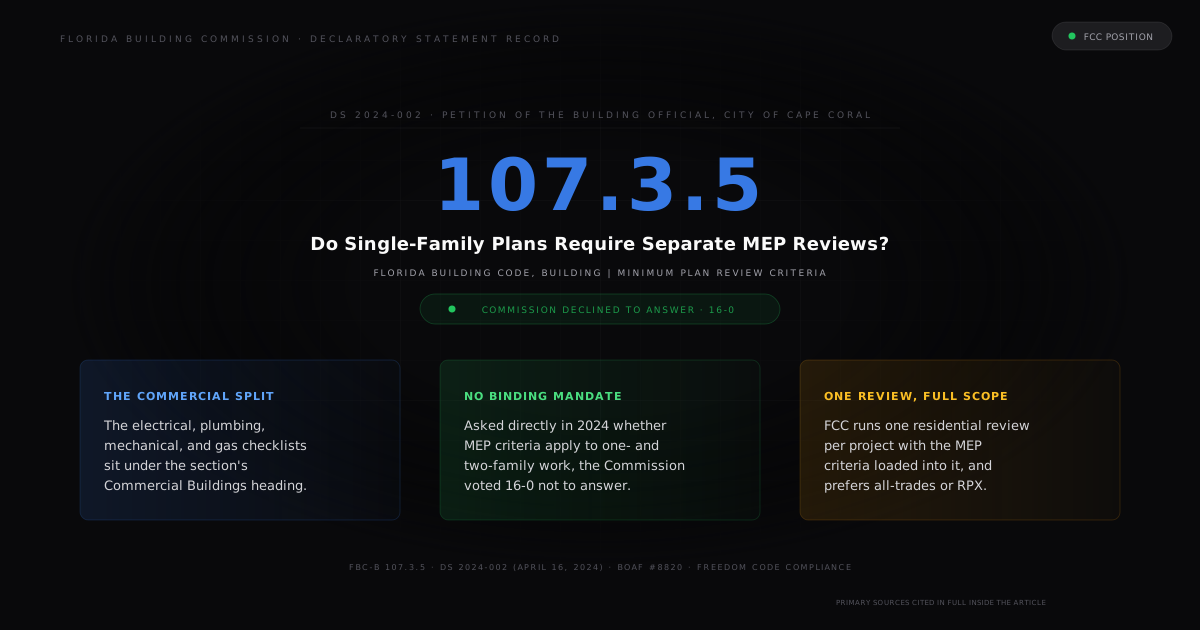
- FBC-B 107.3.5's detailed electrical, plumbing, mechanical, and gas checklists appear under the section's Commercial Buildings heading; the Residential (one- and two-family) list is building-scoped.
- In 2024, the Building Official of the City of Cape Coral asked the Florida Building Commission directly whether MEP plan review criteria must be enforced on one- and two-family projects (DS 2024-002).
- On April 16, 2024, the Commission voted 16-0 that the questions were general in nature and could not be answered, so no binding statewide determination exists.
- Florida's license structure already contemplates one examiner reviewing all residential trades: the Residential Plans Examiner (RPX) license covers building, electrical, mechanical, and plumbing for one- and two-family work.
- FCC performs one residential plan review per single-family project and loads the applicable electrical, mechanical, and plumbing criteria into that review, so the substance is covered under either reading of 107.3.5.
- FCC prefers assigning examiners licensed across all applicable trades, or an RPX, and can escalate the assignment when a building department requests it.
- This is FCC's documented position as a licensed private provider firm, not legal advice; the underlying sources are linked so you can verify every claim.
Does Florida require separate electrical, mechanical, and plumbing plan reviews for single-family homes?
No binding statewide requirement exists for discipline-segregated MEP plan reviews on one- and two-family dwellings. The Florida Building Code's minimum plan review criteria for residential projects (FBC-B 107.3.5) are building-scoped, and the Florida Building Commission declined to impose a broader reading when asked directly in DS 2024-002 (April 16, 2024, 16-0). A single residential plan review performed by a qualified examiner satisfies the code, provided the substantive electrical, mechanical, and plumbing provisions of the FBC-Residential volume are actually reviewed. That is exactly how Freedom Code Compliance structures its reviews, so FCC's process complies under either reading of the section.
If you work anywhere near residential construction in Florida, you have probably run into this question: a single-family project comes in with real electrical scope, a rooftop solar array, a pool with bonding and barrier requirements, or a full new build, and someone asks why the plan review was performed as one residential review instead of separate building, electrical, mechanical, and plumbing reviews. Sometimes the person asking is a permit tech. Sometimes it is a building official. Sometimes it is a contractor who got a different answer in the last county over.
The confusion is real, it is industry-wide, and it has a specific cause. We know because we traced it to the primary sources, including a 2024 Florida Building Commission proceeding that most of the industry has never read. This post lays out what the record actually says, how Freedom Code Compliance operates on it, and what that means if you build with us.
Where the confusion comes from
Section 107.3.5 of the Florida Building Code, Building volume, is titled 'Minimum plan review criteria for buildings.' It is one of the few places in the code that reads like an actual checklist: floor plan, site plan, foundation plan, framing, elevations, and then detailed discipline lists for Electrical, Plumbing, Mechanical, and Gas.
Here is the wrinkle. Those detailed MEP lists sit under the section's Commercial Buildings heading. The Residential (one- and two-family) heading gets its own, much shorter list: site requirements, fire-resistant construction where required, smoke detector locations, egress, structural requirements, accessibility, and impact-resistant coverings. Read literally, the residential minimum criteria are building-scoped, and the MEP checklists belong to commercial review.
The Building Officials Association of Florida looked at this in informal interpretation #8820 and described 107.3.5 as a bare minimum submittal list, with the building official retaining authority to require more. That answer is accurate, but it did not settle the structural question, and different jurisdictions kept reading the section differently.
The question was put to the Commission, and the Commission declined to answer
In 2024 the Building Official of the City of Cape Coral did exactly what you would want a code official to do with an ambiguous section: he petitioned the Florida Building Commission for a declaratory statement, DS 2024-002. His questions were direct. Must electrical, plumbing, mechanical, and gas drawings be part of the submittal package for one- and two-family projects? Must the MEP minimum plan review criteria be enforced on them? Can a building official omit them?
Commission staff drafted an analysis that would have answered yes, reasoning through the scope sections of the FBC-Residential volume. That draft circulates in the industry to this day, and some people treat it as the answer. It is not. The Commission's Code Administration Technical Advisory Committee recommended against adopting it, and on April 16, 2024, the Commission voted 16-0 that the questions presented were general in nature and could not be answered.
The practical effect: there is no binding statewide determination requiring discipline-segregated MEP plan review on one- and two-family projects. The literal text of 107.3.5 stands, and review structure remains a matter of professional judgment exercised within the code.
How FCC sees it
Our position is straightforward, and we have documented it as formal company policy reviewed by a master code professional:
- One residential plan review per single-family project. This follows the literal text of 107.3.5's residential criteria, the outcome of DS 2024-002, and long-standing industry practice. Florida's license structure already contemplates it: the Residential Plans Examiner (RPX) license exists precisely so one qualified examiner can review all four trades on one- and two-family work.
- The MEP substance gets reviewed either way. Our review platform stores plan review criteria for every project type and trade. On a single-family project with electrical, mechanical, or plumbing scope, those criteria load into the single residential review automatically, each item labeled by trade, and the findings are documented the same way. A solar project's review covers the PV disconnect, rapid shutdown, and interconnection requirements whether or not anyone ever argues about section headings.
- Reviewer qualifications follow a ladder. We prefer assigning an examiner licensed across all applicable trades, or an RPX. A building-qualified examiner may perform the review with the cross-trade minimums expressly included. Our assignment tools surface who covers every trade on a project so our coordinators can reach for full coverage first.
Notice what this position does not depend on: winning the interpretive argument. If a future Commission or Legislature resolves 107.3.5 toward the broader reading, our reviews already cover the substance. We built it that way on purpose.
What this means for our clients
If you submit a single-family project to FCC, you get one plan review, one reviewer relationship, and one set of comments, with the electrical, mechanical, and plumbing items reviewed and documented inside it. You do not wait on four separate reviewers to touch a solar permit. You also do not get a gap where the electrical scope fell between two definitions of whose job it was. For the typical residential project, that means faster turnaround with the same substantive coverage a segregated review would have produced.
How we respond when a building department asks
Occasionally a jurisdiction asks why a commercial-building-credentialed reviewer, or a single reviewer of any kind, handled the MEP components of a single-family review. We treat that as a fair question with a documented answer, not a fight.
- We share the position and its sources: the text of 107.3.5, the BOAF interpretation, and the DS 2024-002 disposition.
- We show the review record itself, which documents the trade-by-trade criteria that were evaluated on that specific project.
- If the department still prefers a differently-credentialed reviewer or separate discipline reviews for a project, we accommodate. We escalate the assignment to an RPX, engineer, or architect, or add discipline reviews. Building departments are our partners in this system, and nothing in our process prevents meeting a local preference.
That posture is deliberate. Private providers operate under s. 553.791 alongside building departments, not against them, and the fastest path through an ambiguous code section is a shared set of primary sources.
Sources
- Florida Building Code, Building, 8th Edition (2023), s. 107.3.5, 'Minimum plan review criteria for buildings'
- Florida Building Commission, DS 2024-002 staff analysis and petition record (floridabuilding.org)
- Florida Building Commission, Facilitator's Summary Report, April 16, 2024 meeting (disposition of DS 2024-002)
- BOAF informal interpretation #8820
- F.S. 553.791 (private provider services); F.S. ch. 468, part XII (plans examiner licensure)
This article documents the operating position of Freedom Code Compliance Corp, a licensed Florida private provider firm, and is provided for educational purposes. It is not legal advice. Every source cited is public; we encourage you to read them.
Frequently Asked Questions
What is FBC-B 107.3.5?
Section 107.3.5 of the Florida Building Code, Building volume, titled 'Minimum plan review criteria for buildings,' is a Florida-specific enumerated checklist of the minimum items a plan review must cover. It lists detailed Building, Electrical, Plumbing, Mechanical, and Gas criteria under a Commercial Buildings heading, and a shorter building-scoped list under a Residential (one- and two-family) heading.
Did the Florida Building Commission ever rule on whether MEP review is required for single-family projects?
It was asked directly and declined to answer. In declaratory statement DS 2024-002, the Building Official of the City of Cape Coral asked whether the electrical, plumbing, mechanical, and gas criteria in 107.3.5 must be enforced on one- and two-family projects. On April 16, 2024, the Commission voted 16-0 to approve its Code Administration TAC's recommendation that the questions were general in nature and could not be answered. A staff analysis that would have answered yes was never adopted.
Does that mean electrical and plumbing work on a house goes unreviewed?
No. The substantive requirements of the FBC-Residential volume, which incorporate the National Electrical Code and the residential mechanical, plumbing, and fuel gas chapters, still apply to the construction. FCC's single residential review evaluates those provisions where they apply to the project, and compliance is also verified at inspection. The question DS 2024-002 left open is about review structure, not about whether the code applies.
Who is qualified to review all trades on a single-family project?
Florida licenses a Residential Plans Examiner (RPX) to perform plan review in all four trades for one- and two-family work. Professional Engineers and Registered Architects may also review all disciplines under s. 553.791. A standard plans examiner licensed in Building may perform the residential review as well; FCC's practice is to prefer all-trades coverage where possible and to ensure the cross-trade minimums are expressly part of the review either way.
What does FCC do if a building department disagrees with this approach?
We treat it as a conversation, not a conflict. We share the primary-source record, including the DS 2024-002 disposition, and if the department still prefers a differently-credentialed reviewer or separate discipline reviews on a specific project, we accommodate by escalating the assignment or adding reviews. Nothing in our process prevents that.
Is this legal advice?
No. This article documents Freedom Code Compliance Corp's operating position as a licensed Florida private provider firm, with citations to the public record so you can verify it. For legal questions about a specific project or jurisdiction, consult your attorney.