2026 Florida Building Code Changes for Commercial Jobs: Site Safety Plans, Vibration Limits and More
Key Takeaways
- The 9th Edition (2026) Florida Building Code applies to permit applications received on or after December 31, 2026.
- New Section 3302 requires the owner or owner's agent to develop, implement and maintain a site safety plan and to designate a site safety director.
- The site safety director must perform daily site safety inspections, and the section provides remedies when inspections are not conducted or documented.
- New Section 3307.3 limits construction and demolition vibration to a peak particle velocity of 0.5 inches per second, monitored and controlled by the engineer of record.
- New Section 1208.3 requires dwelling units to have at least 190 square feet of habitable space, and sleeping units need at least 70 square feet of net floor area.
- Group S-1 storage buildings of Type IIB and IIIB construction may now be four stories, up from three.
- The building official may require construction documents in digital form, and flood zone plans must show base flood and proposed lowest floor elevations.
What changes for commercial construction in the 2026 Florida Building Code (9th Edition)?
For permits applied for on or after December 31, 2026, new Section 3302 requires the owner or the owner's agent to develop and maintain a site safety plan, name a site safety director, and have that director inspect the site daily and keep records. New Section 3307.3 limits construction vibration to a peak particle velocity of 0.5 inches per second, monitored by the engineer of record. The edition also sets a 190 square foot minimum for dwelling units, allows a fourth story for some storage buildings, and adds flood elevations and digital submittals to the plan requirements.
Commercial and multifamily permits applied for on or after December 31, 2026 fall under the 9th Edition (2026) Florida Building Code, and the biggest change is not in the drawings. It is on the job site. A new section makes the owner responsible for a written site safety plan, a named site safety director and daily inspections with records. Add a vibration limit, minimum unit sizes and new submittal rules, and a general contractor has a short list to set up before the first 2027 mobilization.
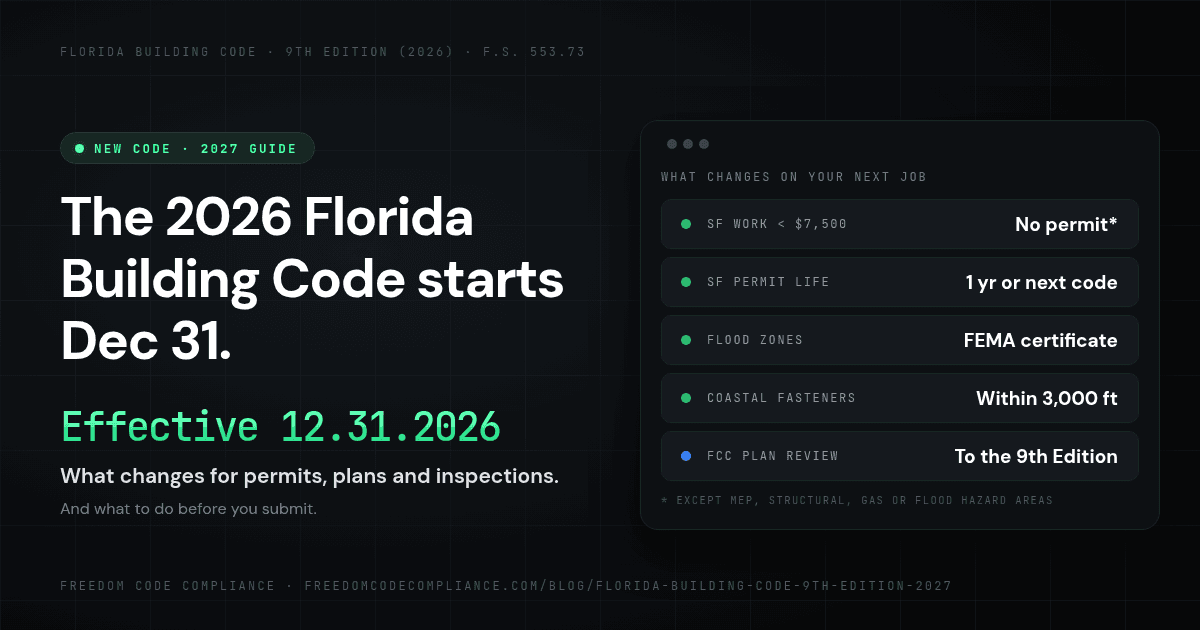
The rule for which edition you are under is simple. Under Florida Statute 553.73(7)(d), the code in effect on the date the building department receives your permit application governs the work for the life of the permit. Applications received on or after December 31, 2026 fall under the 9th Edition. Our guide to the December 31 cutoff covers what counts as filed.
Section 3302: Site Safety Plan, Director and Daily Inspections
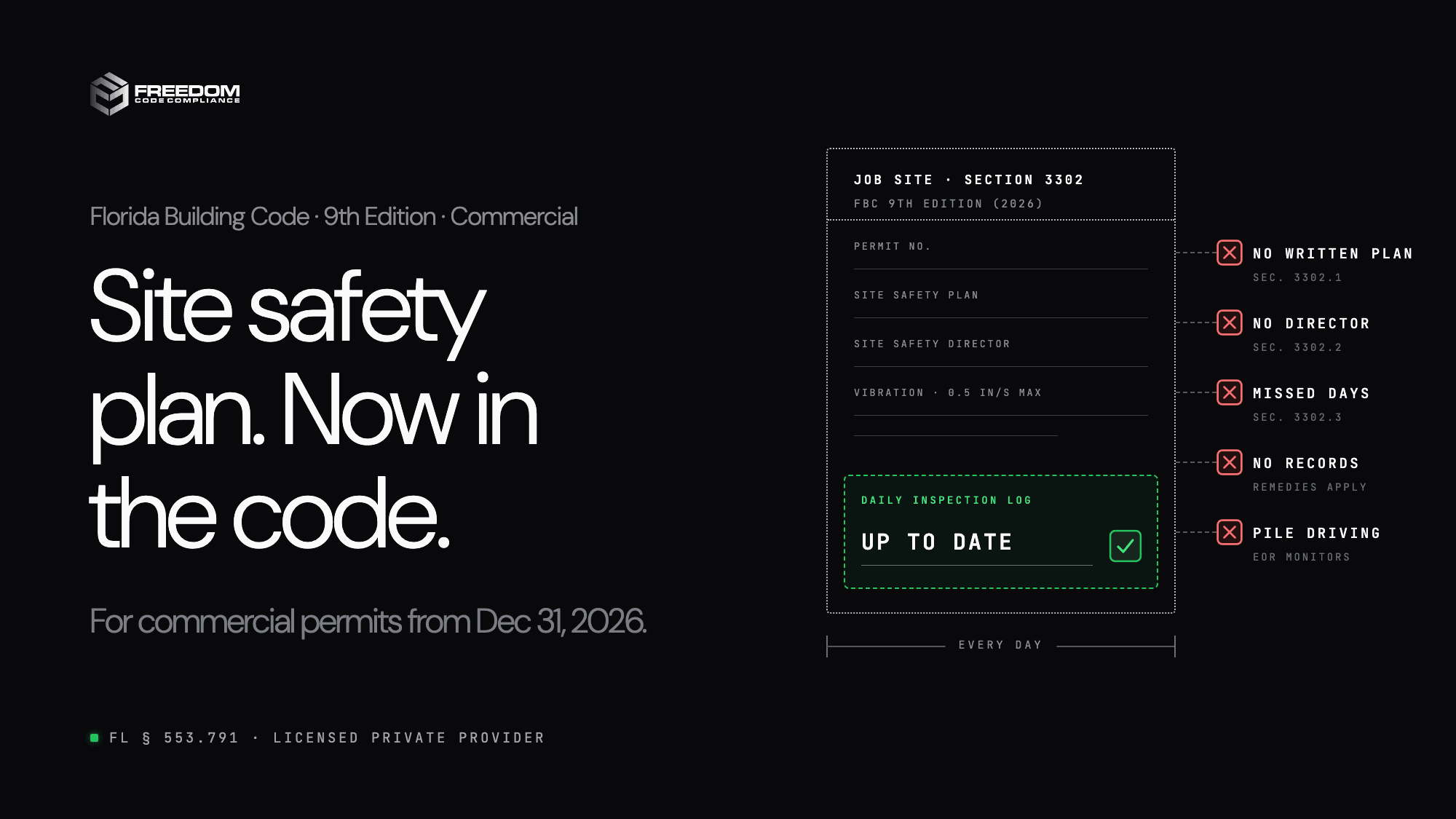
The Florida Building Commission's Analysis of Changes describes new Section 3302 as addressing construction site safety that a building inspector can reasonably verify and enforce while on site for other scheduled inspections. It has four parts.
- 3302.1: the owner or the owner's agent must develop, implement and maintain a site safety plan.
- 3302.1.1: lists the required components of the plan.
- 3302.2: the owner must designate a site safety director.
- 3302.3: the site safety director must perform daily site safety inspections. Section 3302.3.1 addresses remedies for failing to properly conduct the inspections, document them, and maintain the required documentation.
The section sits under the heading for the owner's responsibility for fire protection during construction, and Chapter 33 continues to require compliance with the Florida Fire Prevention Code. The analysis summarizes the section and does not reproduce the plan contents or say which projects are covered, so read the adopted text of 3302 before you write your plan.
What to set up now:
- Decide who writes the plan on each project. The duty is the owner's, and most owners will pass it to the contractor by contract.
- Name the site safety director in writing and keep it with the permit documents.
- Start a daily inspection log from day one. The remedies section is aimed at missing inspections and missing records.
- Keep the plan and the log where an inspector can see them during any scheduled inspection.
Section 3307.3: A Vibration Limit
New Section 3307.3 requires vibrations from permitted construction or demolition to be monitored and controlled by the project's engineer of record for their effect on neighboring buildings. Vibrations from pile driving, deep foundations and other construction or demolition activities are limited to a peak particle velocity of 0.5 inches per second.
On tight urban sites this goes in the foundation bid. Budget for monitoring, and settle with the engineer of record who installs it and who reads it. The excavation retention sections are also revised to cover adjacent property.
Roof Loads During Construction
New Section 3301.3 requires structural roof components to be capable of supporting the roof covering system and the material and equipment loads placed on the roof during installation. Stacked pallets on a reroof are now a code item.
Design Changes That Affect the Program
- Minimum unit size. New Section 1208.3 requires at least 190 square feet of habitable space in a dwelling unit. Sleeping units need at least 70 square feet of net floor area.
- Storage buildings. The allowable stories for Group S-1 in Type IIB and IIIB construction rise from three to four (Table 504.4). Lithium-ion and lithium metal battery storage is added to Group S-1.
- Small food service spaces. Structures and tenant spaces meant for quick transactions, such as takeout and pickup, with a public access area of 300 square feet or less are exempt from the public restroom requirement (456.4.1.1).
- Doors under an overhang. Exterior doors that use the overhang exception to water testing must now carry a Limited Water rating, and the overhang must extend to each side of the door as well as out from it (1709.5.1).
- Risk categories. Ground-mounted photovoltaic systems are added as Risk Category I, and public utility power, water and wastewater facilities are added as Risk Category IV.
- Coastal hardware. Fasteners, connectors and plates within 3,000 feet of a saltwater coastline must meet new Section 1711. See our post on the coastal fastener rule.
Submittal Changes
- Digital documents. The building official may require construction documents in digital form (107.1).
- Flood information. Commercial plans in flood hazard areas must show base flood elevations, proposed lowest floor elevations and dry floodproofing design certification. See flood zone changes.
- Temporary structures. Structures designed under Section 3103.5 are limited to a one-year service period unless an extension is granted (108.1).
- Performance-based alternatives. Alternative materials and methods may comply through the ICC Performance Code, except for structural materials and structural designs (104.11).
Plan Review During a Code Change
A new edition means every reviewer is reading new sections, and department queues tend to grow. Under Florida Statute 553.791, a private provider reviews your plans to the applicable code and signs an affidavit that they comply. The department checks the submittal for completeness and local items and may not re-review the plans for building code compliance. If it gives no written notice of a deficiency within 10 business days, the permit is deemed approved.
Commercial jobs also get a fee reduction under the 2026 law: at least 25 percent of the portion of the permit fee a private provider covers, and at least 50 percent when the private provider performs all required plan review and inspections. Our HB 803 guide explains it.
Freedom Code Compliance reviews commercial and multifamily plans to the edition your permit falls under and inspects by video through myFCC. Single-trade plan reviews come back in minutes, single-family in hours, and commercial and multifamily in one to two days. A licensed inspector joins a live video inspection in minutes. This week's measured figures are on our home page. Start with a plan review.
FCC does not pull permits, file permit applications, or file the Notice to Building Official. You or the owner files with the building department, and the department issues the permit. Check the coverage map to confirm FCC is registered with your department.
Sources
- Florida Building Commission, Analysis of Changes for the 9th Edition (2026), Building
- Greenberg Traurig, New Florida Building Code Edition Takes Effect Dec. 31, 2026 (November 10, 2026)
- Florida Statute 553.73, Florida Building Code (subsection 7(d), which edition governs a permit)
- Florida Statute 553.791, Alternative plans review and inspection
Frequently Asked Questions
Does the 2026 Florida Building Code require a site safety plan?
Yes. New Section 3302 requires the owner or the owner's agent to develop, implement and maintain a site safety plan, and Section 3302.1.1 lists what the plan must contain. Read the adopted section for which projects it covers and the required contents before you mobilize.
Who is the site safety director?
A person the owner designates under Section 3302.2. Under Section 3302.3 the site safety director performs daily site safety inspections. Section 3302.3.1 addresses remedies for failing to conduct the inspections, document them, or keep the required records.
What is the vibration limit for pile driving in Florida?
Under new Section 3307.3, vibrations from pile driving, deep foundations and other construction or demolition activities are limited to a peak particle velocity of 0.5 inches per second. The project's engineer of record must monitor and control vibration for its effect on neighboring buildings.
What is the minimum apartment size under the 2026 Florida Building Code?
New Section 1208.3 requires a dwelling unit to have at least 190 square feet of habitable space. Sleeping units must have a net floor area of at least 70 square feet.
Do these changes apply to a project that is already in permitting?
Not if the application was received before the cutoff. Under Florida Statute 553.73(7)(d), the edition in effect on the date of the permit application governs for the life of the permit. Entitlements and site plan approvals do not count. Only the building permit application does.
How does a private provider help on a commercial job during a code change?
Under F.S. 553.791 a private provider reviews the plans to the applicable code and signs a compliance affidavit, and the building department may not re-review them for building code compliance. For commercial work, a permit fee reduction of at least 25 percent applies to the portion a private provider covers, and at least 50 percent when the private provider performs all required plan review and inspections.