2026 Florida Building Code Pool Changes: Bonding, Lighting, Pressure Tests and Piping
Key Takeaways
- The 9th Edition (2026) Florida Building Code applies to pool permits applied for on or after December 31, 2026.
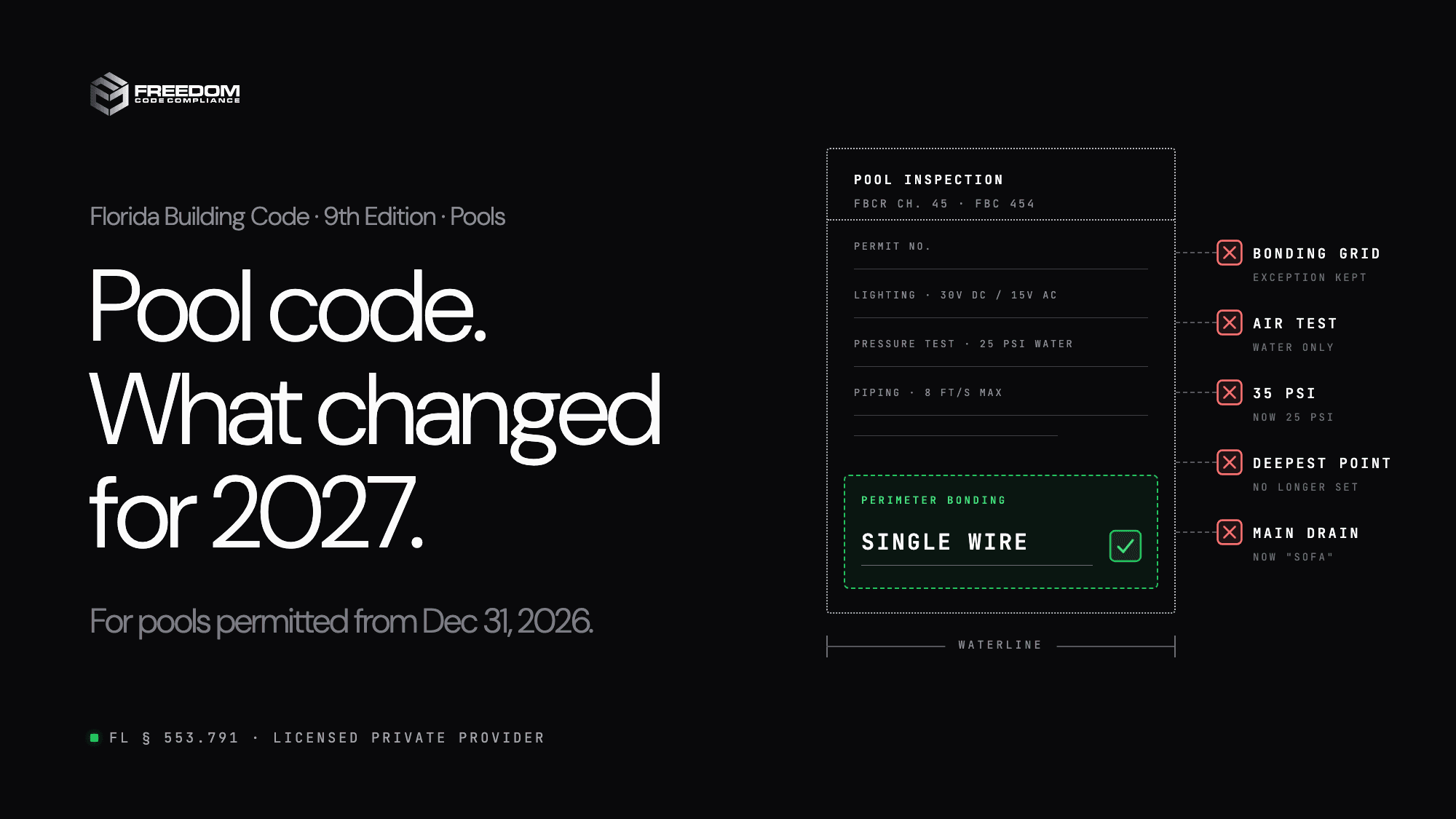
- A new exception keeps Florida's single-wire bonding of pool perimeter surfaces in place of the copper or steel grid in NFPA 70 (Residential 4501.16, Building 454.2.16 and 454.1.10.4.2).
- Underwater lighting, and lighting exposed to nozzle-directed pool water, may not exceed 30 volts DC or 15 volts AC.
- The pressure test is a water test at 25 psi. The air test option is deleted and the pressure drops from 35 psi.
- All pool piping must be designed so water velocity does not exceed 8 feet per second, with a new table relating pipe size to flow rate.
- The main drain is now a suction outlet fitting assembly, and the requirement to place it at or near the deepest point is deleted.
- In flood hazard areas, pool equipment must be anchored to prevent flotation. The requirement to elevate it to the extent practical is deleted.
What changes for swimming pools in the 2026 Florida Building Code (9th Edition)?
For pools permitted on or after December 31, 2026, Florida keeps single-wire equipotential bonding of the pool perimeter through a new exception to the grid in the National Electrical Code. Underwater lighting is limited to 30 volts DC or 15 volts AC. The piping pressure test becomes a water test at 25 psi, with the air test option removed. All piping must be sized so water velocity stays at or under 8 feet per second, and main drains are now called suction outlet fitting assemblies, with no requirement to sit at the deepest point.
Pools permitted on or after December 31, 2026 are designed and inspected to the 9th Edition (2026) Florida Building Code. For pool builders the headline is good news: Florida keeps single-wire bonding. The rest of the list changes how you size pipe, test it, light the pool and place the suction outlet. Private pool rules sit in Chapter 45 of the Residential code and Section 454.2 of the Building code, and the two match.
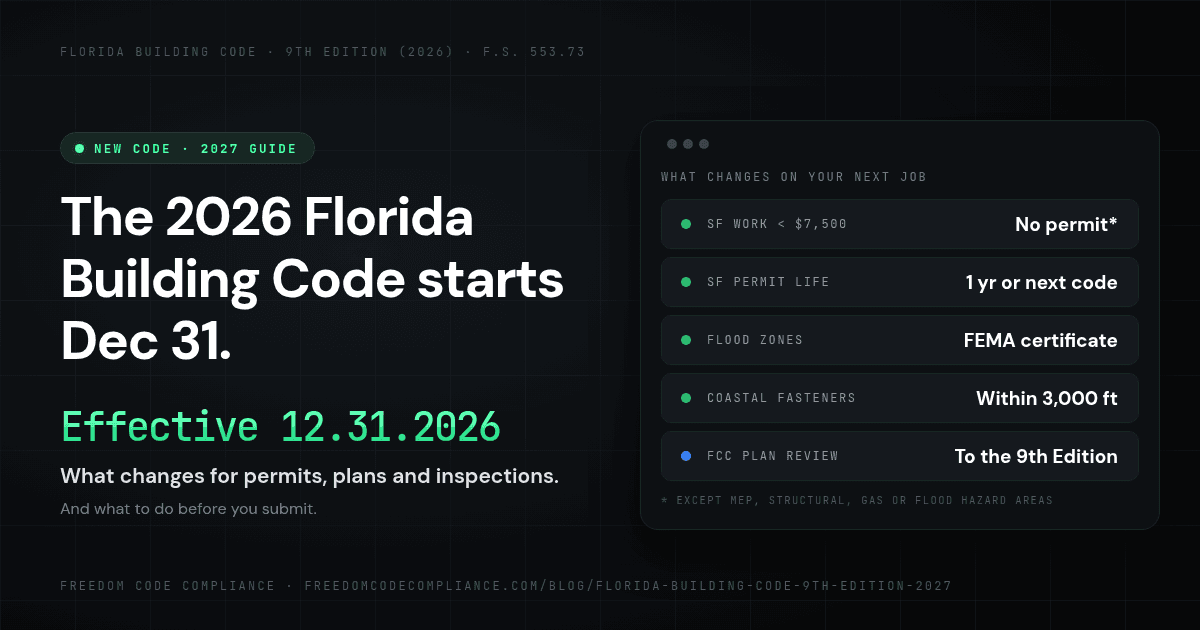
The rule for which edition you are under is simple. Under Florida Statute 553.73(7)(d), the code in effect on the date the building department receives your permit application governs the work for the life of the permit. Applications received on or after December 31, 2026 fall under the 9th Edition. Our guide to the December 31 cutoff covers what counts as filed.
Bonding and Lighting
- Single-wire bonding stays. NFPA 70 calls for a copper or steel grid to bond pool perimeter surfaces. The 9th Edition adds an exception that keeps the single-wire bonding Florida has allowed for 20 years (Residential 4501.16, Building 454.2.16).
- Low-voltage lighting. New sections limit underwater lighting, and lighting that may be exposed to nozzle-directed pool water, to 30 volts DC or 15 volts AC (Residential 4501.16.1, Building 454.2.16.1).
Piping and Pressure Tests
- Water velocity. All piping must be designed so water velocity does not exceed 8 feet per second. A new table shows the effect of pipe size on flow rate (4501.6.3).
- Pressure test. The option to use an air pressure test is deleted, and the water pressure test drops from 35 psi to 25 psi (4501.12.1).
- Deleted sections. The pump capacity and pump materials sections, the water retention and relief valve sections, and the inlet fittings section are removed.
Suction Outlets and Entrapment
- New term. "Suction outlet fitting assembly" replaces main drain and main suction outlet in the definitions.
- Location. The requirement that the device sit at or near the deepest point of the pool is deleted (4501.21.3).
- Standard. ANSI/APSP/ICC 16 is added as a reference standard for entrapment protection.
Definitions Worth Knowing
- Private swimming pool: clarified as permanently installed.
- Portable spa: no longer has to be cord-connected. It may be installed on or above grade and may not be installed with raised decking that allows access.
- New terms: underwater bench, underwater ledge, submerged vacuum fitting and surface skimming system.
Pools in Flood Hazard Areas
The requirement that equipment for pools, spas and water features be elevated to the extent practical is deleted. The equipment must be anchored to prevent flotation and to resist flood forces (Building 1612.4.2, with the matching change in Residential R322.1.6). See our post on flood zone changes for the rest.
Public Pools
Commercial and community pools under Section 454.1 pick up a longer list. The main items:
- Cold plunge. Portable, self-contained, factory-built cold-spa pools listed to UL 1563 are exempt from Section 454.1. Field-built cold-spa pools do not need hydrotherapy jets.
- Sun shelves. A sun shelf may end in water 5 feet deep or less, or in deeper water if it steps to a bench first. The shelf edge needs a dark, slip-resistant contrasting tile marking at least 2 inches wide, with a 2-inch contrasting line on the pool wall.
- Underwater lighting. A new table sets minimum light values for incandescent, LED and other light types, indoors and out.
- Spray features. Wading pool spray features need UV treatment, and disinfectant feed to spray features must be controlled by an interlock tied to the feature pump.
- Bonding. The same single-wire exception applies (454.1.10.4.2).
- Sanitary facilities. Restrooms no longer need a urinal, and diaper changing tables are not required where every pool served is adults only.
- Vanishing edges. Longer edge lengths are allowed on narrower pools, and a top-of-wall surface 18 inches or wider must be slip resistant.
Pool Plan Review and Inspections With FCC
A code change is when a set of pool details that passed last year draws comments. Freedom Code Compliance reviews pool plans to the edition your permit falls under, so a 9th Edition set gets checked against the new pipe sizing, lighting and suction outlet sections before you dig.
Inspections run by live video or from photos and video you submit in myFCC. Have the gauge in frame for the 25 psi water test and the bonding connections uncovered for the camera. Single-trade plan reviews come back in minutes, single-family in hours, and commercial and multifamily in one to two days. A licensed inspector joins a live video inspection in minutes. This week's measured figures are on our home page. See plan reviews and virtual inspections.
FCC does not pull permits, file permit applications, or file the Notice to Building Official. You or the owner files with the building department, and the department issues the permit. Check the coverage map to confirm FCC is registered with your department.
Sources
- Florida Building Commission, Analysis of Changes for the 9th Edition (2026), Building
- Florida Building Commission, Analysis of Changes for the 9th Edition (2026), Residential
- Florida Statute 553.73, Florida Building Code (subsection 7(d), which edition governs a permit)
- Florida Statute 553.791, Alternative plans review and inspection
Frequently Asked Questions
Does Florida still allow single-wire pool bonding in 2027?
Yes. The 9th Edition adds an exception to the copper or steel grid that NFPA 70 requires for bonding pool perimeter surfaces. The Florida Building Commission's analysis says the exception maintains the single-wire bonding permitted in the 8th Edition, which has been in place in Florida for 20 years.
What is the pool pressure test under the 2026 Florida Building Code?
A water pressure test at 25 psi. The 9th Edition deletes the option to test with air and lowers the water test pressure from 35 psi to 25 psi (Residential 4501.12.1, Building 454.2.12.1).
What voltage can underwater pool lights be?
No more than 30 volts DC or 15 volts AC. A new section applies the limit to underwater lighting and to lighting that may be exposed to nozzle-directed pool water (Residential 4501.16.1, Building 454.2.16.1).
Does the main drain still have to be at the deepest point of the pool?
The 9th Edition deletes that requirement. The device is now called a suction outlet fitting assembly, and ANSI/APSP/ICC 16 is added as a reference standard for entrapment protection.
Do the changes apply to a pool that is already permitted?
No. Under Florida Statute 553.73(7)(d), the edition in effect on the date of the permit application governs the work for the life of the permit. A pool applied for on or before December 30, 2026 stays under the 8th Edition (2023).
Can a private provider review and inspect my pool?
Yes. Under F.S. 553.791 a private provider may perform plan review and the required building code inspections. Freedom Code Compliance reviews pool plans to the edition your permit falls under and inspects by live video or from photos and video submitted in myFCC.