Florida East Coast Flooding: 24 Inches of Rain, and How Virtual Inspections Speed Up Roof Restoration
Key Takeaways
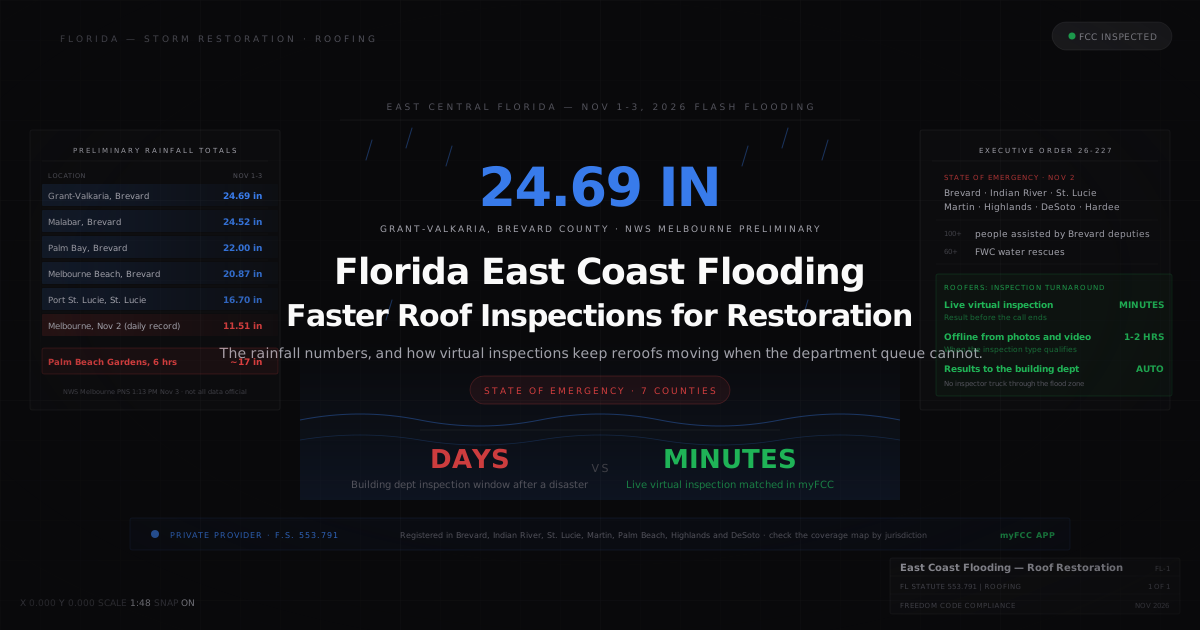
- NWS Melbourne's preliminary totals for November 1-3, 2026 reached 24.69 inches near Grant-Valkaria and 24.52 inches near Malabar in Brevard County, with 20 inches or more at several Palm Bay and Melbourne Beach sites.
- Melbourne recorded 11.51 inches on November 2, its wettest day since records began in 1937, and about 17 inches fell in six hours near Palm Beach Gardens on November 1.
- Executive Order 26-227 declared a state of emergency in Brevard, DeSoto, Hardee, Highlands, Indian River, Martin and St. Lucie counties.
- Roofing work after an event like this comes in three waves: emergency dry-in, repairs, then full reroofs. The last two need permits and inspections, and building department inspection queues become the bottleneck.
- FCC's virtual inspections through myFCC remove the inspection window: live inspections are matched in minutes, qualifying offline inspections are resulted in one to two hours, and results transmit to the building department automatically.
- FCC does not pull permits or file the NTBO. The contractor files with the building department and names FCC as the private provider; check the coverage map for the specific jurisdiction.
How can roofers get inspections faster after the November 2026 Florida east coast flooding?
Use a licensed private provider under Florida Statute 553.791 for the building code inspections on the permit. FCC performs them virtually through the myFCC app: live inspections are matched with a licensed inspector in minutes with a result before the call ends, and qualifying offline inspections are resulted from submitted photos and video in one to two hours. No inspection window, no inspector truck routing around flooded roads, and results transmit to the building department automatically.
Between Sunday, November 1 and midday Tuesday, November 3, 2026, parts of Florida's east coast took more rain in two days than they normally see in half a year. The National Weather Service office in Melbourne measured more than 24 inches near Grant-Valkaria and Malabar in southern Brevard County, with 20 inches or more at several sites around Palm Bay and Melbourne Beach. Governor DeSantis declared a state of emergency in seven counties. Roofers across the Space Coast, the Treasure Coast and Palm Beach County now have more leak calls, tarp calls and reroof jobs than they can staff.
The rebuild is going to run into the same wall it always does: inspections. Every reroof and most structural repairs need a permit and inspections, and the building departments in the flooded counties are about to be buried. This article lays out the rainfall numbers, what they mean for roofing demand, and how virtual inspections through a private provider keep restoration work moving when the building department queue cannot.
The Rainfall Numbers
These are preliminary totals from the NWS Melbourne Public Information Statement issued at 1:13 PM on November 3, covering midnight Sunday, November 1 through noon Tuesday, November 3. The Weather Service notes that not all of the data is considered official.
| Location | County | Rainfall |
|---|---|---|
| 1 N Grant-Valkaria | Brevard | 24.69 in |
| 2 E Malabar | Brevard | 24.52 in |
| 1 S Palm Bay | Brevard | 22.00 in |
| 1 S Melbourne Beach | Brevard | 20.87 in |
| 2 E Bayside Lakes | Brevard | 20.33 in |
| 3 W Palm Bay | Brevard | 19.68 in |
| 3 SE Melbourne Village | Brevard | 18.18 in |
| 2 W Port St. Lucie | St. Lucie | 16.70 in |
| 2 SE Indian Harbour Beach | Brevard | 16.62 in |
A few more data points put the event in context:
- Melbourne's wettest day on record. The Melbourne station recorded 11.51 inches on Monday, November 2, the most rain in a single day since records began in 1937, according to FOX Weather.
- A 1,000-year rain rate in Palm Beach County. Roughly 17 inches fell in six hours around Palm Beach Gardens on Sunday, November 1. Yale Climate Connections reports that is close to double the local six-hour 1,000-year threshold.
- Flash Flood Emergency. The Weather Service declared a Flash Flood Emergency for West Melbourne and Palm Bay on the morning of November 2, later extended to Grant-Valkaria, and described the damage threat as catastrophic.
- Close to the state record. Florida's single-day rainfall record is 23.28 inches at Key West in 1980, per ABC News. The Brevard totals above span about two and a half days, so they are not a direct comparison, but the scale is the same.
- Inland flooding too. Up to 12 inches fell near Avon Park and Sebring in Highlands County and in eastern Hardee and DeSoto counties, and the Peace River was forecast to crest near Arcadia on Thursday, November 5, according to WWSB.
The Emergency Response So Far
- Executive Order 26-227, signed November 2, declared a state of emergency in Brevard, DeSoto, Hardee, Highlands, Indian River, Martin and St. Lucie counties.
- Brevard County deputies assisted more than 100 people in rising water on November 2, and the Florida Fish and Wildlife Conservation Commission completed more than 60 rescues with airboats, shallow-water boats and a helicopter, per The Watchers.
- Brevard Public Schools, Eastern Florida State College and all Brevard County government buildings closed on November 2. Palm Bay issued a shelter-in-place advisory and Melbourne a precautionary boil-water notice.
- Palm Bay Fire Rescue deployed all three of its high-water rescue trucks.
Every one of those closures includes a building department. Permit counters, plan review desks and inspection scheduling in the hardest-hit jurisdictions lost days, and they lost them right before the busiest stretch they will see all year.
What This Means for Roofers
Two days of rain at this intensity finds every weak point on a roof. Expect the work to come in three waves:
- Emergency dry-in and tarping in the first week, mostly on roofs that were already near end of life.
- Repairs and partial replacements over the next month as insurance adjusters work through claims and interior water damage gets traced back to the roof.
- Full reroofs through the winter, including roofs that leaked for the first time and roofs where the deck got wet enough to need replacement.
Waves two and three need permits and inspections. In Florida that usually means an in-progress inspection at dry-in or underlayment, plus a final, and sometimes more depending on the jurisdiction and the roof system. Each one of those inspections is a day you cannot close the job, bill the balance or move the crew.
After a regional event, the building department inspection queue is the bottleneck. Inspectors have the same number of trucks they had the week before, roads in the flooded zones are still closed in places, and every contractor in the county is calling in the same inspections at the same time. A multi-day inspection window becomes a week. A failed inspection for a missing document becomes two.
How Virtual Inspections Speed Up Restoration
Florida Statute 553.791 lets a licensed private provider perform the building code inspections on your permit in place of the building department. FCC performs those inspections virtually through the myFCC app, which changes the math for a roofer with twenty open jobs across three counties.
No inspection window
For a live inspection, your crew requests it in the myFCC app when the roof is ready. A licensed FCC inspector is matched in minutes and walks the inspection over a video call with the person on the roof. The result is issued before the call ends. There is no next-available-day, no four-hour arrival window, and no crew standing around waiting.
Offline inspections from the photos you already take
For inspections that qualify, your crew submits photos and video through myFCC and keeps working. A licensed inspector reviews the media and results the inspection in one to two hours. GPS-tagged and timestamped media you uploaded earlier counts, which matters when a dry-in got covered on a Friday and you need the record on Monday. The myFCC system determines which inspection method applies; some inspection types and project types require a live inspection.
The inspector does not have to drive through the flood zone
This is the quiet advantage this week. Building department inspectors are routing around closed roads and standing water in southern Brevard and the Treasure Coast. A virtual inspection does not depend on an inspector's truck reaching the site, so a job in a neighborhood that is still half underwater can be inspected the day the roof is ready.
Results reach the building department without you chasing them
After each passed inspection, FCC transmits the result to the building department, and FCC files the Certificate of Compliance once all required FCC inspections are complete. Your office is not calling the permit counter to confirm a result got logged, which is exactly the phone call that goes unanswered after a disaster.
Where FCC Can Take These Jobs
FCC is registered as a private provider in all of the coastal counties under the emergency order, including Brevard, Indian River, St. Lucie and Martin, as well as Palm Beach County and the inland counties of Highlands and DeSoto. Registration is by building department, and many cities in those counties run their own, so check the coverage map for the specific jurisdiction before you count on it.
What FCC Does Not Do
- FCC does not pull permits or file permit applications. You or your permit expediter file with the building department, including any emergency repair permit the jurisdiction offers. FCC returns the private provider paperwork that goes with the application.
- FCC does not file the Notice to Building Official. That stays with the permit holder.
- FCC does not handle jurisdiction-retained inspections. Zoning, fire, public works and similar scopes stay with the building department.
- Licensed inspectors make every call. A virtual inspection is a licensed inspector's determination, delivered by video or from submitted media, and it carries the same weight as a site visit.
Get Set Up Before the Reroofs Start
- Apply for a myFCC account now, while the work is still tarps and dry-ins, so it is ready when the first permitted reroof is.
- Photograph everything. Underlayment, flashing, nailing patterns, deck repairs. Timestamped, GPS-tagged photos uploaded to myFCC are what make offline inspections possible.
- Name FCC as the private provider on the permit application. The contractor files; FCC supplies the affidavit and paperwork for the packet.
- Request inspections from the roof. The person who requests the live inspection should be the person with the phone on the job site.
The water is going to drain over the next week. The inspection backlog at the building departments is going to last the rest of the year. If you want your reroofs inspected the day they are ready, apply now or read more about virtual inspections and FCC's work with roofing contractors.
Frequently Asked Questions
How much rain fell in Brevard County in the November 2026 flooding?
Preliminary National Weather Service Melbourne totals for midnight November 1 through noon November 3, 2026 show 24.69 inches near Grant-Valkaria, 24.52 inches near Malabar, 22.00 inches near Palm Bay and 20.87 inches near Melbourne Beach. The Melbourne station recorded 11.51 inches on November 2 alone, its wettest day since records began in 1937. The Weather Service notes that not all of the data is considered official.
Which Florida counties are under the state of emergency?
Executive Order 26-227, signed November 2, 2026, declared a state of emergency in Brevard, DeSoto, Hardee, Highlands, Indian River, Martin and St. Lucie counties.
Do I still need a permit and inspections for storm-damage roof repairs?
In almost all cases, yes. Emergency dry-in and tarping is typically allowed before a permit is issued, but repairs beyond that and any reroof need a permit and the inspections that go with it. Some jurisdictions offer an expedited emergency repair permit after a declared disaster; check with the building department. FCC does not pull permits or file permit applications.
How does a virtual inspection work for a roof?
Your crew requests a live inspection in the myFCC app when the roof is ready. A licensed FCC inspector is matched in minutes and conducts the inspection over a video call with the person on the roof, with a result before the call ends. For inspections that qualify, you can instead submit GPS-tagged, timestamped photos and video through myFCC and a licensed inspector results it in one to two hours. The myFCC system determines which method applies.
Can a private provider inspect roofs in the flooded counties?
FCC is registered in Brevard, Indian River, St. Lucie, Martin, Palm Beach, Highlands and DeSoto counties. Registration is by building department and many cities run their own, so confirm the specific jurisdiction on the FCC coverage map before relying on it.
Does FCC handle the permit paperwork after a storm?
No. FCC does not pull permits, file permit applications or file the Notice to Building Official. The contractor or a permit expediter files with the building department and names FCC as the private provider. FCC supplies the private provider affidavit and paperwork, performs the inspections, transmits results to the building department and files the Certificate of Compliance when all required FCC inspections are complete.