Florida Pool Permits and Inspections: Structural Plans, Barriers, Bonding and the Sequence That Closes the Permit
Key Takeaways
- Florida Building Code 105.2 has no pool exemption. New pools, structural shell repairs, and renovations that touch piping, wiring or the barrier need a permit under 105.1.
- Chapter 45 of the Residential code requires private pools to conform to ANSI/APSP/ICC 3 through 6 and ANSI/PHTA/ICC 7. A sealed structural design for a private pool is a department requirement, not Chapter 45 text.
- Public pool documents must be prepared by a Florida-registered engineer (Building 105.3.1.2), and the permit needs proof of a Department of Health operating permit application (F.S. 553.79(13)).
- F.S. 515.27(1) gives five ways to pass final: a 515.29 barrier, an approved safety cover, exit alarms, self-closing self-latching doors, or an ASTM F2208 pool alarm.
- Barriers are at least 48 inches high, at most 2 inches off grade, and have no opening that passes a 4-inch sphere (R4501.17.1.1 and R4501.17.1.2).
- Pool piping is pressure tested at not less than 35 psi for 15 minutes (R4501.12.1), and the electrical and barrier finals come before the pool is filled (R4501.19).
- Freedom Code Compliance reviews single-family pool plans in 24 hours on average and inspects steel, bonding, plumbing, electrical and barrier stages by video, then files the Certificate of Compliance.
What permits and inspections does a pool need in Florida?
Every new pool in Florida needs a building permit under F.S. 553.79 and Florida Building Code 105.1, with plans that conform to Chapter 45 of the Residential code. Most departments want inspections of the pre-shell steel and bonding, the 35 psi plumbing pressure test, deck steel and perimeter bonding, the electrical and barrier finals before the pool is filled, and a final. To pass final, the pool must have one of the five safety features in F.S. 515.27.
Every new pool in Florida needs a building permit before you dig, and most departments want five to six inspections before the permit closes: steel and bonding before the shell, the plumbing pressure test, deck steel and perimeter bonding, the electrical final and barrier final before the pool is filled, and a final with the safety feature in place. Private pools follow Chapter 45 of the Florida Building Code, Residential, which matches Section 454.2 of the Building code. The barrier rules come from state law, Chapter 515 of the Florida Statutes. Here is what each stage checks, with section numbers from the 8th Edition (2023) code that governs permits applied for today.
When a Pool Needs a Permit
Florida Statute 553.79(1)(a) makes it unlawful to construct, alter, repair or demolish a building without first obtaining a permit. Florida Building Code, Building 105.1 extends that to any regulated electrical, gas, mechanical or plumbing system.
Florida's list of work exempt from permit, Section 105.2, has no pool item. It covers portable appliances, minor parts and leak repairs. For common pool jobs:
- New pool or spa: permit, plans and the full inspection sequence.
- Pool renovation: a permit when the work changes the shell, the circulation piping, the electrical or the barrier. Ordinary minor repairs fall under 105.2.2 only with the building official's approval and never when they touch piping, wiring or equipment.
- Equipment replacement: a new pump circuit, heater or panel feed is electrical, plumbing or gas work under 105.1. Expect a permit and an electrical inspection.
- Cracked pool shell: a structural repair of the shell is a repair under 553.79 and 105.1. Departments generally want an engineer's repair detail with the application, and the repair steel is inspected before the new concrete goes in.
Pool Structural Plans in Florida
For a private residential pool, Chapter 45 does not itself say "signed and sealed." Section R4501.6.1 requires design, construction and workmanship to conform to ANSI/APSP/ICC 3, 4, 5, 6 and 7. In practice, departments ask for an engineered shell and steel design, usually a pool engineer's master plan sealed for the site's soil and wind conditions. Treat the seal as a department requirement rather than code text, and expect it.
Public pools are different. Building 105.3.1.2 says no permit may be issued for "all public swimming pools and public bathing places defined by and regulated under Chapter 514" unless the documents are prepared by or under the direction of a Florida-registered engineer. Under Florida Statute 553.79(13), the permit for a public pool also cannot issue without proof of application for a Department of Health operating permit. Section 454.1 governs public pool design and points to Department of Health Rule 64E-9.
Pool Barriers: The Safety Act and Chapter 45
The Residential Swimming Pool Safety Act sets the rule for final. Under F.S. 515.27(1), "in order to pass final inspection and receive a certificate of completion, a residential swimming pool must meet at least one of the following requirements." The statute lists five options:
- (a) "The pool must be isolated from access to a home by an enclosure that meets the pool barrier requirements of s. 515.29"
- (b) "The pool must be equipped with an approved safety pool cover"
- (c) "All doors and windows providing direct access from the home to the pool must be equipped with an exit alarm that has a minimum sound pressure rating of 85 dB A at 10 feet"
- (d) "All doors providing direct access from the home to the pool must be equipped with a self-closing, self-latching device with a release mechanism placed no lower than 54 inches above the floor"
- (e) A swimming pool alarm that sounds on entry into the water, independently certified to ASTM F2208.
Section 515.29 sets the barrier: at least 4 feet high on the outside, nothing a young child could crawl under, squeeze through or climb over, and gates that open outward, self-close and self-latch from the pool side. Chapter 45 adds the numbers:
- 48 inches minimum height and no more than 2 inches between grade and the bottom of the barrier (R4501.17.1.1).
- No opening that passes a 4-inch sphere (R4501.17.1.2).
- Vertical spacing of 1 3/4 inches when horizontal members are less than 45 inches apart, 4 inches when they are 45 inches or more (R4501.17.1.4 and .5).
- No opening over 1/2 inch within 18 inches of the gate release (R4501.17.1.8).
- Removable child barriers at least 20 inches from the water's edge (R4501.17.1.13).
A standard screen enclosure can serve as all or part of the barrier (R4501.17.1.11). The enclosure itself is a separate aluminum permit. See our aluminum and screen enclosure page.
Under 515.27(2), failing to equip a new residential pool with a safety feature is a second-degree misdemeanor. Section 515.33 requires the pool contractor to give the buyer the chapter's requirements and the state drowning prevention publication at contract.
Bonding, Grounding and Swimming Pool Electrical Inspections
R4501.16 requires electrical work, "including the bonding and grounding of pool components," to comply with Chapter 27 of the Building code. Building 2701.1 adopts NFPA 70, and the referenced standards list it as the 2020 edition. Article 680 of that edition is where the pool rules live: equipotential bonding of the shell steel, perimeter surfaces, metal fittings, the pump motor and the water itself, plus GFCI protection.
R4501.16 also requires GFCI protection for outlets supplying pool pump motors on single-phase 120 to 240 volt branch circuits, and for 15 and 20 amp outlets supplying underwater luminaires above the low voltage contact limit.
Suction Entrapment and the Pressure Test
- Entrapment protection: suction outlets follow ANSI/PHTA/ICC 7 (R4501.6.6, Building 454.2.6.6). Suction piping is limited to 8 feet per second and pressure piping to 10 (R4501.6.3).
- Public pools: F.S. 514.0315 requires an anti-entrapment system or device meeting ASME/ANSI A112.19.8. Federal law adds its own drain cover rules for public pools under the Virginia Graeme Baker Pool and Spa Safety Act.
- Pressure test: under R4501.12.1, all pool piping is "tested and proved tight" under a static water or air test of not less than 35 psi for 15 minutes. Drain and waste piping is filled to overflow (R4501.12.2).
The Pool Construction Inspections That Close the Permit
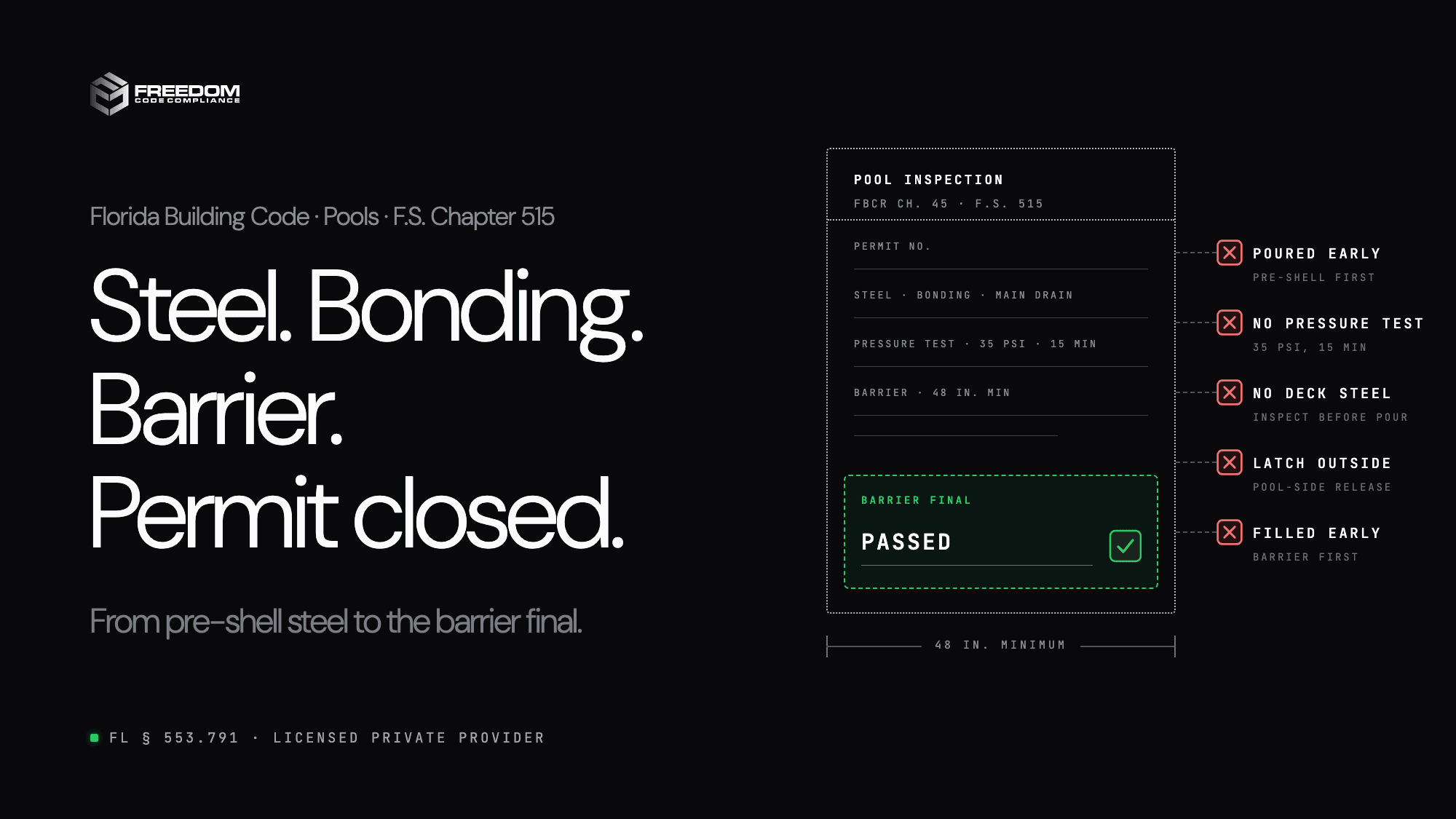
Building 110.3 requires a first inspection "after excavation and installation of reinforcing steel, bonding and main drain and prior to placing of concrete," and a final with the enclosure in place. R4501.19 puts the electrical and barrier finals before the pool is filled, except vinyl liner and fiberglass pools. Most departments split it like this:
- Layout and steel (pre-shell): steel, main drain and shell bonding before shotcrete or gunite.
- Plumbing pressure test: underground circulation piping held at 35 psi for 15 minutes before backfill.
- Deck steel and perimeter bonding: before the deck pour.
- Electrical final: equipment, bonding connections and GFCI protection.
- Barrier and final: the 515.27 safety feature in place, then the permit closes.
Applying after December 30, 2026? Our 2026 pool code changes guide covers what changes under the 9th Edition. Under F.S. 553.73(7), the edition in effect on the date of application governs the permit for its life.
What the Department Keeps
The building department still issues the permit and keeps zoning, drainage, right-of-way and utility approvals. The plan review and the building, electrical and plumbing inspections above can go to a private provider under Florida Statute 553.791.
How FCC Handles the Pool Permit
Freedom Code Compliance reviews the engineered pool set, the electrical and bonding plan, and the barrier against the Florida Building Code. Single-family plan reviews average 24 hours, and multifamily and commercial average 2 days. You submit the permit application with our stamped plans and private-provider paperwork.
Request each inspection in the myFCC app, from steel and bonding to the barrier final. A live virtual inspection matches you with a licensed inspector in minutes, with the result before the call ends. Eligible offline inspections use GPS-tagged, timestamped photos and video and typically return results in minutes. Some inspections must be live, and myFCC tells you which. Results go to the department automatically. When the inspections pass, FCC files the Certificate of Compliance under F.S. 553.791.
See how it works for pool builders, read about our plan reviews and virtual inspections, and check the coverage map. Ready to start? Apply now.
Frequently Asked Questions
Do you need a permit for a pool in Florida?
Yes. Florida Statute 553.79(1)(a) and Florida Building Code 105.1 require a permit before constructing, altering or repairing a building or its electrical, plumbing, mechanical or gas systems. The Florida list of work exempt from permit in 105.2 has no item for pools, spas or hot tubs.
Does a pool renovation need a permit in Florida?
When it changes the shell, the circulation piping, the electrical or the barrier, yes. Florida Building Code 105.2.2 allows ordinary minor repairs without a permit only with the building official's approval, and never for work on piping, wiring or equipment. A new pump circuit, heater or structural shell repair is permitted work.
Do pool structural plans need to be signed and sealed in Florida?
For public pools, yes. Florida Building Code 105.3.1.2 requires documents for public swimming pools regulated under Chapter 514 to be prepared by or under the direction of a Florida-registered engineer. For private residential pools, Chapter 45 requires conformance to the ANSI/APSP/ICC pool standards but does not itself require a seal. Departments generally ask for an engineered shell and steel design anyway.
What are the pool barrier requirements in Florida?
F.S. 515.29 requires a barrier at least 4 feet high on the outside, with no gaps a young child could get through or over, and gates that open outward, self-close and self-latch from the pool side. The Residential code adds a 2-inch maximum gap at grade, no opening that passes a 4-inch sphere, and no opening over 1/2 inch within 18 inches of the gate latch release.
Which pool construction inspections are required in Florida?
Florida Building Code 110.3 requires a first inspection after excavation, steel, bonding and main drain and before concrete, and a final with the enclosure in place. R4501.19 requires the electrical and barrier finals before the pool is filled. Most departments also want a plumbing pressure test and a deck steel and bonding inspection.
What is the pressure test for pool plumbing in Florida?
Under the 8th Edition (2023) code, Residential R4501.12.1 requires all pool piping to be proved tight under a static water or air pressure test of not less than 35 psi for 15 minutes. Circulating pumps are exempt from the test. Permits applied for from December 31, 2026 follow the 9th Edition, which changes this test.
Can FCC do swimming pool electrical inspections virtually?
Yes. Freedom Code Compliance inspects building, electrical and plumbing scopes as a private provider, including pool steel, bonding, pressure tests, electrical finals and barrier finals. You request a live video inspection in the myFCC app and get a result before the call ends, or submit GPS-tagged photos and video for an eligible offline inspection, typically resulted in minutes.