How to Change a Flood Zone in Florida: LOMA, LOMR-F and What It Means for Your Permit
Key Takeaways
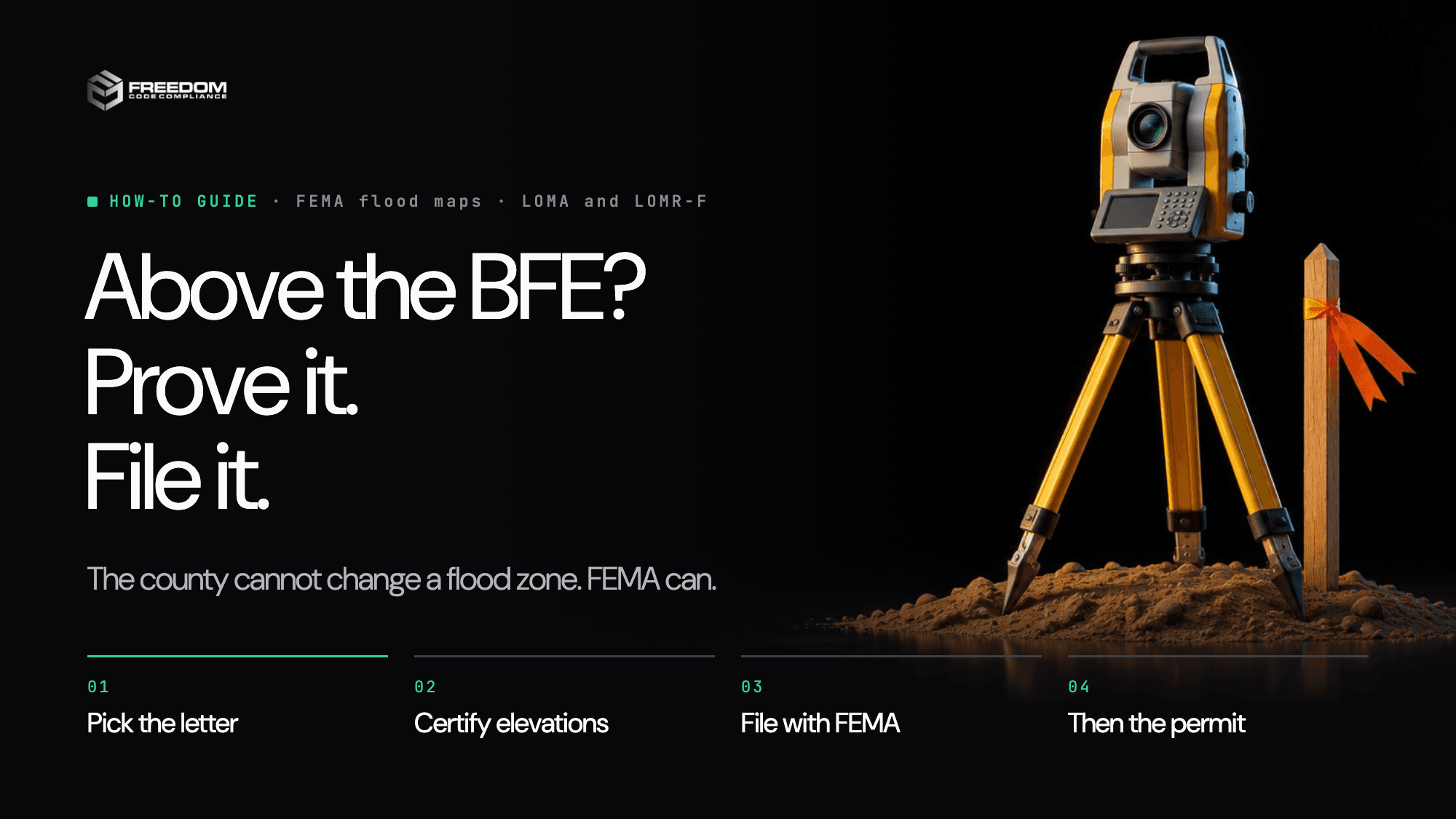
- The building department cannot change a flood zone. FEMA amends the map for one property through a LOMA (natural ground) or a LOMR-F (fill), based on certified elevation data.
- The test is simple: the lowest adjacent grade of the structure, or the lowest point of the lot, must be at or above the Base Flood Elevation. Foundations partly below the BFE do not qualify.
- A Licensed Land Surveyor or Registered Professional Engineer must certify the elevations, or an existing NFIP Elevation Certificate (FEMA Form FF-206-FY-22-152) can stand in.
- A LOMA has no FEMA fee. A single-lot LOMR-F is $425 online or $525 by mail. FEMA must respond within 60 days of receiving all required data under 44 CFR 70.4.
- File the LOMA before the permit application. A letter issued before filing removes the Florida Building Code flood provisions and the 50 percent rule from the job; one issued after does not undo a permit already issued under them.
How do you change a flood zone in Florida?
You change a flood zone by asking FEMA, not the county. A Letter of Map Amendment (LOMA) removes a structure or lot that sits on natural ground at or above the Base Flood Elevation; a Letter of Map Revision Based on Fill (LOMR-F) does the same for a site raised with fill. A licensed surveyor or engineer certifies the lowest adjacent grade or lowest lot elevation, the owner files the MT-EZ or MT-1 form or the Online LOMC, and FEMA must answer within 60 days of a complete package. A LOMA is free; a single-lot LOMR-F is $425 online.
You cannot change a flood zone by asking the county. You change it by proving to FEMA that the ground or the building sits at or above the Base Flood Elevation, with a licensed surveyor's numbers, through a Letter of Map Amendment (LOMA) or, if fill raised the site, a Letter of Map Revision Based on Fill (LOMR-F). A LOMA is free, a single-lot LOMR-F costs $425 online, and FEMA answers within 60 days of a complete package. Here is how the process works, who signs what, and what it changes and does not change for your permit.
Who Sets the Flood Zone
The flood zone on a Florida property comes from the FEMA Flood Insurance Rate Map (FIRM) for that community. The building department does not draw it and cannot move it. The local floodplain administrator applies it: when a permit application lands in a Special Flood Hazard Area (Zone A, AE, AH, AO, VE and the rest), the flood provisions of the Florida Building Code and the community's floodplain ordinance attach to the permit, and the lender attaches the flood insurance requirement to the loan.
FEMA maps are drawn at a scale that cannot see every lot. A house on a natural rise inside a mapped A zone can be above the Base Flood Elevation (BFE) and still carry the zone. The fix is a Letter of Map Change (LOMC), FEMA's term for the family of letters that amend or revise a FIRM for one property or a whole area.
Which Letter You Need
| Letter | When it applies | Form | FEMA fee |
|---|---|---|---|
| LOMA (Letter of Map Amendment) | The structure or lot is on natural high ground, not raised by fill, and sits at or above the BFE | MT-EZ (single residential lot or structure), MT-1 (multiple lots), or eLOMA through a surveyor or engineer | None |
| LOMR-F (Letter of Map Revision Based on Fill) | Earthen fill was placed to raise the structure or lot to or above the BFE | MT-1 or Online LOMC | $425 online, $525 paper, for a single lot or structure |
| CLOMA / CLOMR-F (Conditional) | Before construction, to learn whether a proposed building or fill would qualify | MT-1 | $500 online, $600 paper, single lot |
| LOMR (Letter of Map Revision) | Physical changes to the flooding source: a channel, culvert, bridge, levee or new hydrology, usually for a subdivision or development | MT-2, requested by the community | $8,000 and up |
Fees come from FEMA's flood map-related fee schedule, effective for requests postmarked on or after February 20, 2015 and still current. For most residential work in Florida the answer is a LOMA or a LOMR-F.
The Test FEMA Applies
FEMA compares one number to the BFE:
- For a structure: the Lowest Adjacent Grade (LAG), which FEMA defines as the elevation of the lowest ground touching the structure, including attached patios, stairs, deck supports and garages, to the nearest 0.1 foot. The LAG must be at or above the BFE.
- For a lot or part of a lot: the lowest lot elevation, to the nearest 0.1 foot, must be at or above the BFE.
- Zone AO (sheet flow): the LAG must sit above surrounding grade by at least the depth printed on the map, with drainage paths around the structure, and a certified topographic map goes in with the package.
- Elevated buildings: if the lowest floor is on posts, piers or pilings above the BFE but any part of the foundation is still below it, FEMA will not remove the building.
- Zone A with no published BFE: you have to develop one first. FEMA's guide for approximate Zone A areas covers the accepted methods.
Fill matters because it decides which letter you file. FEMA defines fill as material from any source placed to raise the ground to or above the BFE. Fill placed before the date of the first NFIP map that showed the area in a flood hazard area counts as natural grade. Fill placed after that date means a LOMR-F, and the community has to find the filled land reasonably safe from flooding.
Who Has to Sign
The elevation data is the whole case, and FEMA will not take it from the owner or the contractor. Section B of the MT-EZ must be completed by a Licensed Land Surveyor or Registered Professional Engineer. If an NFIP Elevation Certificate has already been completed for the structure, the certificate can be submitted in place of Section B. The current Elevation Certificate is FEMA Form FF-206-FY-22-152, formerly 086-0-33.
The owner, or a surveyor, engineer or other designated agent, signs Section A and attaches the recorded deed or plat with the legal description. For a portion of a parcel, the metes and bounds description and map have to be certified by the surveyor or engineer as well.
Before the surveyor fills in Section B, they pull the effective FIRM panel and Flood Insurance Study for the property from the FEMA Map Service Center so the BFE and the panel number are the ones FEMA is checking against.
How Long It Takes
Under Section 70.4 of the NFIP regulations, FEMA must notify the requester of its determination in writing within 60 days of receiving all required data. Incomplete packages reset that clock, which is where most delays come from. Status is searchable by case number on FEMA's map change status page. For a single lot or structure that clearly qualifies, eLOMA lets a licensed surveyor or engineer submit the request online and, in FEMA's words, generate a determination within minutes.
A LOMA or LOMR-F takes effect on the date FEMA issues it. A LOMR, because it revises the map for everyone, carries a comment period and takes effect 30 to 90 days after issue.
What the Letter Changes, and What It Does Not
- Insurance: a LOMA or LOMR-F removes the federal mandatory purchase requirement that comes with a federally backed mortgage. The owner sends the letter to the lender and asks for the requirement to be dropped. The lender keeps the right to require coverage anyway. If the lender waives it, the owner can claim a pro-rata refund of the current year's premium, provided no claim is pending or paid that year. FEMA notes that about 25 percent of flood claims come from outside the mapped high-risk area, so dropping the policy is a decision, not an automatic win.
- The permit: a LOMA issued before the permit application removes the structure or lot from the SFHA, so the flood-resistant construction provisions in Florida Building Code Building 1612 and Residential R322 no longer apply to it. A LOMA issued after the permit was applied for does not undo the flood requirements the permit was issued under. Sequence it before you file.
- The 50 percent rule: substantial damage and substantial improvement determinations under the community's floodplain ordinance apply to buildings in the SFHA. A LOMA that takes the building out of the SFHA takes it out of that rule too, as long as it is in hand before the work.
- The map itself: a LOMA amends the map for that property only. The printed FIRM panel still shows the zone. The letter is the proof, so it travels with the property file and goes to every future buyer and lender.
Florida Specifics
The Florida Division of Emergency Management's Office of Floodplain Management is the state coordinating agency for the National Flood Insurance Program and runs the Floodplain Managers' Helpdesk at (850) 815-4556 and [email protected]. Florida put its flood provisions inside the Florida Building Code rather than leaving them to local ordinance alone, so Building 1612 and Residential R322 are the sections a plan reviewer checks for any structure in the SFHA, with the community's ordinance layered on top. The 9th Edition changes what goes on the plans and when Elevation Certificates are due; our post on 2026 flood zone changes walks through it.
One more Florida wrinkle: FEMA's MT-EZ instructions note that not every state lets architects certify elevation data. In Florida the safe certifiers are a licensed surveyor and mapper or a professional engineer.
What This Means on a Job
Three situations come up again and again:
- Custom home on a rise inside an A zone. Get the surveyor to shoot the LAG early. If it clears the BFE, file the LOMA before the permit application. The plans then go in without the flood-resistant construction sections, and the owner's construction loan does not carry a flood policy requirement.
- Lot built up with fill. Plan on a LOMR-F, which means the community sign-off and the fee. Do not pour the slab assuming the letter will come. A CLOMR-F before construction tells you whether it will.
- Flood repair after a storm. If the house is in the SFHA, the 50 percent rule is in play and a LOMA cannot be filed on a damaged building fast enough to matter. Price the work on the assumption the floodplain administrator's determination stands. Our Brevard flooding post covers what that looks like right now.
Freedom Code Compliance does not prepare LOMAs or certify elevations; that is surveyor and engineer work. What we do, as a private provider authorized under Florida Statute 553.791, is review the plans and perform the inspections on the permit once the zone question is settled. In the SFHA that means checking the flood design on the drawings and verifying the elevations at the stages the code requires. Outside it, the job moves like any other: single-family plan review averages 24 hours, and live virtual inspections through the myFCC app are resulted before the call ends. Either way the building department still issues the permit and we keep it moving. Apply here to get set up.
Sources
- FEMA, Change Your Flood Zone Designation
- FEMA, MT-EZ Form Instructions (LOMA for a single residential lot or structure)
- FEMA, LOMA and LOMR-F tutorial
- FEMA, Flood Map-Related Fees
- FEMA, Paper Application Forms (MT-EZ, MT-1, MT-2)
- FEMA glossary, Elevation Certificate (Form FF-206-FY-22-152)
- FEMA glossary, Letter of Map Revision
- 44 CFR Part 70, Procedure for Map Correction (Section 70.4)
- Florida Division of Emergency Management, Office of Floodplain Management
- Florida Building Code, Building, 8th Edition (2023), Section 1612 Flood Loads
- Florida Statute 553.791, Alternative plans review and inspection
Frequently Asked Questions
How do I change my flood zone in Florida?
Apply to FEMA for a Letter of Map Amendment (LOMA) if the structure or lot sits on natural ground at or above the Base Flood Elevation, or a Letter of Map Revision Based on Fill (LOMR-F) if fill raised it. A licensed surveyor or engineer certifies the elevations, you file FEMA form MT-EZ or MT-1 or use the Online LOMC, and FEMA answers within 60 days of a complete package.
Can the building department change my flood zone?
No. The flood zone comes from the FEMA Flood Insurance Rate Map. The local floodplain administrator applies it to permits but cannot amend it. Only FEMA can, through a Letter of Map Change.
How much does it cost to change a flood zone?
FEMA charges nothing for a LOMA. A single-lot LOMR-F is $425 through the Online LOMC or $525 by mail. A conditional CLOMA or CLOMR-F is $500 online or $600 by mail. The surveyor's elevation work is a separate cost.
How long does a LOMA take?
Under 44 CFR 70.4, FEMA must notify the requester of its determination in writing within 60 days of receiving all required data. A simple single-lot request submitted by a surveyor or engineer through eLOMA can return a determination within minutes.
Does a LOMA remove the flood insurance requirement?
It removes the federal mandatory purchase requirement tied to a federally backed mortgage once the owner sends the letter to the lender. The lender may still require coverage. If the lender waives it, the owner can claim a pro-rata refund of the current year's premium if no claim is pending or paid that year.
What is the lowest adjacent grade?
FEMA defines it as the elevation of the lowest ground touching the structure, including attached patios, stairs, deck supports and garages, measured to the nearest 0.1 foot. For a LOMA on a structure, the lowest adjacent grade must be at or above the Base Flood Elevation.
Does a LOMA change the Florida Building Code flood requirements on my permit?
If the LOMA is issued before the permit application, the structure is no longer in the Special Flood Hazard Area and the flood-resistant construction provisions in Florida Building Code Building 1612 and Residential R322, and the community's 50 percent rule, do not apply to it. A LOMA issued after the permit was applied for does not change the requirements that permit was issued under.