Brevard County Is Underwater Again: Record Flooding and the Permit Backlog That Follows
Key Takeaways
- The St. Johns River at Cocoa reached 18.0 feet on November 19, 2026, above flood stage of 16 feet and the previous record of about 17.6 feet set in 1953. Cape Canaveral measured 12.35 inches of rain in 72 hours.
- This is Brevard's second major flood in 17 days. The November 1 and 2 event dropped 23.69 inches at Grant-Valkaria and was rated a 1-in-1,000-year rainfall by the National Weather Service.
- Flood repairs need permits under F.S. 553.79(1). Submerged electrical and HVAC equipment is replaced under permit, and buildings in a flood zone face the NFIP 50 percent substantial damage rule, decided by the local floodplain administrator.
- Applications received on or after December 31, 2026 fall under the 9th Edition Florida Building Code. Flood work that slips past New Year's changes code books.
- F.S. 553.791 authorizes a licensed private provider to perform plan review and inspections on the permit. The building department still issues the permit; the job just does not wait in its queue.
What does the November 2026 Brevard County flooding mean for contractors' permits and inspections?
On November 19, 2026 the St. Johns River at Cocoa passed its 1953 record and Cape Canaveral logged more than 12 inches of rain in 72 hours, the second major Brevard flood in 17 days. Flood repairs still need permits under F.S. 553.79, substantially damaged buildings in flood zones face the 50 percent rule, and building departments that were closed November 19 will see every repair permit arrive at once. Under F.S. 553.791 a licensed private provider can perform the plan review and inspections on those permits so jobs do not wait in the department's queue.
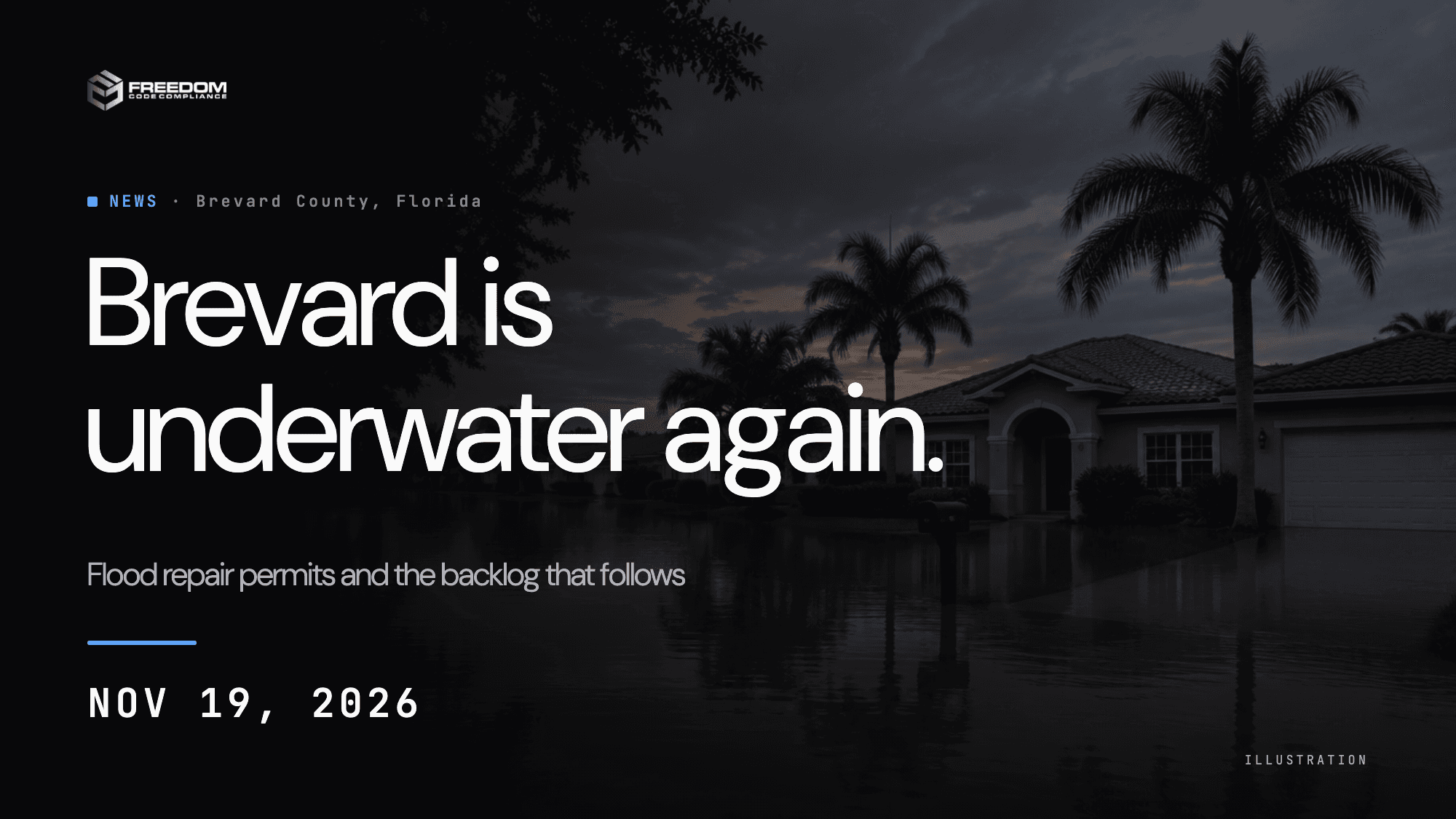
Brevard County is underwater again. On November 19, 2026, the St. Johns River at Cocoa rose past the record it set in 1953, Cape Canaveral measured more than 12 inches of rain in three days, and county crews ran more than 100 high-water rescues in a single day. It is the second major flood to hit the Space Coast this month. For contractors, what comes next is as predictable as the water: a wall of repair permits lands on building departments that are still digging out from November 2. Here is what happened, what Florida code requires on flood repairs, and how to keep your jobs out of that line.
If you are in it right now, stay safe and stay off flooded roads. The permits can wait a day. You cannot be replaced.
What Happened on the Space Coast
Two floods, 17 days apart.
November 1 and 2. A stalled system dropped 23.69 inches at Grant-Valkaria and 23.44 inches at Malabar in about 36 hours, with roughly 19.75 inches in Palm Bay. The National Weather Service in Melbourne called it a 1-in-1,000-year rainfall event. Two people died in Palm Bay. Governor DeSantis declared a state of emergency on November 2 and asked the White House for an expedited major disaster declaration on November 9. As of November 19 that declaration had not been issued. We covered the first flood and what it meant for roofers in Florida East Coast Flooding: 24 Inches of Rain and Faster Roof Inspections.
November 18 and 19. Before the first flood drained, the rain came back. The National Weather Service 72-hour report posted the evening of November 19 showed the heaviest totals on the barrier islands and the north county:
| Location | 72-hour rainfall |
|---|---|
| Cape Canaveral Space Force Station | 12.35 in |
| Cocoa Beach | 11.49 in |
| Patrick Space Force Base | 10.62 in |
| Port Canaveral | 9.81 in |
| Melbourne | 8.38 in |
| Titusville | 8.30 in |
The St. Johns River at Cocoa reached 18.0 feet at 5:15 a.m. on November 19, two feet above flood stage and above the previous record of about 17.6 feet from 1953. Homes along the river in west Cocoa and Rockledge start taking water at 17.2 feet. Palm Bay ordered mandatory evacuations at Palm Bay Estates mobile home park and moved residents out by boat. The Port Malabar Boulevard bridge, reopened with a ribbon cutting on November 16 after the first flood, partly collapsed again. County offices closed to the public on November 19. Brevard Public Schools are closed until November 30. On November 18 the Governor expanded the state of emergency to 21 counties, Brevard included.
Friday morning's forecast still called for 5 to 10 more inches possible through early Saturday. The numbers above will move.
The Backlog Starts the Day the Water Drops
Every flood follows the same sequence. Week one is dry-out, demolition of wet drywall and tarps on damaged roofs. Week two, insurance adjusters have been through and the repair permits start. By week three, every contractor in the county is applying for permits and calling in inspections at the same time, on the same handful of jurisdictions, some of which were closed for days and are working through their own flooded buildings and staff who could not get to work.
Brevard has it twice over. Departments were still processing permits from November 2 when the second flood hit. Palm Bay alone had hauled 2,800 cubic yards of debris from the first flood before the second one arrived, and debris was still sitting on California Avenue curbs when the rain returned.
For a contractor the cost is simple. A rough-in inspection that normally books in two days books in a week or more. The crew cannot close walls until it passes. The crew sits, or it moves to another job and comes back, and the homeowner who is living in a hotel waits. Multiply that by three or four inspections per job and thirty jobs, and the inspection calendar, not the labor, decides how many families you get home by Christmas.
What the Code Requires on Flood Repairs
Flood repair is not exempt from permitting. A few points contractors get wrong under pressure:
- Repairs need a permit. Florida Statute 553.79(1) requires a permit to alter or repair a building. Replacing flood-cut drywall, a submerged electrical panel, a water heater or an air handler all fall under it. The narrow exemptions are in Florida Building Code Building 105.2. Our permit guide by job type walks through them.
- Submerged equipment is replaced, not dried. Electrical panels, breakers, receptacles, HVAC equipment and gas appliances that sat in floodwater are generally replaced under an electrical or mechanical permit with their own inspections.
- The 50 percent rule. Under the National Flood Insurance Program definitions in 44 CFR 59.1, which Florida communities adopt in their floodplain ordinances, a building in a Special Flood Hazard Area is "substantially damaged" when the cost to restore it to its pre-damage condition would equal or exceed 50 percent of its market value before the damage. The local floodplain administrator makes that determination, and it is based on the full cost to restore, not the portion the owner chooses to repair now. A substantially damaged building has to be brought into compliance with the flood-resistant construction provisions in Florida Building Code Building 1612 and Residential R322, which usually means elevation. Price flood work knowing that determination is coming.
- Roof repairs over 25 percent. If a roof section has to be replaced, the 25 percent rule in Florida Building Code Existing Building 706.1.1 still applies. Details are in our roof replacement permit guide.
- Manufactured homes. Palm Bay Estates is a mobile home park. Flood repairs to manufactured homes in a flood zone trigger the same substantial damage review, and setups and tie-downs follow Florida Administrative Code Chapter 15C-1. See our mobile home page.
- 9th Edition timing. The 8th Edition (2023) code governs permit applications received through December 30, 2026. Applications received on or after December 31, 2026 fall under the 9th Edition. Flood work that slips past New Year's changes code books. Our 9th Edition flood zone changes post covers what moves.
Florida Law Gives You Another Line
Florida Statute 553.791 authorizes a licensed private provider to perform the plan review and the building code inspections on your permit. The building department still issues the permit, and the contractor still applies for it. What changes is who reviews the plans and who shows up for the inspections. The department gets the private provider's plan compliance affidavit and inspection reports instead of putting your job in its own queue, and the statute gives the department two business days to issue the permit once a complete application with the affidavit is in.
This is exactly why Freedom Code Compliance exists. After every hurricane and flood the same thing happens: everyone needs repairs at once, building departments get buried, and construction projects sit waiting. The law has offered a way around that line since 2002. Most contractors still do not use it.
Here is what it looks like with us during the seven days ending November 19, 2026, the week between the two floods:
- Plan review: approved in an average of 52 working minutes.
- Live virtual inspections: a licensed inspector on video in just over one minute on average, and the result delivered before the call ends.
- Offline inspections: eligible submissions of photos and video typically return results in minutes.
Our standing averages are 24 hours on single-family plan review and about two days on commercial and multifamily. The week between the floods ran faster than that because we staffed for it. We are staffing for this one too.
Inspections happen in the myFCC app. Your crew holds the phone, our inspector directs the walk, and the signed report goes to the building department automatically. No truck roll, no inspector stuck behind a washed-out bridge on Port Malabar Boulevard, no "between 8 and 5" window. For flood work that means the rough electrical, the rough mechanical and the insulation inspection can happen the same day the trade finishes, and the walls close the next morning.
Two things we do not do, so there is no confusion. We do not pull permits or file the application; the contractor does. And we do not make substantial damage determinations; that belongs to the local floodplain administrator. We review the plans and perform the inspections, and we are quick about it.
Get Ahead of the Backlog
If you are rebuilding on the Space Coast, apply with us and we will set you up on myFCC. One application covers your company, and every job after that is a request in the app. We work across the Space Coast and Treasure Coast and the rest of Florida.
Let's get ahead of the backlog together. To everyone in Brevard tonight: we are thinking of you.
Sources
- Space Coast Daily, National Weather Service: Brevard storm was a 1-in-1,000-year rainfall event (Nov. 4, 2026)
- Florida Today, Recap: Heavy rain, flooding on Space Coast forces evacuations, warnings (Nov. 19, 2026)
- WKMG ClickOrlando, Live updates: Central Florida floods (entries through Nov. 20, 2026)
- NWS Melbourne flood statement for the St. Johns River at Cocoa, as reported Nov. 19, 2026
- 44 CFR 59.1, Definitions (substantial damage, substantial improvement)
- Brevard County Floodplain Administration
- Florida Statute 553.79, Permits
- Florida Statute 553.791, Alternative plans review and inspection
- Florida Statute 553.73(7)(d), which code edition governs a permit application
- Florida Building Code, Building, 8th Edition (2023), Section 1612 Flood Loads
- Florida Building Code, Existing Building, 8th Edition (2023), Section 706.1.1
Frequently Asked Questions
How bad was the November 2026 flooding in Brevard County?
Two major floods hit in 17 days. On November 1 and 2, 2026, Grant-Valkaria measured 23.69 inches and Malabar 23.44 inches in about 36 hours, which the National Weather Service in Melbourne rated a 1-in-1,000-year event. On November 18 and 19, Cape Canaveral Space Force Station recorded 12.35 inches in 72 hours, Cocoa Beach 11.49 and Patrick Space Force Base 10.62. The St. Johns River at Cocoa reached 18.0 feet on November 19, above its 1953 record.
Do flood repairs need a building permit in Florida?
Yes. Florida Statute 553.79(1) requires a permit to alter or repair a building, and the exemptions in Florida Building Code Building 105.2 are narrow. Replacing flood-cut drywall, a submerged electrical panel, a water heater, an air handler or a damaged roof section all require permits and inspections.
What is the 50 percent rule after a flood?
Under 44 CFR 59.1 and the floodplain ordinance each Florida community adopts, a building in a Special Flood Hazard Area is substantially damaged when the cost to restore it to its pre-damage condition equals or exceeds 50 percent of its pre-damage market value. The local floodplain administrator makes the determination on the full restoration cost. A substantially damaged building must be brought into compliance with the flood provisions in Florida Building Code Building 1612 and Residential R322, which usually means elevating it.
Why do building departments get backed up after a flood?
Every contractor in the area applies for repair permits and calls in inspections at the same time, usually two to three weeks after the water drops, on departments that were themselves closed during the storm. In Brevard the second flood arrived while departments were still working through permits from the November 2 flood.
Can a private provider help with flood repair permits in Brevard County?
Yes. Florida Statute 553.791 authorizes a licensed private provider such as Freedom Code Compliance to perform the plan review and the building code inspections on a permit anywhere in Florida. The contractor still applies for the permit and the building department still issues it. The private provider's plan compliance affidavit and inspection reports replace the department's own review and inspection queue.
Does Freedom Code Compliance pull permits or decide substantial damage?
No. The contractor applies for and pulls the permit, and the local floodplain administrator makes substantial damage determinations. Freedom Code Compliance reviews the plans and performs the inspections under F.S. 553.791, with live virtual inspections through the myFCC app resulted before the call ends.