2026 Florida Building Code Roofing Changes: Drip Edge, Hips and Ridges, Reroofing
Key Takeaways
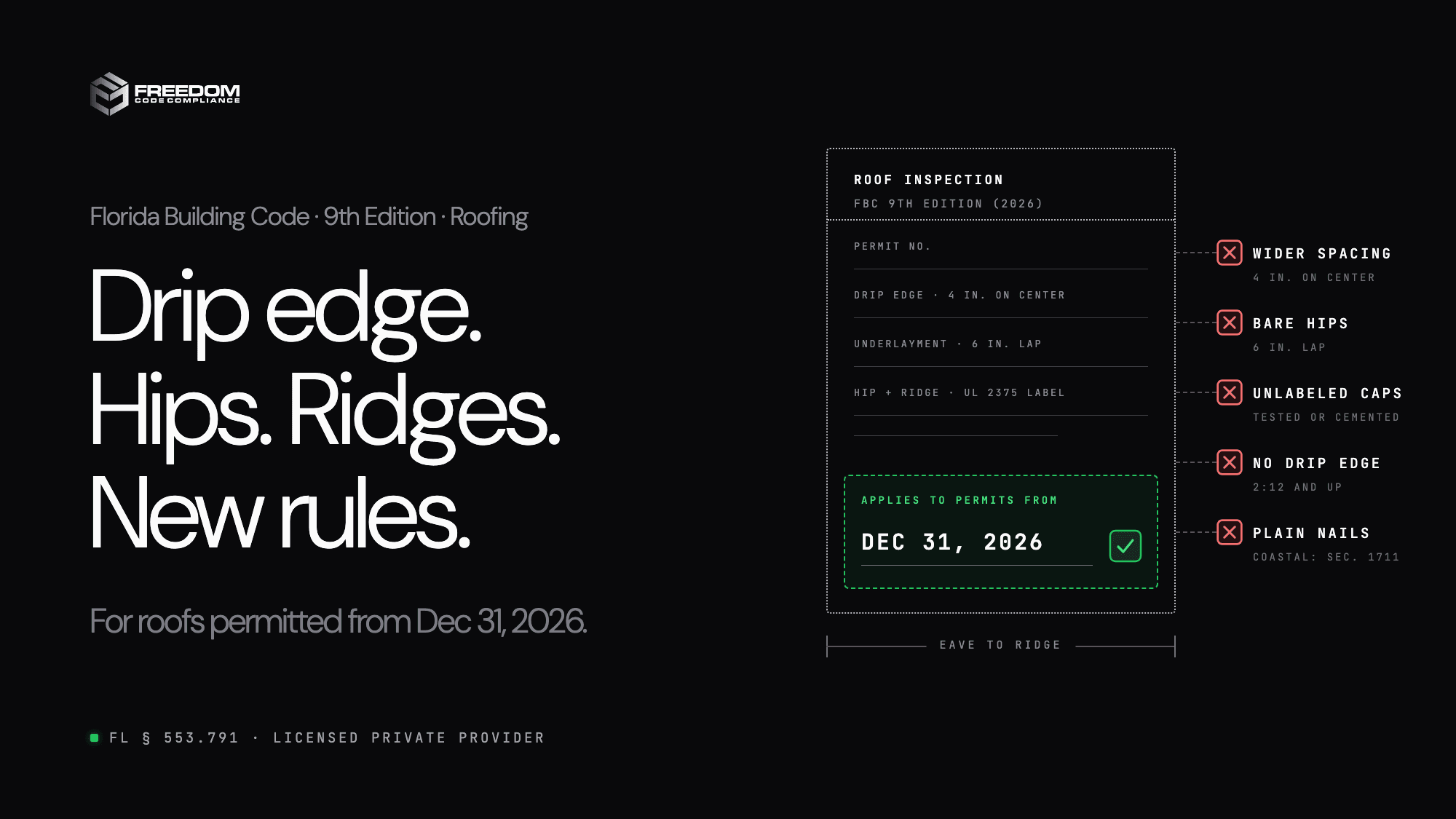
- The 9th Edition (2026) Florida Building Code applies to permit applications received on or after December 31, 2026.
- Asphalt shingle drip edge must be mechanically fastened at 4 inches on center at any wind speed (Building 1507.2.9.3, Residential R905.2.8.5).
- Drip edge is now required on tile, metal, roll roofing, slate, wood and photovoltaic shingle roofs with a slope of 2:12 or greater, installed over the underlayment.
- Hip and ridge asphalt shingles must be tested to a modified UL 2375 and labeled, or attached with 1-inch spots of roof cement in addition to fasteners.
- Underlayment must lap over hips and ridges by at least 6 inches, except where ventilation openings are provided.
- On a reroof, the upper roof covering or roof system alone may be removed when the existing or repaired substrate is adequate for the new roof.
- Roofing nails, screws and clips near a saltwater coastline must meet the new corrosion section, 1711 in Building and R332 in Residential.
What changes for roofing in the 2026 Florida Building Code (9th Edition)?
For permits applied for on or after December 31, 2026, asphalt shingle drip edge must be fastened at 4 inches on center at any wind speed, and drip edge is now required on most other steep-slope roof coverings. Hip and ridge shingles must be wind tested and labeled or set in roof cement, underlayment must lap hips and ridges by at least 6 inches, and a reroof with two layers may keep an adequate substrate when only the upper system is removed. Roofing fasteners near a saltwater coastline must meet the new corrosion section. The wind load standard, ASCE 7-22, does not change.
Roofs permitted on or after December 31, 2026 are built and inspected to the 9th Edition (2026) Florida Building Code. The wind load standard stays the same. What changes is the detailing an inspector can see: drip edge, hips and ridges, underlayment laps, flashing, what may stay in place on a reroof, and the fasteners you use near the coast. This list comes from the Florida Building Commission's Analysis of Changes, with the section numbers.
The rule for which edition you are under is simple. Under Florida Statute 553.73(7)(d), the code in effect on the date the building department receives your permit application governs the work for the life of the permit. Applications received on or after December 31, 2026 fall under the 9th Edition. Our guide to the December 31 cutoff covers what counts as filed.
Drip Edge: 4 Inches on Center, on More Roof Types
- Asphalt shingles. Drip edge must be mechanically fastened at 4 inches on center for any wind speed, and the fasteners must meet the shingle fastener section (Building 1507.2.9.3, Residential R905.2.8.5).
- Metal panels, metal shingles, mineral-surfaced roll roofing, slate and photovoltaic shingles. New sections require drip edge on slopes of 2:12 and greater, fastened at a maximum of 4 inches on center and installed over the underlayment.
- Concrete and clay tile. Drip edge is required on slopes of 2:12 and greater, applied per the FRSA/TRI Florida High Wind Concrete and Clay Roof Tile Installation Manual.
- Wood shingles and shakes. Drip edge is required on slopes of 2:12 and greater, installed over the underlayment.
Hips and Ridges
- Hip and ridge asphalt shingles must be tested and classified under UL 2375, modified to a wind speed of 110 mph, and the packaging must carry a label showing it (Building 1507.2.7.2, Residential R905.2.6.2).
- The prescriptive alternative: 1-inch diameter spots of roof cement meeting ASTM D3019 or ASTM D4856, or another adhesive the manufacturer specifies, in addition to the manufacturer's fasteners.
- Metal hip and ridge covers must be tested for uplift resistance under ANSI/MCA FTS-1 (Building 1504.3.1.1).
- Slate shingles must be tested to ASTM D3161 and labeled with their classification.
Underlayment, Flashing and Ventilation
- Underlayment must lap over hips and ridges by at least 6 inches, except where ventilation openings are provided (Building 1507.1.1, Residential R905.1.1).
- Flashing requirements now cover all roof types and shapes. New sections for metal, roll roofing, slate, built-up, modified bitumen, single-ply and photovoltaic roofs require flashing per the code and the manufacturer's installation instructions.
- Attic ventilation must include both intake and exhaust, with unvented attics handled under their own section.
- Lightning protection attached to or through metal edge systems, gutters or roof coverings must use attachment methods designed by a registered design professional for the design wind loads (Building 1510.8.6).
Reroofing: What Can Stay in Place
The recover-versus-replacement section changes in both the Existing Building code (706.3) and the Building code (1511.3).
- Two-layer roofs. A revised exception lets you remove only the upper roof covering or roof system during a recover, provided the existing or repaired substrate is adequate for the new approved roof. The roofing association says the change was written so sound insulation or lightweight insulating concrete can stay.
- Self-adhering underlayment. The old coatings exception is replaced with language on existing vapor barriers and self-adhering underlayments. New sections 706.7.3.1 through 706.7.3.3 list which underlayments may go over an existing self-adhering underlayment on shingle and metal roofs, tile roofs, and low-slope roofs under 2:12.
- Shingle coatings. The rules for coating asphalt shingles move to their own sections, Building 1507.2.10 and Residential R905.2.9.
- Loads during the job. New Section 3301.3 requires the structural roof components to support the roof covering system plus the material and equipment loads placed on the roof during installation.
The conditions that force a tear-off are still there. Water-soaked or deteriorated components, and tile, slate and wood shake roofs, come off down to the deck.
Near the Coast: Corrosion-Resistant Fasteners
Roofing nails, screws and clips in areas near a saltwater coastline must meet the new corrosion section, 1711 in the Building code and R332 in the Residential code. The Commission's analysis gives 3,000 feet as the distance. The roofing association's April summary of the code text shows a 300-foot trigger for screws, so confirm the distance for your fastener in the adopted text. Our post on the coastal fastener rule has the details.
High-Velocity Hurricane Zone
The High-Velocity Hurricane Zone keeps its own roofing sections, 1512 through 1525. Changes there include drip edge at eaves and gables installed over the underlayment, the same 6-inch underlayment lap and hip and ridge shingle rules, tile underlayment uplift resistance reported on the Product Approval, ridge vents tested to TAS 100(A), and the same coastal fastener reference.
How FCC Inspects Roofs Under the 9th Edition
Freedom Code Compliance inspects roofing work by live video or from photos and video you submit in myFCC, to the edition your permit falls under. On a 9th Edition roof, expect the inspector to ask for these on camera:
- Drip edge fastener spacing with a tape in the frame.
- The underlayment lap at a hip and at the ridge before caps go on.
- The hip and ridge shingle packaging label, or the roof cement spots.
- Fastener boxes on coastal jobs.
Single-trade plan reviews come back in minutes, single-family in hours, and commercial and multifamily in one to two days. A licensed inspector joins a live video inspection in minutes. This week's measured figures are on our home page. There is no inspection window to wait through and no second trip for a re-inspection. See virtual inspections for how it works.
FCC does not pull permits, file permit applications, or file the Notice to Building Official. You or the owner files with the building department, and the department issues the permit. Check the coverage map to confirm FCC is registered with your department.
Sources
- Florida Building Commission, Analysis of Changes for the 9th Edition (2026), Building
- Florida Building Commission, Analysis of Changes for the 9th Edition (2026), Residential
- Florida Building Commission, Analysis of Changes for the 9th Edition (2026), Existing Building
- Florida Roofing and Sheet Metal Contractors Association, Changes in the 2026 9th Edition of the Florida Building Code
- Florida Roofing and Sheet Metal Contractors Association, Tile Changes in the 2026 Ninth Edition Florida Building Code
- Florida Statute 553.73, Florida Building Code (subsection 7(d), which edition governs a permit)
- Florida Statute 553.791, Alternative plans review and inspection
Frequently Asked Questions
When do the 2026 Florida Building Code roofing changes take effect?
December 31, 2026. Under Florida Statute 553.73(7)(d), the edition in effect on the date of the permit application governs the work, so a reroof applied for on or before December 30, 2026 stays under the 8th Edition (2023) for the life of the permit.
How far apart are drip edge fasteners under the 2026 Florida Building Code?
Four inches on center. The 9th Edition requires asphalt shingle drip edge to be mechanically fastened at 4 inches on center for any wind speed, and it requires the fasteners to meet the shingle fastener section. Drip edge on metal panels, metal shingles, roll roofing, slate and photovoltaic shingles is also fastened at a maximum of 4 inches on center.
Did the wind load standard change in the 9th Edition?
No. The Florida Roofing and Sheet Metal Contractors Association reports that ASCE 7-22 remains the wind load standard for this edition, so the tables in the FRSA-TRI tile installation manual do not change. Garage and vehicle access door pressure tables were adjusted slightly to match ASCE 7-22.
Can I recover a roof that already has two layers?
Only in the case the new exception describes. A roof with two or more applications of roof covering still triggers removal, but the 9th Edition lets you remove only the upper roof covering or roof system when the existing or repaired substrate is adequate for the new approved roof. Water-soaked or deteriorated components still have to come off.
Do hip and ridge shingles need a label now?
Yes, unless you use the prescriptive method. Hip and ridge asphalt shingles must be tested and classified under a version of UL 2375 modified to a 110 mph wind speed, and the packaging must carry a label saying so. The alternative is 1-inch diameter spots of roof cement, or another adhesive the manufacturer specifies, in addition to the required fasteners.
Can a private provider inspect my roof under the new code?
Yes. Under F.S. 553.791 a private provider inspects to the code edition that applies to the permit. Freedom Code Compliance inspects roofing work by live video or from photos and video submitted in myFCC, and sends the results to the building department.