Florida Roof Replacement Permits: What the Code Requires and the Inspections That Close the Permit
Key Takeaways
- A roof replacement or reroof needs a permit under F.S. 553.79(1) and FBC Building 105.1. The minor-repair exemption in FBC 105.2.2 requires the building official's approval and does not cover a tear-off.
- The licensed roofing contractor pulls the permit. Under F.S. 489.113(3), other contractors must subcontract roofing unless they hold the roofing license, except shingles on a new building of their own construction.
- Under F.S. 553.844(5), added by SB 4-D in 2022, a roof built or replaced under the 2007 Florida Building Code or later may be repaired past 25 percent without replacing the whole roof.
- Homes permitted before the Florida Building Code took effect on March 1, 2002 need deck renailing and a secondary water barrier on a reroof (FBC Existing Building 706.7).
- In the wind-borne debris region, a pre-code home insured or valued at $300,000 or more needs roof-to-wall upgrades on a reroof, capped at a 15 percent increase in reroof cost (FBC Existing Building 706.8).
- Under the 8th Edition, shingle drip edge is fastened at 12 inches on center, or 4 inches where Vasd is 110 mph or more or the mean roof height exceeds 33 feet (FBC 1507.2.9.3, R905.2.8.5).
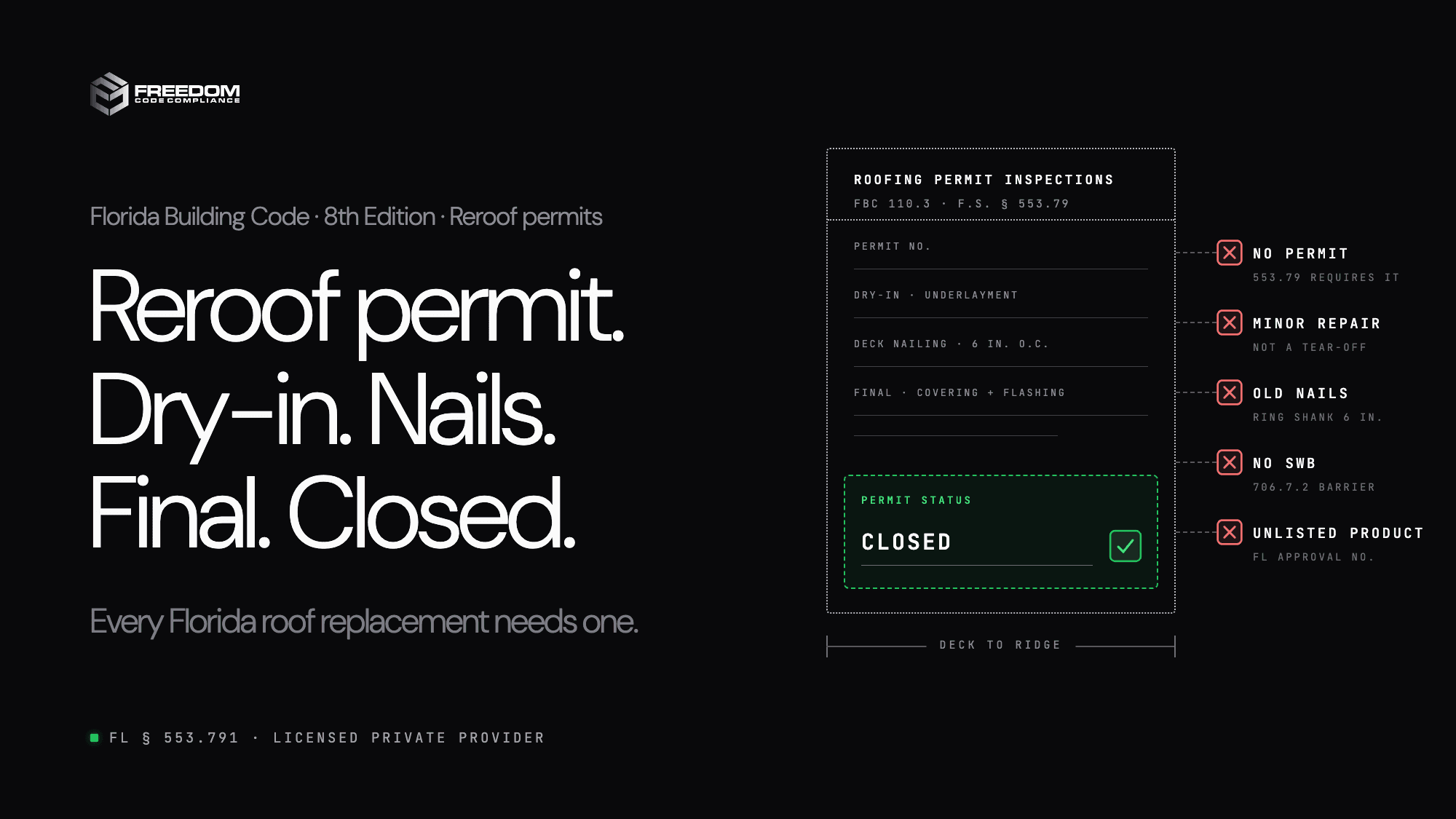
- FBC 110.3 lists a sheathing inspection and a roofing inspection covering dry-in, insulation, roof coverings and flashing. FCC inspects these by video and sends the results to the building department.
Do you need a permit to replace a roof in Florida?
Yes. Florida Statute 553.79(1) and Florida Building Code Building 105.1 require a permit before any roof replacement or reroof, and the minor-repair exemption in FBC 105.2.2 does not cover a tear-off. The permit closes after the dry-in, sheathing or deck-nailing, and final roofing inspections pass.
Yes. A roof replacement or reroof in Florida needs a building permit before work starts, and the permit closes only after the required roofing inspections pass. Florida Statute 553.79(1) bars any construction, alteration or repair without a permit, and the minor-repair exemption in the Florida Building Code does not cover a reroof. Below: what the 8th Edition (2023) code requires, who pulls the permit, and the inspections that close it.
When a Florida Roof Permit Is Required
F.S. 553.79(1)(a) makes it unlawful to "construct, erect, alter, modify, repair, or demolish any building" in Florida "without first obtaining a permit therefor from the appropriate enforcing agency." FBC Building 105.1 requires anyone altering or repairing a building to "obtain the required permit."
The only exemption contractors point to is FBC Building 105.2.2, Minor Repairs. It reads: "Ordinary minor repairs may be made with the approval of the building official without a permit," provided they do not cut walls, remove structural members, change egress, or touch piping, wiring or mechanical equipment. It depends on the building official's approval, and it does not reach a tear-off. Treat every roof replacement permit in Florida as required, whether the job is in Jacksonville, Hillsborough County or Volusia County.
Who Pulls the Roofing Permit
The licensed contractor doing the work applies for the permit. Under F.S. 489.105(3)(e), a roofing contractor's scope is "unlimited in the roofing trade." It also covers skylights, roof-deck attachment, sheathing and fascia replacement during a reroof, and roof-to-wall upgrades under FBC Existing Building 706 done with the reroof.
Other licenses are limited. F.S. 489.113(3) requires a contractor to subcontract roofing work unless it holds a certificate or registration in that trade. The exception that matters here, 489.113(3)(b), lets a general, building or residential contractor install wood shingles, wood shakes, or asphalt or fiberglass shingles "on a new building of his or her own construction." A reroof on an existing house is not that. If you are searching for roofing contractors who handle permits, the answer is the roofer. FCC does not pull permits or file permit applications. FCC reviews the plans, supplies the private-provider paperwork, and inspects the work.
The 25 Percent Rule and SB 4-D
FBC Existing Building 706.1.1 (and Building 1511.1.1, Residential R908.1.1) limits repairs: "Not more than 25 percent of the total roof area or roof section of any existing building or structure shall be repaired, replaced or recovered in any 12-month period unless the roof covering on the entire existing roof system or roof section is replaced or recovered to conform to the requirements of this code."
SB 4-D (Chapter 2022-269, Laws of Florida) added F.S. 553.844(5), which the code now carries as the exception: "if an existing roofing system or roof section was built, repaired, or replaced in compliance with the requirements of the 2007 Florida Building Code or any subsequent editions of the Florida Building Code, and 25 percent or more of such roofing system or roof section is being repaired, replaced, or recovered, only the repaired, replaced, or recovered portion is required to be constructed in accordance with the Florida Building Code in effect, as applicable."
A roof permitted under the 2007 code or later can be repaired past 25 percent without replacing the whole roof. An older roof cannot. Check the original permit date before pricing a repair.
Mitigation on Older Homes: Deck, Water Barrier, Roof-to-Wall
F.S. 553.844(3) requires the Commission's mitigation rules for site-built single-family homes. The code puts them in FBC Existing Building 706.7 and 706.8. Both carry the exception "Structures permitted subject to the Florida Building Code are not required to comply with this section." The code took effect March 1, 2002, so these apply to homes permitted before then.
- Deck attachment (706.7.1). When the covering on a wood deck is removed and replaced, the deck must meet the renail rules. Where panels are held by staples, 6d nails, or 8d nails wider than 6 inches apart, add ASTM F1667 RSRS-01 ring shank nails (0.113-inch shank, 2 3/8 inches long) at 6 inches on center (Table 706.7.1.2).
- Secondary water barrier (706.7.2). "When a roof covering is removed and replaced, a secondary water barrier shall be installed" per Building 1507.1.1 or Residential R905.1.1. Slopes under 2:12 with a continuous roof system, and tile installed to the code, are deemed to comply.
- Roof-to-wall connections (706.8). This applies in the wind-borne debris region to a building with "an insured value of $300,000 or more" or, if uninsured, a just valuation of $300,000 or more. The cap: "Mandated retrofits of the roof-to-wall connection shall not be required beyond a 15 percent increase in the cost of reroofing."
Underlayment, Nailing and Drip Edge (8th Edition)
- Underlayment (Building 1507.1.1.1, Residential R905.1.1.1). For shingles and metal, use one of three methods: a full deck of ASTM D1970 self-adhering underlayment, a 3 3/4-inch self-adhering strip over every deck joint with approved underlayment over it, or two layers of ASTM D226 Type II, D4869 Type III or IV, or D8257, half-lapped. Two-layer underlayment is cap-nailed at 12 inches on center in the field and 6 inches at laps, with metal caps where Vult is 170 mph or more.
- Shingle nails (1507.2.6, R905.2.5). Minimum 12-gage (0.105-inch) shank, 3/8-inch head, ASTM F1667, penetrating 3/4 inch into the sheathing or through it. At least four nails per strip shingle (R905.2.6).
- Drip edge (1507.2.9.3, R905.2.8.5). Required at eaves and gables of shingle roofs, over the underlayment, lapped 3 inches, fastened at 12 inches on center. Where Vasd is 110 mph or more or the mean roof height exceeds 33 feet, fastening drops to 4 inches on center.
Permits applied for on or after December 31, 2026 fall under the 9th Edition (F.S. 553.73(7)(d), FBC Building 105.3), where drip edge goes to 4 inches on center at any wind speed. See our 9th Edition roofing changes post and how to lock in the 2023 code.
Product Approval
F.S. 553.842(5) names roofing among the product categories that must be approved under one of the statewide methods. The shingle, tile or metal system and the underlayment each carry a Florida Product Approval (FL) number or a local approval. List both on the permit and install to the approval's conditions.
The Inspections That Close a Roof Permit
FBC Building 110.3 lists the minimum building inspections. Two cover a roof job.
- Sheathing inspection. Made "either as part of a dry-in inspection or done separately" after roof sheathing and fasteners are complete. On a reroof, this is where the deck re-nail gets checked.
- Roofing inspection. At a minimum covers dry-in, insulation, roof coverings and flashing. The dry-in or underlayment check is the in-progress inspection, made before the covering hides it. On a flat roof, the dry-in or decking inspection looks at the deck, insulation attachment and base sheet before the cap goes down.
- Final. Finished covering, flashing and drip edge. Then the permit closes.
The building department keeps permit issuance and zoning. Under F.S. 553.791, the owner may use a private provider for the plan review and inspections.
How FCC Handles Your Roof Permit
The dry-in and nailing inspections suit a virtual roof inspection done offline. You upload GPS-tagged, timestamped photos and video in the myFCC app, and eligible submissions typically come back in minutes. myFCC tells you which method each inspection needs. For the final, request a live inspection in myFCC. A licensed inspector is matched in minutes and you have the result before the call ends.
FCC sends each result to the building department automatically and files the Certificate of Compliance after the required FCC inspections pass. When a roof job needs plans, single-family plan reviews average 24 hours, and you submit the permit application with FCC's stamped plans and private-provider paperwork.
See FCC for roofers, virtual inspections and plan reviews. Check the coverage map for your building department, then apply for access.
Sources
- Florida Statute 553.79, Permits
- Florida Statute 489.105, Definitions
- Florida Statute 489.113, Qualifications for practice
- Florida Statute 553.844, Windstorm loss mitigation
- SB 4-D (2022), enrolled text, Chapter 2022-269
- Florida Statute 553.842, Product evaluation and approval
- Florida Building Code, Building, 8th Edition (2023), Chapter 1
- Florida Building Code, Building, 8th Edition (2023), Chapter 15
- Florida Building Code, Residential, 8th Edition (2023), Chapter 9
- Florida Building Code, Existing Building, 8th Edition (2023), Chapter 7
- Florida Statute 553.73, Florida Building Code (subsection (7)(d), which edition governs a permit)
- Florida Statute 553.791, Alternative plans review and inspection
Frequently Asked Questions
Do I need a roofing permit in Florida to replace a roof?
Yes. Florida Statute 553.79(1) makes it unlawful to alter or repair a building without a permit, and Florida Building Code Building 105.1 requires the permit before work starts. The minor-repair exemption in FBC 105.2.2 needs the building official's approval and does not cover a tear-off and replacement.
Who can pull a roof replacement permit in Florida?
A licensed roofing contractor. Florida Statute 489.105(3)(e) gives roofing contractors unlimited scope in the roofing trade. Under 489.113(3), general, building and residential contractors must subcontract roofing unless they hold the roofing license, except for shingle roofing on a new building of their own construction.
What is the 25 percent roof rule in Florida?
FBC Existing Building 706.1.1 limits repairs to 25 percent of a roof or roof section in any 12-month period before the whole roof must meet the current code. Florida Statute 553.844(5), added by SB 4-D in 2022, exempts roofs built, repaired or replaced under the 2007 Florida Building Code or later. On those roofs only the repaired portion must meet the current code.
What is checked at a flat roof dry-in or decking inspection?
FBC Building 110.3 lists a sheathing inspection, made with the dry-in or separately, for roof sheathing and fasteners, and a roofing inspection covering dry-in, insulation, roof coverings and flashing. On a low-slope roof that means the deck attachment, insulation and base sheet are checked before the cap sheet covers them.
Does a reroof require roof-to-wall connection upgrades?
Only on some older homes. FBC Existing Building 706.8 applies to buildings in the wind-borne debris region with an insured value or just valuation of $300,000 or more, and structures permitted under the Florida Building Code are exempt. Mandated retrofits are capped at a 15 percent increase in the cost of reroofing.
Can I get a virtual roof inspection in Florida?
Yes, where Freedom Code Compliance is registered with your building department. Under F.S. 553.791 the owner may use a private provider. FCC inspects dry-in and nailing from GPS-tagged, timestamped photos and video submitted in myFCC, typically resulted in minutes, matches live inspections with a licensed inspector in minutes, and sends results to the department automatically. Check the coverage map at /service-areas.