Do I Need a Permit in Florida? A Contractor's Guide by Job Type, With the Penalties for Skipping One
Key Takeaways
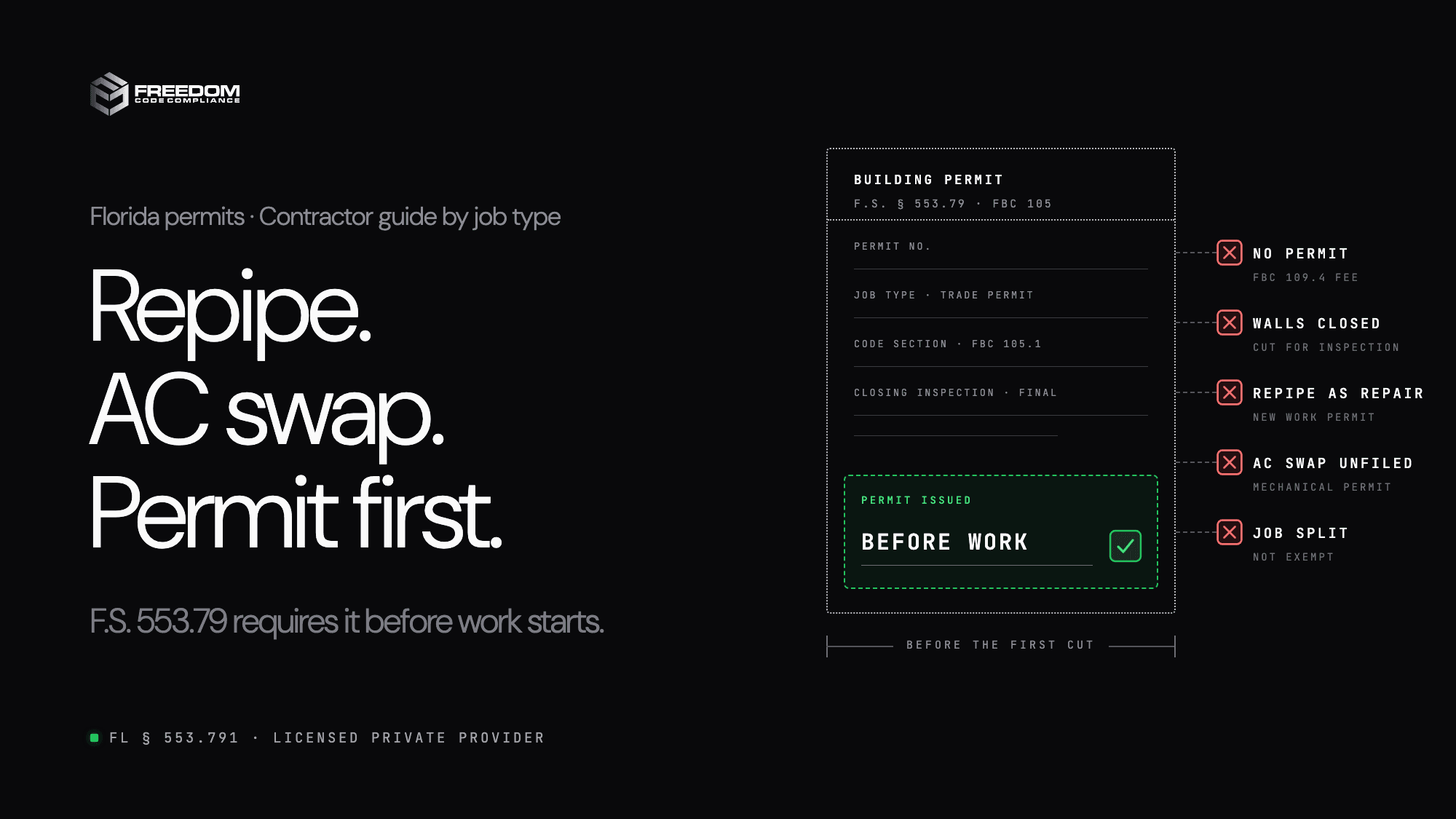
- F.S. 553.79(1)(a) makes it unlawful to construct, erect, alter, modify, repair or demolish a building in Florida without first obtaining a permit.
- Florida's adopted FBC 105.2 has no Building or Electrical exemption list. It exempts mainly portable equipment, minor gas and mechanical parts, piping inside equipment, small self-contained refrigeration units, load management devices, and leak and stoppage repairs.
- Replacing a defective concealed pipe is new work under 105.2, so a repipe needs a plumbing permit.
- Water heaters, panel and service upgrades, AC changeouts, garage doors, windows, reroofs and demolition all need a permit.
- The F.S. 553.79(1)(g) exemption for single-family work under $7,500 excludes electrical, plumbing, structural, mechanical and gas work and flood hazard areas.
- Starting before the permit triggers the added fee in FBC 109.4 and exposes a licensed contractor to discipline and fines up to $10,000 per violation under F.S. 489.129(1)(o).
- FCC's virtual inspections close BMEP permits with live results in minutes or eligible offline results typically in minutes, sent to the department automatically.
Do I need a permit in Florida for a repipe, water heater, panel upgrade, AC changeout or reroof?
Yes. Florida Statute 553.79(1)(a) makes it unlawful to construct, alter, repair or demolish a building without first obtaining a permit, and Florida Building Code Section 105.1 names electrical, gas, mechanical and plumbing systems directly. Florida's exemption list in Section 105.2 covers mainly portable equipment, minor gas and mechanical parts, piping inside equipment, small self-contained refrigeration units, load management devices, and leak and stoppage repairs.
Yes, in almost every case. Florida Statute 553.79(1)(a) makes it unlawful to construct, erect, alter, modify, repair or demolish a building without first obtaining a permit, and Florida's adopted version of the permit exemption list is far shorter than the model code's. Repipes, water heaters, panel upgrades, AC changeouts, garage doors, windows, reroofs and demolition all need one.
The Rule: Florida Statute 553.79(1)(a)
The statute reads: "it shall be unlawful for any person, firm, corporation, or governmental entity to construct, erect, alter, modify, repair, or demolish any building within this state without first obtaining a permit therefor from the appropriate enforcing agency." Florida Building Code Section 105.1 names the systems: anyone who intends to "erect, install, enlarge, alter, repair, remove, convert or replace any impact-resistant coverings, electrical, gas, mechanical or plumbing system" must "obtain the required permit."
The Residential volume has no permit section of its own. R105 is reserved, and R101.2.1 sends administration to Chapter 1 of the Building volume, so one list governs houses and commercial work.
What Is Exempt From a Permit in Florida (FBC 105.2)
Section 105.2 of the 8th Edition (2023) Florida Building Code opens: "Exemptions from permit requirements of this code shall not be deemed to grant authorization for any work to be done in any manner in violation of the provisions of this code." The whole list:
- Gas: a portable heating appliance, and replacement of a minor part "that does not alter approval of equipment or make such equipment unsafe."
- Mechanical: portable heating, ventilation, cooling and evaporative cooling equipment, water or steam piping inside regulated equipment, replacement of a part that does not alter its approval, a "self-contained refrigeration system containing 10 pounds (4.54 kg) or less of refrigerant and actuated by motors of 1 horsepower (0.75 kW) or less," and load management control devices.
- Plumbing: stopping leaks, and clearing stoppages or removing and reinstalling water closets "provided such repairs do not involve or require the replacement or rearrangement of valves, pipes or fixtures." If a concealed pipe or trap is defective and gets replaced with new material, "such work shall be considered as new work and a permit shall be obtained."
Where Florida differs from the model code. The model International Building Code carries a "Building" list (small sheds, fences, sidewalks, painting, flooring, cabinets, swings, window awnings) and an "Electrical" list. Florida's adopted 105.2 has neither heading. There is no 105.2 exemption for a shed, a fence, flooring or cabinets. Local amendments to the administrative chapter under F.S. 553.73(4)(a) "must be more stringent."
Two narrow paths remain. Section 105.2.2 lets "ordinary minor repairs" go without a permit "with the approval of the building official," but not repairs that touch structure, egress, piping, "electric wiring systems or mechanical equipment." And F.S. 553.79(1)(g) exempts work valued under $7,500 on a single-family dwelling, by written request. That exemption does not apply in a flood hazard area or to "any electrical, plumbing, structural, mechanical, or gas work," and splitting a project to qualify is barred.
Do I Need a Permit? Florida Answers by Job Type
| Job | Permit? | Governing section | Inspection that closes it |
|---|---|---|---|
| Repipe | Yes, plumbing | FBC 105.1, and 105.2 (replaced pipe is new work) | Plumbing rough-in if walls are open, then final |
| Water heater replacement | Yes, plumbing, plus electrical or gas if those change | FBC 105.1, 105.2.2 | Plumbing final (and electrical or gas final) |
| Electrical panel or service upgrade | Yes, electrical | FBC 105.1, Chapter 27 (NFPA 70, 2020 NEC) | Electrical final |
| AC changeout | Yes, mechanical | FBC 105.1, F.S. 553.912 | Mechanical final |
| Garage door | Yes, building | FBC 105.1, product approval | Building final against the approval |
| Windows and exterior doors | Yes, building | FBC 105.1, F.S. 553.842(5) | Impact-resistant system inspection, then final |
| Reroof | Yes, roofing | FBC 105.1, Existing Building 706.1.1 | Roofing (dry-in, coverings, flashing), then final |
| Demolition | Yes | F.S. 553.79(1)(a), FBC 105.1 | After utilities are disconnected, then final |
| Shed | Yes (no 105.2 size exemption) | FBC 105.1, local amendments | Foundation or anchoring, then final |
| Fence | Usually zoning, no state code exemption | Local zoning, F.S. 553.79(1)(g) where it applies | Zoning final |
| Driveway and pavers | Local zoning and right-of-way | Local code | Zoning or right-of-way |
| Screen enclosure | Yes, building | FBC 105.1, 2002.4 (wind loads) | Footing, then final |
| Pool equipment swap | Yes, electrical (and plumbing if piping changes) | FBC 105.1, 110.3 | Existing pool inspection: GFCI, bonding |
| Pool resurfacing only | No 105.2 exemption covers it | FBC 105.2.2 minor repair, if approved | Final, if permitted |
Repipe, water heater, panel upgrade
Section 105.2 calls replaced pipe "new work." A water heater swap replaces equipment tied to water supply, wiring or gas piping, which 105.2.2 keeps out of the minor repair path. A panel or service upgrade falls under Chapter 27, where the Existing Building code "and NFPA 70 shall govern the alteration, repair, relocation, replacement and addition of electrical components." That is NFPA 70-20, the 2020 NEC.
AC changeout permit
A changeout is a mechanical permit, since only portable and small self-contained units are exempt. F.S. 553.912 requires air conditioners installed in Florida to "meet the minimum efficiency ratings of the Florida Building Code-Energy Conservation." It states the intent that residential replacements use "equipment sizing analysis and duct inspection."
Roofing permit, windows and garage doors
Existing Building 706.1.1 limits repair or replacement to 25 percent of a roof section in any 12-month period before the whole section must meet current code, unless the roof was built to the 2007 code or later. Windows and exterior doors are product approval categories under F.S. 553.842(5). Where impact-resistant systems go in, 110.3 requires inspections confirming "the system indicated on the plans was installed." Roofs applied for on or after December 31, 2026 follow the 9th Edition roofing changes.
Building Without a Permit: Fees and Penalties
- The fee. FBC 109.4: anyone who "commences any work on a building, structure, electrical, gas, mechanical or plumbing system before obtaining the necessary permits shall be subject to a fee established by the building official that shall be in addition to the required permit fees."
- Opening it back up. FBC 110.1 requires permitted work to "remain exposed" until approved, and the jurisdiction is not liable for "removal or replacement of any material required to allow inspection." An after-the-fact repipe permit can mean cut drywall.
- Your license. F.S. 489.129(1)(o) lets the Construction Industry Licensing Board discipline a contractor for "proceeding on any job without obtaining applicable local building department permits and inspections." The board can suspend or revoke and fine up to "$10,000 per violation." Electrical contractors: F.S. 489.533(1)(r).
- Unlicensed work. F.S. 489.127(1)(h) bars anyone from commencing work "for which a building permit is required" without the permit in effect. For an unlicensed person, a first violation is a first-degree misdemeanor. A repeat, or a violation during a declared emergency, is a third-degree felony.
- Sale and insurance. Unpermitted or open work tends to surface when a buyer, lender or insurer pulls permit history.
How FCC Closes the Permit Faster
F.S. 553.791 lets you use a private provider, and FCC is one. You still submit the permit application, and the department still issues the permit and keeps zoning, fire, utilities, public works and right-of-way. When the job needs plans, upload them in myFCC and FCC returns stamped plans and private-provider paperwork for your application. Plan review averages 24 hours for single-family and 2 days for multifamily and commercial. See the MEP plan review guide.
Once the permit is open, virtual inspections close it. Request a live inspection in myFCC and you are matched with a licensed inspector in minutes, with the result before the call ends. Eligible offline inspections use GPS-tagged, timestamped photos and video and typically return results in minutes. FCC inspects building, mechanical, electrical and plumbing scopes, sends results to the department automatically, and files the Certificate of Compliance after its inspections pass. See builders, HVAC, roofing and windows and doors.
Check the coverage map, then apply for access.
Sources
- Florida Statute 553.79, Permits, applications, issuance, inspections
- Florida Statute 553.73, Florida Building Code
- Florida Statute 553.912, Air conditioners
- Florida Statute 553.842, Product evaluation and approval
- Florida Statute 489.129, Disciplinary proceedings
- Florida Statute 489.127, Prohibitions and penalties
- Florida Statute 489.533, Disciplinary proceedings (electrical)
- FBC Building 8th Edition (2023), Chapter 1
- FBC Residential 8th Edition (2023), Chapter 1
- FBC Building 8th Edition (2023), Chapter 27
- FBC Existing Building 8th Edition (2023), Chapter 7
- FBC Building 8th Edition (2023), Chapter 20
Frequently Asked Questions
Do I need a permit to repipe in Florida?
Yes. Florida Building Code Section 105.2 exempts stopping leaks, but says that when a concealed water, drain, waste or vent pipe is removed and replaced with new material, the work is new work and a permit must be obtained. A repipe needs a plumbing permit and closes with the plumbing inspections, rough-in where walls are open and then final.
Do I need a permit for an electrical panel upgrade in Florida?
Yes. Florida Building Code Section 105.1 requires a permit to install, alter, repair or replace any electrical system, and Florida's adopted Section 105.2 has no electrical exemptions. Panel and service work is governed by Chapter 27, which references NFPA 70-20, the 2020 National Electrical Code, and closes with an electrical final inspection.
Is a permit required for an AC changeout in Florida?
Yes, for a central system. Florida Building Code Section 105.2 exempts only portable heating, cooling and ventilation equipment and self-contained refrigeration systems with 10 pounds or less of refrigerant and motors of 1 horsepower or less. A changeout is a mechanical permit, and F.S. 553.912 requires installed air conditioners to meet the Florida Building Code-Energy Conservation minimum efficiency ratings.
Do I need a permit to replace a water heater in Florida?
Yes. A water heater replacement is plumbing work under Florida Building Code Section 105.1, and Section 105.2.2 excludes replacement of water supply or gas piping, electric wiring and mechanical equipment from the minor repair path. Expect a plumbing permit, plus electrical or gas permitting when the circuit or gas piping changes.
What are the fees for building without a permit in Florida?
The building official sets them. Florida Building Code Section 109.4 says anyone who starts work before obtaining the necessary permits is subject to a fee established by the building official, in addition to the required permit fees. A licensed contractor also faces discipline under F.S. 489.129(1)(o), with administrative fines up to $10,000 per violation.
Do I need a roofing permit in Florida for a reroof?
Yes. A reroof is an alteration under Florida Building Code Section 105.1, and Existing Building Section 706.1.1 limits repair or replacement to 25 percent of a roof section in any 12-month period before the whole section must meet current code, with an exception for roofs built to the 2007 code or later. The permit closes with the roofing inspection covering dry-in, coverings and flashing.
Does FCC pull the permit?
No. The contractor submits the permit application with FCC's stamped plans and private-provider paperwork, and the building department issues the permit. FCC then performs the building, mechanical, electrical and plumbing inspections by video, sends results to the department automatically, and files the Certificate of Compliance after its inspections pass.