Florida Demolition Permits: Who Can Pull One, What the Code Requires, and the Inspections That Close It
Key Takeaways
- Florida Statute 553.79(1)(a) and FBC Building 105.1 (8th Edition, 2023) require a permit to demolish any building.
- F.S. 489.105(3) makes demolition of all buildings and residences contracting work. The license must match the structure.
- Rule 61G4-15.100(1)(p) creates a state building demolition specialty license for buildings three stories or less. A local demolition certificate of competency works only in the jurisdiction that issued it.
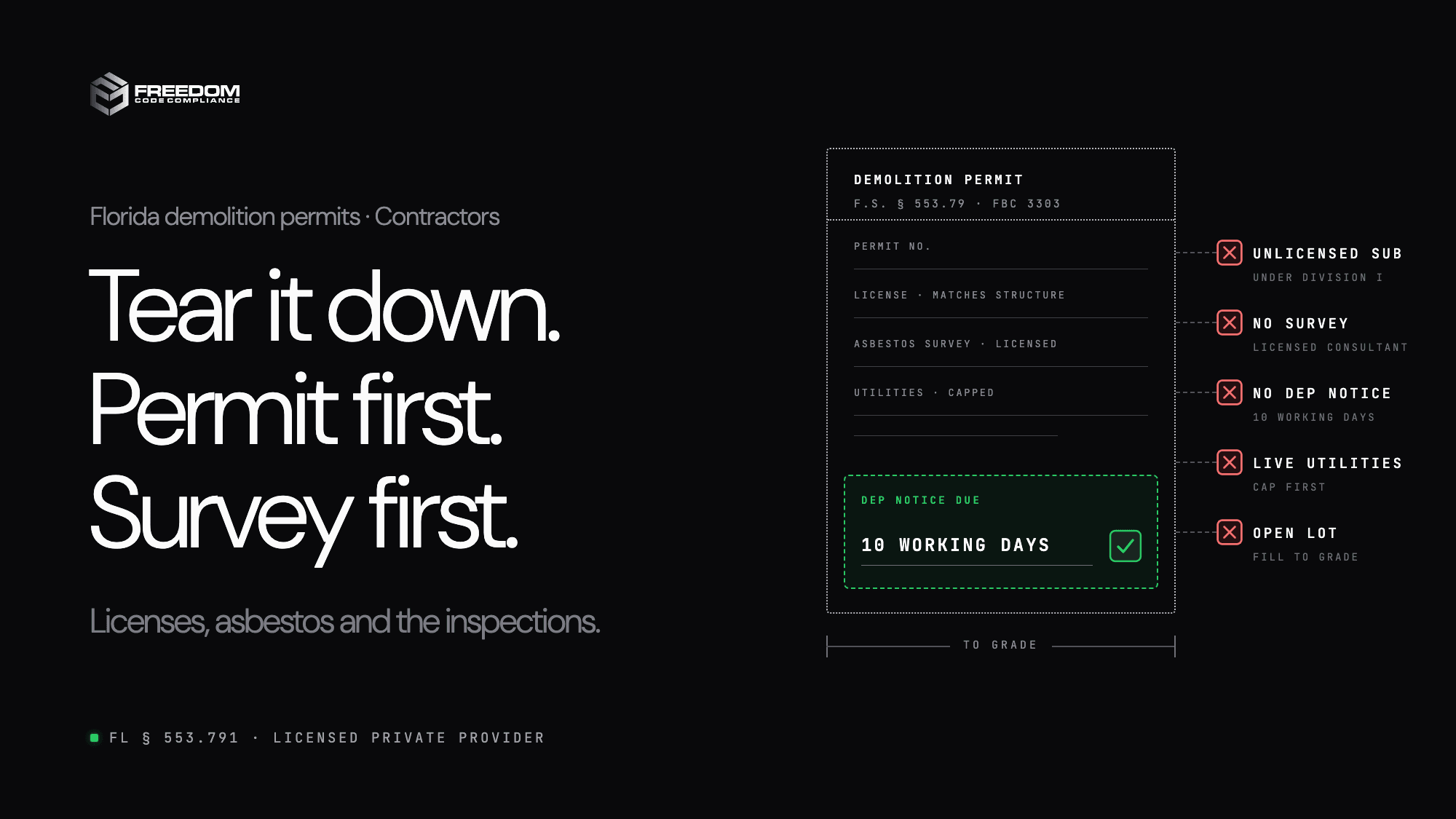
- On a commercial building or a residential building with five or more units, a licensed asbestos consultant must do the asbestos survey (F.S. 469.003(1)), and the DEP notice is due at least 10 working days before demolition (Rule 62-257.301(3)(b)1).
- FBC Section 3303 requires pedestrian protection before demolition, capped utilities, a filled lot at grade and control of water on the site.
- FBC 110.3 lists two demolition inspections: one after utilities are disconnected and secured, and a final after all demolition is complete.
- FCC reviews the plans and inspects the building, mechanical, electrical and plumbing work on the permit that follows the demolition.
Do you need a demolition permit in Florida, and who can pull one?
Yes. Florida Statute 553.79(1)(a) and Florida Building Code Section 105.1 require a permit to demolish any building, and the contractor must hold a Division I license that covers the structure, a state building demolition specialty license, or a local demolition certificate of competency. For a commercial building, or a residential building with five or more dwelling units, a licensed asbestos consultant surveys the building first, and the owner or operator notifies the Florida Department of Environmental Protection at least 10 working days before demolition starts.
Florida requires a building permit to demolish any building. Florida Statute 553.79(1)(a) and Section 105.1 of the 8th Edition (2023) Florida Building Code both list demolition as permitted work. The contractor of record must hold a Division I license (general, building or residential) that covers the structure, a state building demolition specialty license, or a local demolition certificate of competency. Before work starts on a commercial building, or a residential building with five or more dwelling units, a licensed asbestos consultant surveys the building, and the owner or operator notifies the Florida Department of Environmental Protection at least 10 working days ahead. Here is what the statute and code require, with the section numbers.
When a Demolition Permit Is Required in Florida
Florida Statute 553.79(1)(a) bars anyone from constructing, altering, repairing or demolishing a building without first obtaining a permit. Florida Building Code, Building Section 105.1 says the same thing at the code level. An owner or authorized agent who intends to demolish a building or structure applies to the building official first.
Two kinds of permits cover demolition work:
- Standalone demolition permit. Used when the whole building or a separate structure comes down. Under Section 107.2.6, the site plan must show the construction to be demolished. Under Section 3303.1, the building official may require demolition plans, a schedule or both, and no work starts until they are approved.
- Partial demolition inside a renovation permit. Interior gut-outs and selective demolition usually ride on the alteration permit, with the plans showing what comes out.
One statutory carve-out matters to coastal builders. Under F.S. 553.79(25), a local government may not prohibit a private owner from getting a permit to demolish a single-family home in a FEMA flood zone when the lowest finished floor sits at or below base flood elevation. The application gets administrative review only. Homes on the National Register, or designated historic on or before January 1, 2022, are excluded, and later designations count only with the owner's consent (553.79(25)(d)). See our guide to flood zone plan requirements for the rebuild.
Who Can Pull a Demolition Permit: Licensed Demolition Contractors
Demolition is contracting in Florida. The definition of contractor in F.S. 489.105(3) includes a person who will "add to, demolish, subtract from, or improve any building or structure." The same subsection limits "demolish" to steel tanks, towers and other structures over 50 feet tall, and all buildings or residences.
Florida law does not create a separate demolition class in the Division I definitions. Instead, the license must match the structure:
- Division I contractors. General, building and residential contractors under F.S. 489.105(3)(a) through (c) may demolish within the scope of their license. A residential contractor's scope stops at the homes that license covers.
- Building demolition specialty contractor. Florida Administrative Code Rule 61G4-15.100(1)(p), effective May 5, 2024, is the state specialty license. It covers buildings or residences three stories or less, and steel tanks and towers 50 feet or less.
- Local specialty demolition license. The Department of Business and Professional Regulation says a local certificate of competency lets you contract for demolition only inside the jurisdiction that issued it.
- Subcontracted demolition. Per the same DBPR guidance, a demolition sub generally needs no license when working under an appropriately licensed Division I contractor.
Asbestos Survey and the 10 Working Day DEP Notice
Every Florida permit for demolition or renovation of an existing structure must carry an asbestos notification statement (FBC Building 105.9). It puts the owner or operator on notice of F.S. 469.003 and of the duty to notify the Department of Environmental Protection.
- Pre-demolition inspection. The federal asbestos rule, 40 CFR 61.145(a), requires the owner or operator to thoroughly inspect the facility for asbestos before demolition starts.
- Who surveys. Under F.S. 469.003(1), only a trained, licensed asbestos consultant may conduct an asbestos survey.
- Who abates. Under F.S. 469.003(3), asbestos abatement takes a licensed asbestos contractor, with narrow exemptions in F.S. 469.002.
- The notice. Florida Administrative Code Rule 62-257.301(3)(b)1 requires notice at least 10 working days before a demolition starts. The federal rule sets the same timing at 61.145(b)(3)(i). A demolition at a covered facility needs the notice even when the survey finds no asbestos. Electronic filing with payment through DEP's Business Portal costs $100, or $200 otherwise, and counties with their own air programs are exempt from the DEP fee (Rule 62-257.301(3)(g) and (h)).
- The residential exclusion. The federal definition of facility in 40 CFR 61.141 excludes residential buildings with four or fewer dwelling units. A building that was ever subject to the rule stays covered.
Lead paint is a separate rule. Under 40 CFR 745.81(a)(2)(ii), a firm doing renovations in pre-1978 housing or child-occupied facilities must be certified by EPA. The definition of renovation in 745.83 includes removing walls, ceilings, plumbing and windows. That is what "EPA certified demolition contractor" usually means for selective demolition in older homes.
FBC Chapter 33 Safeguards During Demolition
Section 3303 of the Florida Building Code, Building (8th Edition, 2023) governs demolition on site:
- 3303.2 Pedestrian protection. Demolition may not start until the protection Section 3306 requires is in place.
- 3303.3 Means of egress. A horizontal exit stays until an approved substitute exists.
- 3303.4 Vacant lot. The lot is filled and kept at existing grade, or as local ordinance requires.
- 3303.5 Water accumulation. Keep water from pooling or damaging foundations on the site and next door.
- 3303.6 Utility connections. Service connections are discontinued and capped under the utility's rules.
- 3303.7 Fire safety. Follows this code and the Florida Fire Prevention Code.
Section 3306 sizes the walkways and barriers by building height and distance to the lot line.
What the Building Department Keeps
The department issues the demolition permit. Zoning, tree removal, right-of-way and public works approvals stay local. Power, gas, water and sewer providers handle disconnects and caps. Fire officials keep fire safety. These are not building-code scopes, and the Certificate of Compliance can wait on them, so line them up early.
The Inspections That Close a Demolition Permit
Section 110.3 of the Florida Building Code, Building lists two demolition inspections:
- First inspection. Made after all utility connections are disconnected and secured, so no unsafe or unsanitary condition exists during or after demolition.
- Final inspection. Made after all demolition work is complete. The lot should be at grade per 3303.4.
That is often the whole list. A standalone whole-building demolition usually closes on a site or final inspection after the utilities are confirmed capped. Section 110.3.9 lets the building official require others.
Partial demolition inside a renovation permit works differently. There is usually no separate demolition inspection. The removal shows up in the renovation's own inspections: framing where walls came out, mechanical, electrical and plumbing rough-ins where systems were cut back, then the final.
How FCC Handles the Permit After the Demolition
The permit that follows the demolition is where weeks get lost. FCC is a private provider under Florida Statute 553.791, and we pick up the renovation or new-construction permit that follows the demolition.
- Plan review. Single-family plan reviews average 24 hours. Multifamily and commercial average 2 days. You get stamped plans and the private-provider paperwork in myFCC, then you submit the permit application to the department.
- Inspections. FCC inspects building, mechanical, electrical and plumbing on that permit. Request a live virtual inspection in the myFCC app and a licensed inspector joins in minutes, with your result before the call ends. Eligible offline inspections, with GPS-tagged, timestamped photos and video, typically return results in minutes. Results go to the department automatically.
- Close-out. FCC files the Certificate of Compliance after its inspections pass.
FCC does not pull permits, file permit applications, or file the Notice to Building Official. Asbestos surveys, DEP notices, demolition monitoring and utility work are not building-code inspections, and FCC does not perform them. See plan reviews, virtual inspections and the coverage map. See also our builder and commercial builder pages. If the rebuild may cross December 31, 2026, read how to lock in the 2023 code. Ready to start? Apply now.
Sources
- Florida Statute 553.79, Permits (subsections (1)(a) and (25))
- Florida Statute 489.105, Definitions (subsection (3))
- Florida Administrative Code Rule 61G4-15.100, Certified Specialty Contractors
- Florida DBPR, Construction Industry FAQs (demolition)
- Florida Statute 469.003, License required
- Florida Statute 469.002, Exemptions
- Florida Department of Environmental Protection, Asbestos Program
- Florida Administrative Code Rule 62-257.301, Notification Procedure and Fee
- 40 CFR 61.145, Standard for demolition and renovation and 40 CFR 61.141, Definitions
- 40 CFR 745.81 and 40 CFR 745.83, EPA Renovation, Repair and Painting rule
- Florida Building Code, Building, 8th Edition (2023), Chapter 1 (Sections 105.1, 105.9, 107.2.6, 110.3)
- Florida Building Code, Building, 8th Edition (2023), Chapter 33 (Sections 3303 and 3306)
Frequently Asked Questions
Do I need a demolition permit in Florida?
Yes. Florida Statute 553.79(1)(a) bars demolishing any building without first obtaining a permit, and Section 105.1 of the 8th Edition (2023) Florida Building Code lists demolition as permitted work. Partial demolition for a renovation is usually covered by the alteration permit for the new work.
Does Florida have a demolition contractor license?
Yes, as a specialty. Florida Administrative Code Rule 61G4-15.100(1)(p) creates the building demolition specialty contractor, limited to buildings and residences three stories or less and steel tanks and towers 50 feet or less. General, building and residential contractors may also demolish within their scopes under F.S. 489.105(3). A local demolition certificate of competency is valid only in the jurisdiction that issued it.
Can a residential demo contractor work without a license?
Only as a subcontractor. Florida's Department of Business and Professional Regulation says a demolition sub generally needs no license when hired and supervised by an appropriately licensed Division I contractor. Contracting directly with the owner to demolish a building or residence requires a license that covers the structure.
What is a pre-demolition inspection in Florida?
It usually means the asbestos inspection. Under 40 CFR 61.145(a), the owner or operator of a covered facility (a commercial building, or a residential building with five or more dwelling units) must thoroughly inspect the building for asbestos before demolition, and under F.S. 469.003(1) only a licensed asbestos consultant may conduct the survey. The building department's first demolition inspection, under FBC 110.3, comes after utilities are disconnected and secured.
When is the DEP asbestos notice due for a demolition?
At least 10 working days before the demolition starts, under Florida Administrative Code Rule 62-257.301(3)(b)1 and 40 CFR 61.145(b)(3)(i). The owner or operator files it, and a demolition at a covered facility needs it even if no asbestos is found. Residential buildings with four or fewer dwelling units fall outside the federal definition of facility.
What is an EPA certified demolition contractor?
Usually a firm certified under EPA's lead Renovation, Repair and Painting rule. Under 40 CFR 745.81(a)(2)(ii), firms renovating pre-1978 housing or child-occupied facilities must be EPA certified, and 745.83 counts removing walls, ceilings, plumbing and windows as renovation. Asbestos work is licensed separately under Florida Statute 469.
Does FCC inspect demolition work?
FCC handles the building-code work on the permit that follows. FCC reviews the renovation or new-construction plans, with single-family reviews averaging 24 hours, and inspects building, mechanical, electrical and plumbing work by live or offline virtual inspection. Asbestos surveys, DEP notices, demolition monitoring and utility disconnects are not building-code inspections, and FCC does not perform them.