Are Hurricane Shutters Required in Florida? Opening Protection Under the Florida Building Code
Key Takeaways
- The Florida Building Code requires opening protection in the wind-borne debris region, and impact-rated glazing or an approved shutter both satisfy it (Building 1609.1.2, Residential R301.2.1.2).
- The wind-borne debris region is within 1 mile of the coastal mean high water line where Vult is 130 mph or more, or anywhere Vult is 140 mph or more.
- Outside the HVHZ, openings within 30 feet of grade need the ASTM E1996 large missile test and openings above 30 feet need the small missile test. In Miami-Dade and Broward, Building 1626 applies TAS 201, 202 and 203.
- Shutters must carry a Florida Product Approval under F.S. 553.842 or a local approval such as a Miami-Dade NOA, and the label must show the approval number (Building 1709.9.2).
- Wood structural panels of at least 7/16 inch are allowed for buildings with a mean roof height of 33 feet or less where Vult is 180 mph or less, with permanently installed anchors. The HVHZ impact section has no such exception.
- Building 105.1 requires a permit to install, replace or repair impact-resistant coverings, and Building 110.3.13 has the inspector check the installation against the plans and the product approval.
- Rule 61G4-15.100 names shutters in the scope of the window and door installation specialty contractor, and impact-resistant opening protection in the glass and glazing specialty scope.
Are hurricane shutters required in Florida?
The Florida Building Code does not require shutters as such. It requires glazed openings in the wind-borne debris region to be impact resistant or covered by an approved impact-resistant covering (Building 1609.1.2, Residential R301.2.1.2), so impact-rated windows or approved shutters both comply. The product needs a Florida Product Approval or Miami-Dade NOA, and the installation needs a permit and an inspection against that approval.
No. The Florida Building Code does not require hurricane shutters as such. It requires opening protection for glazed openings in the wind-borne debris region, and an impact-rated window or door and an approved shutter both satisfy it. Whichever you install, the product needs a Florida Product Approval or a Miami-Dade Notice of Acceptance, and the job needs a permit and an inspection against that approval. Section numbers below are from the 8th Edition (2023) Florida Building Code.
Are Hurricane Shutters Required in Florida? Where the Rule Applies
Building 1609.1.2 and Residential R301.2.1.2 require glazed openings in the wind-borne debris region to be impact resistant or protected by an impact-resistant covering. Both codes define the region as the part of the hurricane-prone region:
- Within 1 mile of the coastal mean high water line where the ultimate design wind speed, Vult, is 130 mph or greater, or
- Anywhere Vult is 140 mph or greater.
Under the Building code, the wind speed map depends on Risk Category (Figures 1609.3(1) through 1609.3(3)). Both codes exempt storage sheds of 720 square feet or less not designed for habitation, and sunrooms or enclosed porches under an existing roof when the wall between them and the interior has protected openings.
Older homes can trigger it too. For a site-built single-family home in the region that was permitted before the Florida Building Code, Building 105.15 requires opening protection when a permitted job costs $50,000 or more and the home's insured value (or just value, if uninsured) is $750,000 or more. Homes permitted under the Florida Building Code are exempt. Roof covering work is excluded.
Test Standards: ASTM E1996, E1886 and the TAS Protocols
- Outside the High-Velocity Hurricane Zone (HVHZ). Building 1609.1.2 accepts ANSI/DASMA 115 for garage and rolling doors, or TAS 201, 202 and 203, AAMA 506, ASTM E1996 and ASTM E1886. Openings within 30 feet of grade must pass the large missile test of ASTM E1996. Openings more than 30 feet above grade must pass the small missile test. Residential R301.2.1.2 calls for the large missile test of ASTM E1996 and ASTM E1886, TAS 201, 202 and 203, or AAMA 506.
- Wind zones and pressure. Building 1609.1.2.2 and R301.2.1.2.1 set Florida's ASTM E1996 wind zones, from Zone 1 (130 to under 140 mph) to Zone 4 (above 170 mph). Coverings are tested at 1.5 times the design pressure (1609.1.2.4.1).
- Inside the HVHZ. The HVHZ is Broward and Miami-Dade counties (Building Chapter 2). Building 1626.1 requires every part of the envelope, not only glazing, to meet the impact criteria or be covered by a device that does. Up to 30 feet, the large missile test runs under TAS 201 and TAS 203: a 9-pound 2x4 at 50 feet per second (1626.2). Above 30 feet, the small missile test applies (1626.3). TAS 202 is the static air pressure protocol in the set.
Florida Product Approval vs a Miami-Dade NOA
Shutters and impact protective systems are categories the Florida Building Commission approves under F.S. 553.842(5), and Rule 61G20-3.001 lists both. A product may not be marketed as hurricane protection unless it is approved under 553.842 or the local product approval statute, 553.8425.
- Florida Product Approval is statewide. Under 553.842(4), a local jurisdiction may not require more testing for a product used within its approval. A building official may deny an application inconsistent with the approval, in a signed report (553.842(9)).
- A Miami-Dade Notice of Acceptance (NOA) is issued by Miami-Dade's Product Control office, which 553.842(8)(a) names as an approved product evaluation entity. Miami-Dade's shutter permit checklist accepts Florida Building Commission approvals as well as NOAs.
In Miami-Dade and Broward, use a product approved for the HVHZ. Elsewhere, a Florida Product Approval covering the job's wind zone and design pressure is enough.
Where the installer finds what the inspector checks:
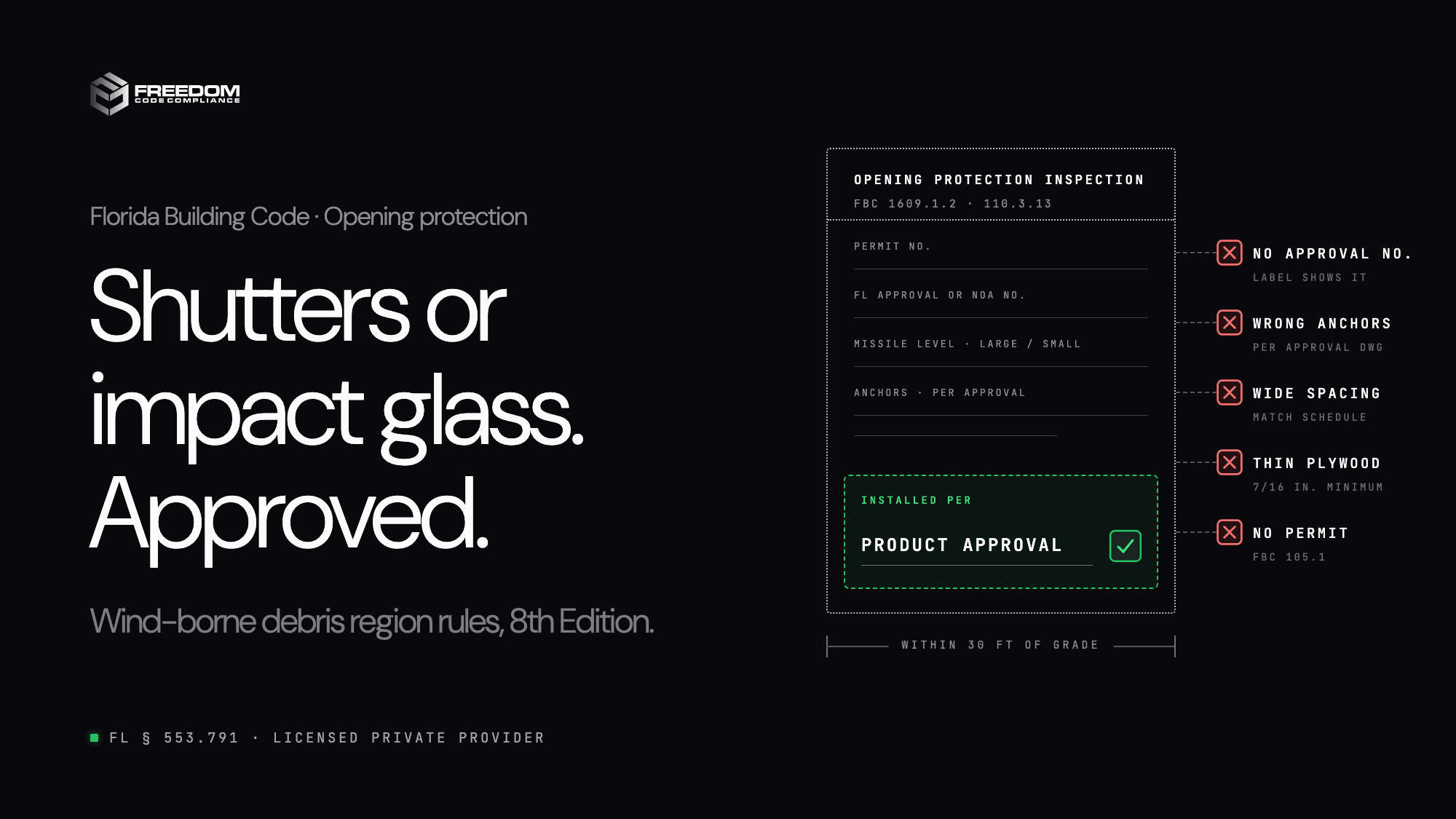
- The label. It shows the approval holder, approval method, test standards, and the Florida approval number or NOA number (Building 1709.9.2). Accordions carry it on the bottom of the locking bar or center mate, roll-downs on the hood or bottom slat, and metal or plastic panels at least every 3 lineal feet (1709.9.3).
- The anchor schedule. The approval's installation drawings give anchor type, edge distance and spacing. Section 1709.9.4 requires installation per those instructions and the approval, with the instructions on the job site.
The Wood Structural Panel Exception
Plywood or OSB is allowed in one narrow case. Building 1609.1.2 permits wood structural panels for Group R-3 or R-4 buildings with a mean roof height of 33 feet or less where Vult is 180 mph or less. Residential R301.2.1.2 has the same exception without the occupancy limit. The requirements:
- At least 7/16 inch thick, with no more than 44 inches between lines of fasteners.
- Precut to extend 2 inches past the fastener lines, predrilled, and attached with corrosion-resistant anchors permanently installed on the building.
- Attachment designed for components and cladding loads, or fasteners at 16 inches on center along the opposing long sides.
- Wood frame: anchors based on 1/4-inch lag screws with 300 pounds ASD withdrawal. Concrete or masonry: 300 pounds withdrawal and 525 pounds shear at a 1.5-inch edge distance.
The HVHZ impact section, Building 1626.1, carries no wood panel exception. In Miami-Dade and Broward, plan on tested protection.
Hurricane Shutters Permit, Plan Review and Inspection
Shutter installation needs a permit. F.S. 553.79(1)(a) makes it unlawful to construct, alter or repair a building without one, and Building 105.1 names the work directly: anyone who intends "to erect, install, enlarge, alter, repair, remove, convert or replace any impact-resistant coverings" must obtain the permit first.
Plan review checks the opening schedule against the approval: opening sizes, design pressures against the rated pressure, the missile level for each opening's height, and the anchor detail for the wall type. A storm shutter inspection checks two things under Building 110.3.13: the system on the plans was installed, and it follows the manufacturer's instructions and the product approval. In practice that is anchors, spacing, edge distance and the label. F.S. 553.791(1)(r) lists door and window replacements as single-trade work a private provider can review and inspect.
Who Installs: Licensed Shutter Installers
Florida has state-certified specialty categories that name this work. Under Rule 61G4-15.100(1)(j), a window and door installation specialty contractor installs exterior windows and doors, "hurricane protection devices, shutters, and hardware" that make no structural changes. Under 61G4-15.100(1)(s), a glass and glazing specialty contractor installs "structurally anchored impact-resistant opening protection." Both rest on the specialty contractor definition in F.S. 489.105(3)(q). F.S. 489.117(4)(a) bars local license requirements only for scopes that match no state category, and shutters match two.
What the Building Department Keeps
The department issues the permit and keeps zoning review, which some apply to permanent shutters on commercial buildings. Plan review and building inspections can go to a private provider under F.S. 553.791, which allows inspections in person or virtually.
How FCC Handles the Plan Review and Inspections
Freedom Code Compliance reviews the shutter or window package against the approval. Single-family plan reviews average 24 hours, and multifamily and commercial reviews average 2 days. You submit the permit application with FCC's stamped plans and private-provider paperwork.
For the final, request a live virtual inspection in the myFCC app. A licensed inspector joins in minutes and checks anchors, spacing, edge distance and labels on video, with the approval drawings on site. You get the result before the call ends. Where an inspection is eligible for offline review, GPS-tagged, timestamped photos and video typically get results in minutes. FCC sends results to the department automatically and files the Certificate of Compliance after its inspections pass. FCC does not pull permits or file the Notice to Building Official.
Related: coastal fasteners under Section 1711 and the December 31 code cutoff. Trades: windows and doors, aluminum, builders. Check the coverage map, then apply for access.
Sources
- Florida Building Code, Building, 8th Edition (2023), Chapter 16 (1609.1.2, 1626)
- Florida Building Code, Building, 8th Edition (2023), Chapter 2 (wind-borne debris region, HVHZ)
- Florida Building Code, Residential, 8th Edition (2023), Chapter 3 (R301.2.1.2)
- Florida Building Code, Building, 8th Edition (2023), Chapter 17 (1709.9)
- Florida Building Code, Building, 8th Edition (2023), Chapter 1 (105.1, 105.15, 110.3.13)
- Florida Statute 553.842, Product evaluation and approval
- Florida Statute 553.8425, Local product approval
- Florida Administrative Code Chapter 61G20-3, Product Approval
- Florida Statute 553.79, Permits
- Florida Statute 489.105, Definitions and 489.117, Registration and specialty contractors
- Florida Administrative Code Rule 61G4-15.100, Certified Specialty Contractors
- Florida Statute 553.791, Alternative plans review and inspection
- Miami-Dade County, Windows, Shutters, Doors and Security Bars
Frequently Asked Questions
Are hurricane shutters required in Florida?
Not as such. The Florida Building Code requires glazed openings in the wind-borne debris region to be impact resistant or protected by an approved impact-resistant covering (Building 1609.1.2, Residential R301.2.1.2). Impact-rated windows and doors meet the rule without shutters, and approved shutters meet it over standard glass.
What does the Florida Building Code say about hurricane shutters?
It treats them as impact-resistant coverings. In the wind-borne debris region they must pass ASTM E1996 and E1886, TAS 201, 202 and 203, or another standard the code lists, be tested at 1.5 times the design pressure, carry a permanent label with the approval number, and be installed per the manufacturer's instructions and product approval (Building 1609.1.2, 1709.9).
How do you get hurricane shutters certified for Miami-Dade?
The manufacturer gets the product approved, not the installer. Miami-Dade's Product Control office issues the Notice of Acceptance, and in the High-Velocity Hurricane Zone the product must pass the TAS 201 and TAS 203 impact tests under Building 1626, with TAS 202 as the pressure test in the same set. Miami-Dade also accepts Florida Building Commission product approvals for shutter permits. The installer follows the approval drawings and keeps them on site.
Do hurricane shutters need a permit in Florida?
Yes. Building 105.1 requires a permit to erect, install, alter, repair, remove or replace any impact-resistant coverings, and F.S. 553.79 makes building work without a permit unlawful. Plan review checks the opening schedule, design pressures and anchor details against the product approval.
What does a storm shutter inspection check?
Two things under Building 110.3.13: that the system on the approved plans was installed, and that it was installed per the manufacturer's instructions and product approval. That means anchor type, spacing and edge distance, plus the permanent label showing the Florida approval or NOA number.
Who can install hurricane shutters in Florida?
Licensed contractors whose scope covers the work. Rule 61G4-15.100 lists shutters and hurricane protection devices in the window and door installation specialty contractor scope, and structurally anchored impact-resistant opening protection in the glass and glazing specialty contractor scope. Both are state-certified specialty categories under F.S. 489.105(3)(q).
Can a private provider inspect hurricane shutter installation?
Yes. F.S. 553.791 lets a private provider handle plan review and inspections, in person or virtually, and lists door and window replacements as single-trade work. Freedom Code Compliance reviews shutter and window packages and inspects anchors and labels by live video in the myFCC app.